chatgpt image apr 18, 2026, 03 22 59 am

Form 141 – Simplifying TDS Compliance | Complete Practical Guide

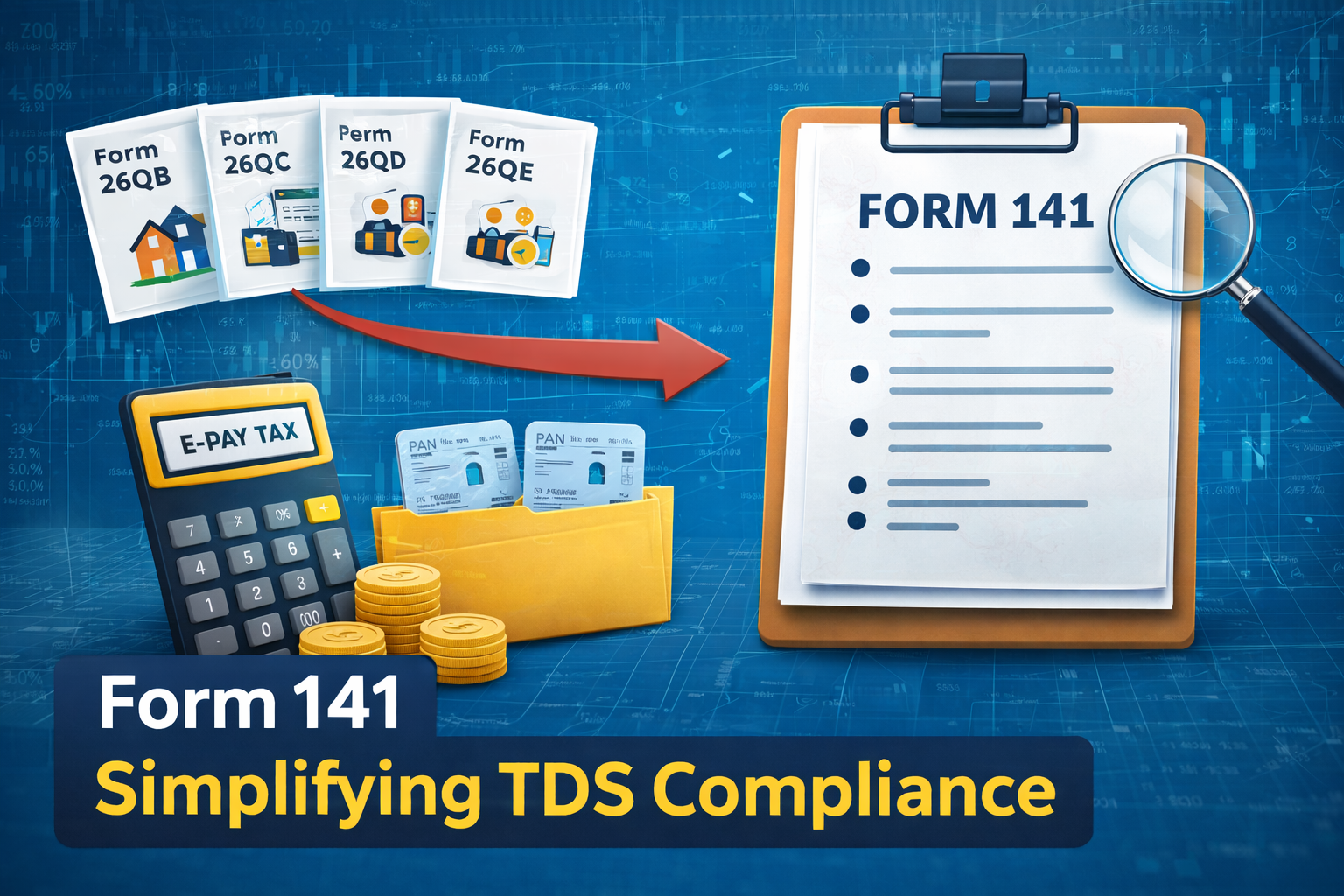
The Income-tax Department has introduced Form 141, a consolidated challan-cum-statement that significantly transforms how TDS is reported for certain transactions.

This change replaces multiple forms with a single unified reporting system, making compliance more streamlined while improving data tracking and transparency.


1. What Has Changed

Earlier System

Taxpayers had to file different forms depending on the type of transaction:

FormPurpose
26QBProperty purchase
26QCRent payments
26QDPayments to professionals/contractors
26QEVirtual digital assets

Now – One Form (Form 141)

All the above are merged into Form 141, with different schedules:

ScheduleCovers
Schedule ARent
Schedule BProperty purchase
Schedule CProfessional/contract payments
Schedule DVirtual digital assets

2. Who Needs to File Form 141

Primarily applicable to:

  • Individuals
  • HUFs
  • Not subject to tax audit

Transactions Covered

(A) Rent

  • Monthly rent exceeding ₹50,000
  • TDS to be deducted and reported

(B) Property Purchase

  • Property value ₹50 lakh or more
  • TDS applicable on higher of:
    • Agreement value
    • Stamp duty value

(C) Professional / Contract Payments

  • Total payments exceeding ₹50 lakh in a financial year

(D) Virtual Digital Assets

  • Transfer of crypto/NFT (subject to limits)

3. Major Practical Change – Filing Logic

Earlier

  • Separate form for every buyer–seller combination

Now

  • One form per buyer
  • Multiple sellers can be included in a single form

Example

ScenarioEarlierNow
2 buyers, 3 sellers6 forms2 forms

Impact

  • Reduced compliance burden
  • Less repetitive data entry
  • Better alignment with responsibility of the buyer

4. Instalment Payments – Better Tracking

For transactions like property where payments are made in parts:

  • Each instalment must be reported
  • Categorised as:
    • First instalment
    • Subsequent instalment
    • Final instalment
  • System links all instalments for the same transaction

Practical Benefit

  • Clear transaction trail
  • Reduced mismatch issues

5. Removal of Common Filing Issues

Earlier challenge:

  • TDS liability arises when payment is made
  • But registration details may not yet be available

Now Improved

  • Form allows reporting details “if available”

Benefit

  • Avoids delays
  • Reduces incorrect filing
  • Matches real-world transaction timelines

6. Details Required for Filing

Basic Information

  • PAN of both parties
  • Address, mobile number, email

Transaction Details

ScheduleRequired Details
ARent amount, period
BProperty value, date
CNature of service, amount
DType of asset, transfer value

7. Step-by-Step Filing Process

  1. Login to Income-tax portal
  2. Go to e-Pay Tax
  3. Select Form 141
  4. Choose applicable schedule
  5. Enter:
    • Party details
    • Transaction details
    • TDS amount
  6. Make payment
  7. Submit form
  8. Download challan

8. Time Limit & Compliance

  • File within 30 days from the end of the month in which TDS is deducted

If Delayed

  • Interest applies
  • Late fee of ₹200 per day
  • Additional penalties may be levied

9. Common Mistakes to Avoid

  • Deducting TDS only on agreement value (ignoring stamp value)
  • Entering incorrect PAN
  • Selecting wrong schedule
  • Not reporting instalments correctly
  • Late filing

10. Practical Example

Property Purchase Case

  • Agreement value: ₹80 lakh
  • Stamp duty value: ₹90 lakh

TDS Calculation

  • Applicable value = ₹90 lakh
  • TDS = ₹90,000

Common Error

Many taxpayers deduct ₹80,000 instead of ₹90,000 → leads to short deduction and penalties


11. Practical Impact for Professionals

  • Fewer forms → easier compliance
  • More structured reporting
  • Better tracking by department
  • Higher importance of accurate data

12. Conclusion

Form 141 is a major step toward simplifying compliance, but it also increases the importance of:

  • Accurate reporting
  • Proper classification
  • Timely filing

Professionals should proactively guide clients to avoid errors and ensure smooth compliance.

Follow for Practical Tax Knowledge
🔹 Instagram: https://www.instagram.com/yourfintaxbuddy/

🔹 Facebook: https://www.facebook.com/yourfintaxbuddy
🔹 YouTube: www.youtube.com/@YourFinTaxBudd

📩 For queries & professional consultation:
Email: info@yourfintaxbuddy

👉 Follow for real-world tax, GST & compliance insights.
chatgpt image apr 15, 2026, 06 54 12 pm

Surcharge and Cess under Income Tax

When computing income tax liability, many taxpayers stop at slab-wise tax. However, the actual tax payable is materially impacted by two additional levies:

  • Surcharge (based on income thresholds)
  • Health & Education Cess (H&EC) (fixed percentage)

This article provides a comprehensive, technical, and practical analysis relevant for professional application.


1. Statutory Framework

(A) Surcharge

  • Governed by Finance Act of the relevant year (for AY 2026–27 → Finance Act, 2025)
  • It is not a separate tax, but an incremental charge on income tax

(B) Health & Education Cess

  • Introduced via Finance Act, 2018
  • Applicable @ 4% on: Income Tax + Surcharge

2. Surcharge Rates for Individuals (AY 2026–27)

(A) Normal Provisions (excluding special income adjustments)

Total IncomeSurcharge Rate
Up to ₹50 lakhNil
₹50 lakh – ₹1 crore10%
₹1 crore – ₹2 crore15%
₹2 crore – ₹5 crore25%
Above ₹5 crore37%

(B) Special Provisions / Restrictions

1. Section 115BAC (New Tax Regime)

  • Maximum surcharge capped at 25%
  • Effective from AY 2024–25 onwards

2. Special Rate Incomes

As per provisos to surcharge provisions:

Nature of IncomeMaximum Surcharge
Dividend income15%
Capital gains u/s 111A, 112, 112A15%

👉 Even if total income exceeds ₹2 crore / ₹5 crore, surcharge on such income cannot exceed 15%


3. Concept of Marginal Relief

Legal Intent

To ensure that:

Additional tax payable due to surcharge does not exceed the income exceeding the threshold.

Applicability Thresholds

  • ₹50 lakh
  • ₹1 crore
  • ₹2 crore
  • ₹5 crore

Illustration – Marginal Relief

Case:

  • Total Income = ₹51,00,000

Step 1: Tax without surcharge (₹50 lakh)
Assume tax = ₹13,12,500

Step 2: Tax on ₹51 lakh with surcharge

  • Tax ≈ ₹13,42,500
  • Surcharge @10% ≈ ₹1,34,250

Total = ₹14,76,750

Excess tax due to surcharge = ₹1,64,250
But income increased only by ₹1,00,000

👉 Marginal relief applies → excess tax is restricted to ₹1,00,000


4. Step-by-Step Tax Computation (Practical Illustration)

Case Study

  • Assessee: Individual
  • Total Income: ₹60,00,000
  • Regime: Old Tax Regime

Step 1: Slab-wise Tax Calculation under old tax regime

Income SlabRateTax
Up to ₹2,50,000Nil0
₹2,50,001 – ₹5,00,0005%₹12,500
₹5,00,001 – ₹10,00,00020%₹1,00,000
₹10,00,001 – ₹60,00,000 (₹50L)30%₹15,00,000

👉 Total Tax = ₹16,12,500


Step 2: Add Surcharge

  • Income > ₹50L → 10% surcharge

👉 ₹16,12,500 × 10% = ₹1,61,250


Step 3: Add Health & Education Cess

👉 (₹16,12,500 + ₹1,61,250) × 4%
= ₹17,73,750 × 4%
= ₹70,950


Step 4: Total Tax Liability

👉 ₹16,12,500

  • ₹1,61,250
  • ₹70,950
    = ₹18,44,700

Effective Tax Rate

👉 ₹18,44,700 ÷ ₹60,00,000 ≈ 30.75%


5. Key Practical Insights for Professionals

(A) Planning Around ₹50L / ₹1Cr Thresholds

  • Even small increments in income can trigger disproportionate tax liability
  • Evaluate:
    • Timing of income recognition
    • Capital gain realization
    • Bonus structuring

(B) Capital Gains Strategy

  • Prefer capital gains where possible:
    • Surcharge capped at 15%
  • Useful in:
    • Portfolio restructuring
    • ESOP planning

(C) Regime Selection (Old vs New – Section 115BAC)

  • For high-income individuals:
    • New regime may be beneficial due to 25% surcharge cap vs 37%

(D) Advance Tax Implications

  • Incorrect surcharge estimation leads to:
    • Interest u/s 234B & 234C
  • Always consider surcharge while computing installments

6. Common Errors and Compliance Risks

IssueRisk
Ignoring surcharge thresholdsUnderpayment of tax
Not applying marginal reliefExcess tax payment
Incorrect treatment of capital gains surchargeLitigation exposure
Ignoring surcharge cap under 115BACWrong regime selection
Advance tax miscalculationInterest liability

7. Important Legal References

  • Finance Act, 2025 – Surcharge rates
  • Finance Act, 2018 – Health & Education Cess @ 4%
  • Section 115BAC – New tax regime provisions
  • Sections 111A, 112, 112A – Special rate incomes
  • CBDT Circulars on marginal relief (various years)

8. Conclusion

Surcharge and cess are not merely add-ons—they are critical components of total tax liability, especially for high-income individuals.

From a professional standpoint:

  • Always compute effective tax rate, not just slab rate
  • Factor in marginal relief at threshold levels
  • Evaluate regime selection strategically
  • Incorporate surcharge in advance tax planning

A precise computation can optimize tax outflow and prevent compliance risks.

You can also read about ITR forms.

Please follow us on Social Media Platforms

https://www.youtube.com/@YourFinTaxBudd

https://www.instagram.com/yourfintaxbuddy

https://www.facebook.com/yourfintaxbuddy

chatgpt image apr 12, 2026, 01 49 18 pm

ITR-4 (Sugam) – AY 2026-27

Complete Practical Guide with Amendments, Eligibility & Filing Process


1. Overview of ITR-4 (Sugam)

ITR-4 (Sugam) is a simplified return form prescribed under Rule 12 of the Income-tax Rules, 1962 for small taxpayers opting for presumptive taxation schemes.

It is applicable to:

  • Individuals
  • HUFs
  • Partnership Firms (other than LLP)

Relevant Sections Covered:

  • Section 44AD – Presumptive taxation for business
  • Section 44ADA – Presumptive taxation for professionals
  • Section 44AE – Presumptive taxation for transporters

Income Threshold:

  • Total income ≤ ₹50 Lakhs

2. Key Changes in ITR-4 for AY 2026-27 (FY 2025-26)

Recent updates reflect increased reporting requirements and alignment with compliance monitoring systems:

(1) Reporting of Two House Properties

  • Earlier restriction: 1 house property
  • Now allowed: Up to 2 house properties

Practical Impact:

  • Small taxpayers owning multiple houses can now continue using ITR-4 without shifting to ITR-3.

(2) Removal of Foreign Retirement Benefit Reporting

  • Disclosure under Section 89A removed

Impact:

  • Simplifies return for taxpayers with foreign retirement accounts.

(3) Mandatory Bank Balance Disclosure

  • Taxpayer must disclose:
    • Bank account details
    • Balance as on year-end

Compliance Risk:

  • Mismatch with AIS/TIS may trigger scrutiny under risk management system.

(4) Reporting LTCG u/s 112A up to ₹1.25 Lakhs

  • Now allowed to report limited capital gains under:
    • Section 112A

Conditions:

  • Only LTCG on equity shares / equity mutual funds
  • No brought forward losses
  • No carry forward losses

3. Eligibility Criteria – Who Can File ITR-4

A taxpayer can file ITR-4 if ALL the following conditions are satisfied:

Residential Status

  • Must be Resident (ROR)

Income Sources Allowed

Income HeadConditions
Business Incomeu/s 44AD or 44AE
Professional Incomeu/s 44ADA
Salary/PensionAllowed
House PropertyMaximum 2
Other SourcesInterest, etc.
Capital GainsOnly LTCG u/s 112A (≤ ₹1.25 lakh)

Example – Practical Case

Mr. A (Resident Individual):

  • Business income (44AD): ₹30 lakhs turnover
  • Declared profit: ₹3 lakhs
  • Salary income: ₹5 lakhs
  • Interest income: ₹50,000
  • LTCG (equity): ₹1 lakh

✅ Eligible for ITR-4


4. Who Cannot File ITR-4 (Critical Restrictions)

The following taxpayers must NOT use ITR-4:

(A) Income/Threshold Based Restrictions

  • Total income > ₹50 lakhs
  • Agricultural income > ₹5,000

(B) Nature of Income Restrictions

  • Income from:
    • Lottery / betting / racehorses
  • Any capital gains (except limited 112A case)
  • Income from crypto (VDA) – taxable u/s Section 115BBH

(C) Compliance-Based Restrictions

  • Required to maintain books u/s:
    • Section 44AA
  • Tax audit applicable u/s:
    • Section 44AB

(D) Specific Disqualifications

  • Director in a company
  • Investment in unlisted shares
  • RNOR / Non-resident
  • Foreign assets or signing authority
  • Claiming relief u/s:
    • Section 90
    • Section 90A
    • Section 91

(E) Other Important Cases

  • TDS deducted u/s Section 194N

5. Due Dates – AY 2026-27

CategoryDue Date
Non-Audit Cases31st August 2026
Audit Cases31st October 2026

Amendment Note:

  • Extended timeline introduced via Budget 2026 for non-audit cases.

6. Structure of ITR-4 – Detailed Breakdown

PART A – General Information

  • PAN, Aadhaar, business nature, filing status

PART B – Gross Total Income

  • Income from all heads consolidated

PART C – Deductions

  • Chapter VI-A deductions (80C, 80D, etc.)

PART D – Tax Computation

  • Tax liability, rebate u/s 87A, interest, late fee

Key Schedules

SchedulePurpose
Schedule BPPresumptive income computation
GST DetailsTurnover reconciliation
Financial ParticularsAssets & liabilities
Schedule TDS/TCSTax credits
Schedule ITAdvance tax & self-assessment

7. Step-by-Step Filing Process (Practical Workflow)

Step 1: Data Collection

  • PAN, Aadhaar
  • Bank statements
  • GST turnover (if applicable)
  • AIS/TIS reconciliation

Step 2: Choose Presumptive Scheme

SectionRate
44AD8% (6% digital)
44ADA50%
44AEFixed per vehicle

Step 3: Compute Income

Example (44AD):

  • Turnover: ₹40 lakhs
  • Digital receipts: ₹20 lakhs

Income:

  • 6% of 20L = ₹1.2L
  • 8% of 20L = ₹1.6L
  • Total = ₹2.8L

Step 4: Claim Deductions

  • Chapter VI-A deductions

Step 5: Tax Calculation

  • Include:
    • Interest u/s 234A/B/C
    • Late fee u/s Section 234F

Step 6: File Return

  • Through income tax portal
  • Validate using:
    • Aadhaar OTP
    • DSC
    • Net banking

8. Compliance Risks & Common Mistakes

High-Risk Areas

  • ❌ Turnover mismatch with GST returns
  • ❌ Under-reporting digital receipts
  • ❌ Incorrect presumptive percentage
  • ❌ Ignoring AIS/TIS data
  • ❌ Claiming ineligible deductions

Practical Red Flags

  • Cash deposits inconsistent with turnover
  • High expenses despite presumptive scheme
  • Bank balance mismatch

9. Best Practices (Professional Approach)

  • Reconcile:
    • Books vs GST vs AIS
  • Maintain working papers (even if presumptive)
  • Ensure correct classification of income
  • Avoid aggressive tax positions

10. Strategic Advisory (CA Perspective)

  • Use ITR-4 only when strictly eligible
  • If:
    • Turnover high
    • Margins low
      → Consider opting out and filing ITR-3
  • Evaluate:
    • 5-year lock-in under 44AD (Section 44AD(4))

Conclusion

ITR-4 is a highly efficient compliance tool for small taxpayers under presumptive taxation. However, with increasing data integration (AIS, GST, banking), accuracy and reconciliation have become critical.

A conservative and well-documented approach is essential to avoid notices and ensure smooth assessments.

Read about ITR Form 3

Read about ITR Form 2

Read about ITR Form 1

chatgpt image apr 11, 2026, 11 27 16 am

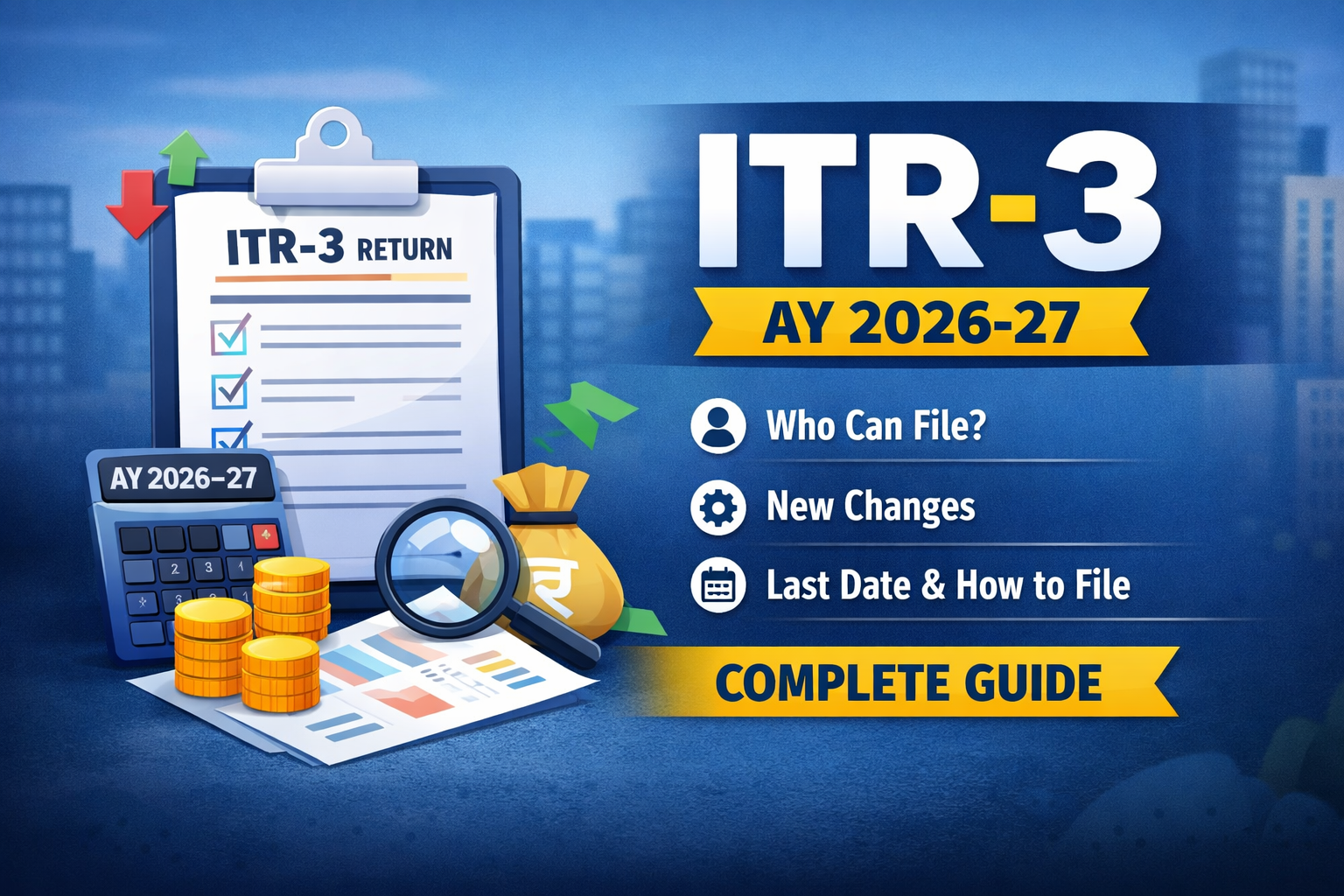
ITR-3 (AY 2026–27)

1. Applicability of ITR-3

As per Rule 12 of the Income-tax Rules, 1962:

ITR-3 is applicable to:

  • Individuals & HUFs having:
    • Income from business or profession
    • Income from:
      • Proprietorship
      • Freelancing/consultancy
      • F&O / intraday trading
      • Presumptive business (if not opting ITR-4)
  • Also includes:
    • Salary / Pension
    • House Property
    • Capital Gains
    • Other Sources
    • Partner’s remuneration (except LLP nuance)

📌 Practical interpretation:

  • If books of accounts are maintained → ITR-3
  • If audit applicable u/s 44AB → Mandatory ITR-3

2. Key Changes in AY 2026–27

(A) Capital Gains Reporting Simplified

  • Earlier requirement:
    • Split CG into before & after 23rd July 2024
  • Now removed

📌 Practical impact:

  • Reduces reporting complexity
  • Lower reconciliation issues with AIS/TIS

(B) New Disclosure – F&O Income

  • Specific field added for:
    • Turnover
    • Profit/Loss from F&O

📌 Risk area:

  • ICAI Guidance Note on Turnover must be strictly followed:
    • Absolute profit method
    • Premium inclusion

(C) Additional Deduction Disclosures

Enhanced reporting required for:

  • Section 80G (Donations)
  • Section 80GGC (Political contributions)
  • Section 80DD / 80U (Disability)

📌 Compliance risk:

  • PAN/Aadhaar of donee entity mismatch → deduction disallowance

(D) Section 44BBD (New Audit Reporting Field)

  • Additional disclosure introduced

📌 Conservative approach:

  • Carefully cross-check applicability (sector-specific provision)
  • Avoid incorrect reporting unless clearly applicable

3. Due Dates (AY 2026–27)

CaseDue Date
Non-audit31 August 2026
Audit cases (44AB)31 October 2026

📌 Note:

  • This differs from ITR-1/2 (31 July)
  • Many taxpayers mistakenly assume same due date

4. Structure of ITR-3 (Highly Technical)

🔹 Part A (Financial Statements)

  • Part A-GEN → General info
  • Part A-BS → Balance Sheet
  • Part A-P&L → Profit & Loss
  • Manufacturing / Trading Accounts
  • Part A-OI → Other info (audit related)
  • Part A-QD → Quantitative details

📌 Practical note:

  • Mandatory for non-presumptive cases
  • Optional fields become critical in scrutiny cases

🔹 Key Schedules (Core Computation)

Income Heads:

  • Schedule S → Salary
  • Schedule HP → House Property
  • Schedule BP → Business/Profession
  • Schedule CG → Capital Gains
  • Schedule OS → Other Sources

Depreciation & Assets:

  • DPM / DOA / DEP → Depreciation
  • DCG → Deemed capital gains

Loss Set-off:

  • CYLA / BFLA / CFL → Loss adjustments

Special Schedules:

  • Schedule AMT (Sec 115JC)
  • Schedule SI (Special rates)
  • Schedule GST → Turnover reconciliation

High-Risk Compliance Schedules:

  • Schedule AL → Mandatory if income > ₹50 lakh
  • Schedule FA → Foreign assets
  • Schedule FSI/TR → Foreign income relief

5. Who Cannot File ITR-3

  • Persons eligible for:
    • ITR-1
    • ITR-2
    • ITR-4

📌 Practical filter:

  • No business income → NOT ITR-3

6. Practical Case Scenarios

Case 1: Freelancer

  • Income: ₹18 lakh (consulting)
  • Expenses claimed
    ✔ File: ITR-3

Case 2: Trader (F&O Loss)

  • Turnover: ₹1.2 Cr (as per ICAI method)
  • Loss: ₹8 lakh
    ✔ ITR-3 + possible audit u/s 44AB

Case 3: Small Business (Presumptive)

  • Turnover: ₹60 lakh
  • Opting 44AD
    ✔ ITR-4 (not ITR-3)

7. Common Mistakes (Critical for Practice)

❌ Not reconciling:

  • Schedule BP vs GST turnover
  • P&L vs AIS/TIS

❌ Incorrect F&O turnover calculation

❌ Missing Schedule AL (> ₹50 lakh income)

❌ Claiming deductions without proper details (80G, etc.)

❌ Ignoring ICDS adjustments (Schedule ICDS)


8. Compliance Risk Areas

  • Section 44AB Audit Trigger
    • Miscalculation → penalty u/s 271B
  • Mismatch with AIS/TIS
    • Leads to automated notices
  • Capital Gains reporting errors
    • Especially 112A schedule
  • GST vs Income mismatch
    • Now increasingly scrutinized

9. Best Practices (CA-Level Advisory)

✔ Always reconcile:

  • Books vs GST vs AIS

✔ Maintain:

  • Proper working papers for:
    • Turnover
    • Expenses
    • Depreciation

✔ Use:

  • Trial balance mapping → avoid errors in schedules

✔ Document:

  • Deduction proofs (especially 80G)

✔ Review:

  • Schedule SI for special rate income

10. Strategic Insight for Your Practice

Given your target of scaling return filings:

  • Segment clients:
    • ITR-1 → Volume
    • ITR-3 → High-value advisory
  • Focus on:
    • Traders
    • Freelancers
    • Professionals

These categories require interpretation + judgment, not just filing.

 Read our detailed guide on ITR-2

chatgpt image apr 9, 2026, 10 32 40 pm

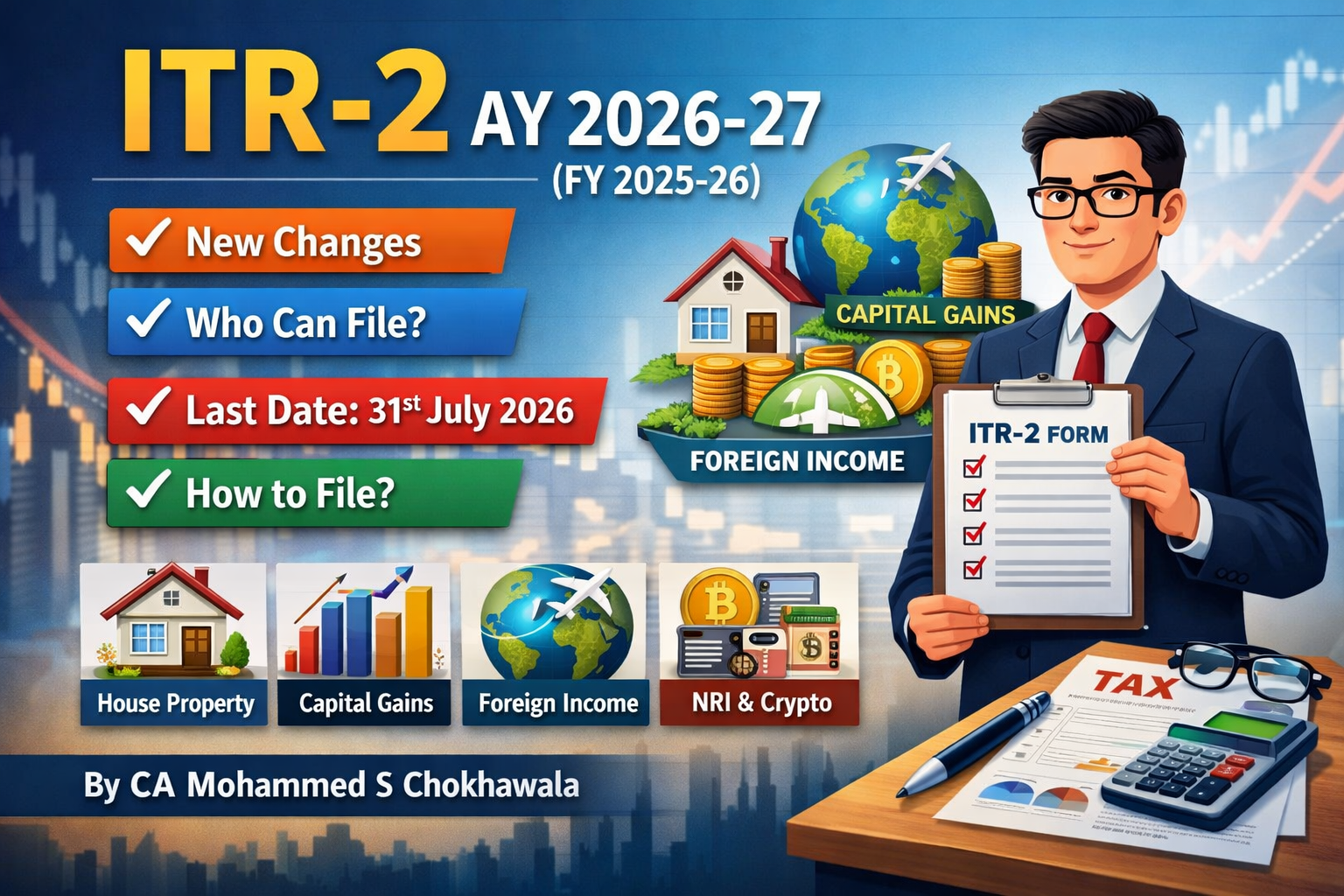
ITR-2 for AY 2026–27 (FY 2025–26)

By CA Ayush Rathor | Updated as per latest available changes (April 2026)


1. Overview – Where ITR-2 Fits Practically

ITR-2 is the default return form for individuals/HUFs who:

  • Do NOT have business/professional income (i.e., no income under Profits & Gains of Business or Profession)
  • But have complex income structures, such as:
    • Capital gains
    • Multiple house properties
    • Foreign assets/income
    • High-income cases (> ₹50 lakh)

👉 Professional View:
Whenever a case moves beyond the simplicity of ITR-1 (Sahaj), the migration typically happens to ITR-2 unless business income triggers ITR-3.


2. Key Changes in ITR-2 for AY 2026–27

(A) Rationalisation of Capital Gains Reporting

  • Earlier bifurcation:
    • Before 23 July 2024
    • After 23 July 2024

✅ Now removed

Practical Impact:

  • Simplifies reporting in Schedule CG
  • Reduces reconciliation complexity for:
    • Equity transactions
    • Real estate transactions

👉 CA Insight:
Earlier, this split created unnecessary compliance friction during audit trail verification and AIS reconciliation. Removal improves usability.


(B) Enhanced Disclosure for Donations (Section 80G)

  • Mandatory to report:
    • Transaction/Receipt Number
    • Donation reference details

📌 Legal Reference: Section 80G read with Rule 11AA

Practical Implication:

  • No more blanket deduction claims
  • Cross-verification with NGO filings (Form 10BD)

⚠️ Compliance Risk:

  • Mismatch between:
    • Donor claim (ITR)
    • Donee reporting (Form 10BD)
      → May lead to disallowance notices u/s 143(1)

(C) Removal of Rate-Specific Columns (CG Schedules)

  • Earlier explicit categories:
    • STCG @15% (Section 111A)
    • LTCG @10% (Section 112A)
    • LTCG @20% (Section 112)

✅ Now streamlined

Interpretation:

  • Backend computation logic retained
  • Front-end reporting simplified

👉 Conservative View for Practice:
Continue maintaining working papers classification-wise:

  • Section 111A
  • Section 112A
  • Section 112

3. Eligibility – Who Should File ITR-2

Covered Assessees:

Nature of IncomeRelevant Section
Salary/PensionSec 15–17
Multiple House PropertiesSec 22–27
Capital GainsSec 45
Other Sources (Lottery, etc.)Sec 56
Agricultural Income > ₹5,000Sec 10(1) (reporting requirement)
Foreign Income/AssetsFEMA + Income Tax
RNOR / Non-ResidentsSec 6

Special Mandatory Cases:

You must file ITR-2 if:

  • Director in a company
  • Investment in unlisted equity shares

👉 Even if income is otherwise simple.


Practical Illustration

Case 1:

  • Salary ₹18 lakh
  • LTCG ₹2 lakh (equity)

➡ Cannot use ITR-1 → ITR-2 mandatory


4. Who Cannot File ITR-2

❌ If income includes:

  • Business income (Sec 28)
  • Professional income

➡ Must shift to ITR-3


5. Due Date for AY 2026–27

  • Non-audit cases: 31st July 2026

📌 Legal Reference: Section 139(1)


Consequences of Delay

SectionImpact
Sec 234FLate fee up to ₹5,000
Sec 234AInterest on tax payable
Sec 139(4)Belated return restrictions

Practical Risk:

  • Loss carry forward disallowed (if filed late)
    👉 Especially relevant for:
  • Capital losses
  • House property losses

6. Structure of ITR-2 – Technical Breakdown

Part A – General Information

  • PAN, Aadhaar, residential status
  • Filing status (Original/Revised)

Core Income Schedules

SchedulePurpose
Schedule SSalary
Schedule HPHouse Property
Schedule CGCapital Gains
Schedule OSOther Sources

Capital Gains Special Schedules

  • Schedule 112A → Listed equity
  • Schedule 115AD (for NRIs)

Loss Adjustment Mechanism

ScheduleFunction
CYLACurrent year set-off
BFLABrought forward set-off
CFLCarry forward losses

Deductions

ScheduleSection
VIAChapter VI-A
80GDonations
80GGAScientific/Rural
80GGCPolitical contributions

Foreign & International Taxation

SchedulePurpose
FSIForeign income
TRForeign tax credit (Rule 128)
FAForeign assets disclosure

⚠️ High Risk Area:
Non-disclosure → scrutiny + penalty


High Net Worth Individuals

  • Schedule AL (Assets & Liabilities)

📌 Trigger: Income > ₹50 lakh


Special Computation Schedules

ScheduleSection
AMTSec 115JC
AMTCSec 115JD

Other Critical Schedules

  • Schedule SI → Special rate incomes
  • Schedule EI → Exempt income
  • Schedule VDA → Crypto taxation (Sec 115BBH)

7. Step-by-Step Filing Process (Practical Workflow)

Step 1: Data Collection

  • Form 16
  • AIS/TIS reconciliation
  • Capital gain statements (broker)
  • Interest certificates
  • Foreign asset details

Step 2: Reconciliation

  • Match:
    • AIS vs books
    • 26AS vs TDS claimed

Step 3: Capital Gains Working

  • Segregate:
    • STCG vs LTCG
    • Section-wise classification

Step 4: Deduction Validation

  • Ensure:
    • Proper documentation
    • Donation receipts with ARN

Step 5: Tax Computation

  • Normal vs special rate income
  • Apply:
    • Sec 112A
    • Sec 115BBH (crypto)

Step 6: Filing & Verification

  • File on income tax portal
  • Verify via:
    • Aadhaar OTP / EVC / DSC

8. Common Errors Observed in Practice

❌ Wrong ITR selection (ITR-1 instead of ITR-2)
❌ Ignoring AIS mismatches
❌ Incorrect capital gains classification
❌ Claiming 80G without valid receipt
❌ Non-disclosure of foreign assets


9. Best Practices (CA Advisory)

✔ Always prepare working papers before filing
✔ Maintain capital gain computation sheets
✔ Cross-check AIS, 26AS, broker statements
✔ Avoid aggressive deduction claims without documentation
✔ Use ITR-2 even voluntarily if complexity exists (risk mitigation)


10. Strategic Insight

ITR-2 is no longer just a compliance form—it is now a data-matching document:

  • AIS integration
  • NGO reporting (Form 10BD)
  • Foreign asset disclosures
  • Crypto tracking

👉 Conclusion (Professional View):
Accuracy, reconciliation, and documentation are now more critical than computation itself.

👉 Read our detailed guide on ITR-1 (Sahaj)

chatgpt image apr 8, 2026, 10 00 51 pm

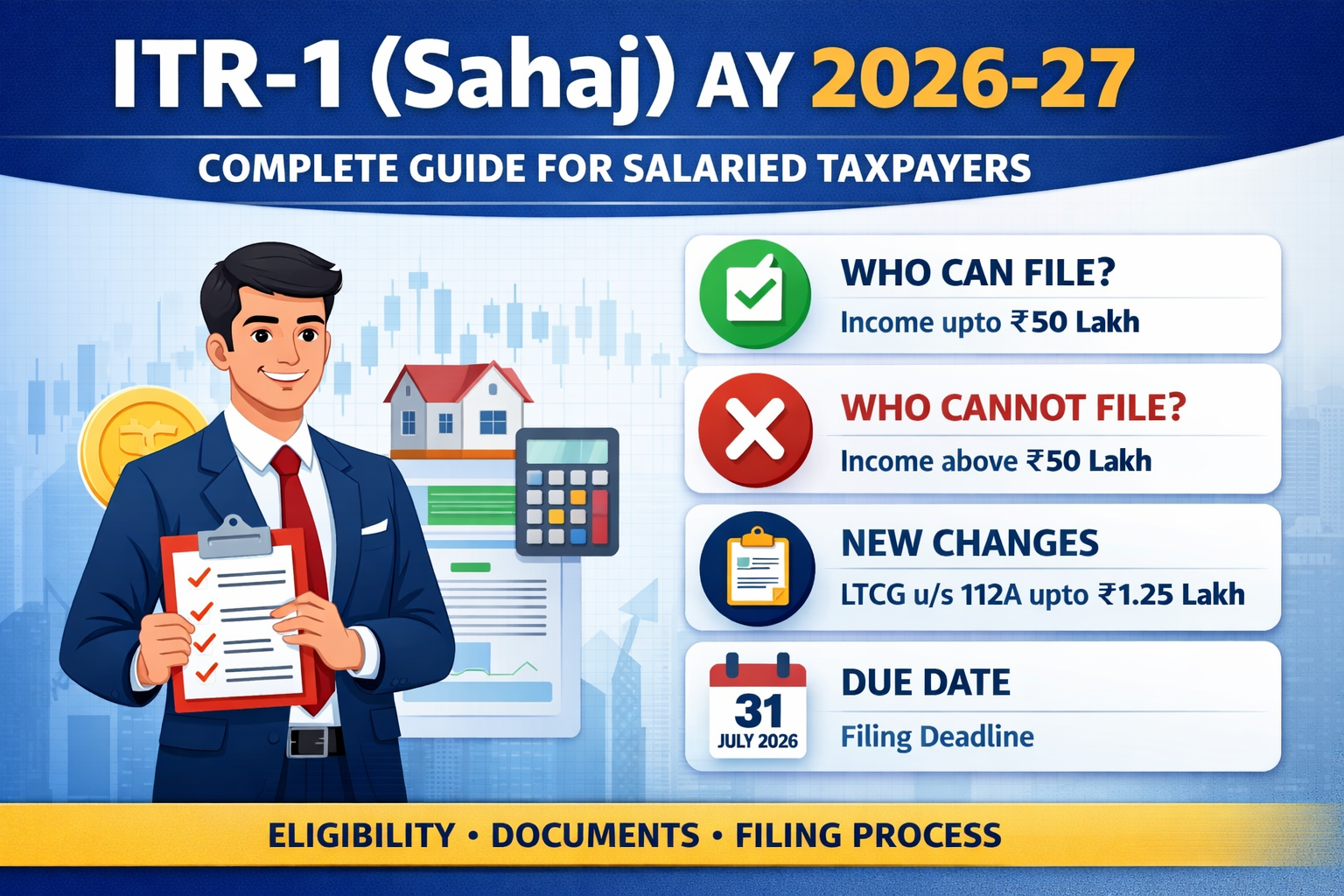
ITR-1 (Sahaj) AY 2026-27: Complete Practical Guide for Salaried Taxpayers

Eligibility | Latest Changes | Due Dates | Filing Strategy

By CA Ayush Rathor


📌 Overview

For most salaried individuals in India, ITR-1 (Sahaj) remains the primary return form. However, despite its simplicity, incorrect selection or incomplete reporting can result in defective returns under Section 139(9) and unnecessary compliance exposure.

For FY 2025-26 (AY 2026-27), certain key modifications have expanded the scope of ITR-1, making it essential to reassess eligibility before filing.


🔍 What is ITR-1 (Sahaj)?

ITR-1 is prescribed for resident individuals having total income up to ₹50 lakh with limited and straightforward sources of income.

Permissible Income Heads:

  • Income from Salary or Pension
  • Income from House Property (up to 2 houses)
  • Income from Other Sources (interest, family pension, etc.)
  • Agricultural income up to ₹5,000
  • Long-Term Capital Gains under Section 112A up to ₹1.25 lakh (without carry forward/set-off of loss)

👉 Practically, ITR-1 should be used only where income structure is clean, linear, and non-litigious.


🚨 Key Changes in AY 2026-27

The following updates are significant from a compliance standpoint:

1. Inclusion of LTCG u/s 112A (Up to ₹1.25 lakh)

  • Earlier restriction has been relaxed
  • Now small equity investors can continue using ITR-1
  • Condition: No brought forward or current year capital loss

2. Reporting of Two House Properties

  • Earlier practical limitation removed
  • Both self-occupied or let-out properties can now be reported

3. Removal of Foreign Retirement Income Reporting

  • Simplifies compliance for salaried individuals with overseas retirement components

4. Alignment with Revised Capital Gains Framework

  • Updated as per latest taxation rules applicable to listed securities

✅ Eligibility Criteria (Practical View)

You should opt for ITR-1 if ALL the following conditions are satisfied:

ParticularsCondition
Residential StatusResident Individual
Total Income≤ ₹50 lakh
House PropertyMax. 2
Capital GainsOnly LTCG u/s 112A up to ₹1.25 lakh
Agricultural Income≤ ₹5,000
Other IncomeInterest / family pension

💡 Professional Insight:
Even if technically eligible, avoid ITR-1 where:

  • Multiple adjustments are required
  • AIS/TIS shows complex transactions
  • There is any interpretational ambiguity

❌ Non-Eligibility (Critical Triggers)

ITR-1 must NOT be used in the following cases:

  • Income exceeding ₹50 lakh
  • Any business or professional income
  • Director in a company (mandatory disclosure requirement)
  • Holding unlisted equity shares
  • Foreign assets / foreign income (Schedule FA applicability)
  • Capital gains other than permitted LTCG
  • Income from Virtual Digital Assets (Section 115BBH)
  • Claim of relief under Sections 90 / 90A / 91
  • Agricultural income exceeding ₹5,000

⚠️ Compliance Risk:
Wrong selection of ITR form may result in:

  • Defective return notice u/s 139(9)
  • Delay in refund
  • Increased scrutiny risk

📅 Due Dates – AY 2026-27

ParticularsDue Date
Original Return (Non-audit)31 July 2026
Belated Return31 December 2026

Late Filing Consequences:

  • Late fee u/s 234F: Up to ₹5,000
  • Interest u/s 234A/B/C on tax liability

📂 Documentation Checklist

Ensure the following before initiating filing:

  • Form 16 (Salary details)
  • Form 26AS (TDS reconciliation)
  • AIS & TIS (transaction-level verification)
  • PAN & Aadhaar
  • Bank account details (pre-validated)
  • Deduction proofs:
    • Section 80C (PF, LIC, ELSS, etc.)
    • Section 80D (Mediclaim)
    • HRA computation
    • Housing loan interest certificate

⚙️ Filing Process (Condensed Workflow)

  1. Login to Income Tax Portal
  2. Select AY 2026-27 → File Return
  3. Choose ITR-1 (Sahaj)
  4. Auto-import data (Form 16, AIS)
  5. Validate income & deductions
  6. Compute tax liability
  7. Submit return
  8. Complete e-verification (mandatory)

📊 Practical Illustration

Case:

  • Salary Income: ₹12,00,000
  • Interest Income: ₹80,000
  • LTCG u/s 112A: ₹1,10,000
  • One self-occupied + one let-out property

👉 Eligible for ITR-1 since:

  • Total income < ₹50 lakh
  • LTCG within ₹1.25 lakh
  • Only 2 house properties
  • No losses

⚠️ Common Errors to Avoid

  • Not reporting savings bank interest
  • Ignoring AIS/TIS discrepancies
  • Claiming deductions without documentation
  • Using ITR-1 despite capital losses
  • Incorrect house property reporting

💡 Professional Conclusion

ITR-1 is a convenience-based form, not a default choice.
Selection must be based on eligibility, accuracy, and risk assessment.

✔️ Validate data with AIS/TIS
✔️ Ensure correct head-wise reporting
✔️ Avoid aggressive or unsupported claims


📣 Advisory

Where income structure involves even moderate complexity, it is advisable to shift to ITR-2 instead of forcing ITR-1 eligibility.

👉 “Before filing your ITR-1, it is essential to understand how your salary tax is calculated. Read our detailed guide on TDS on Salary under Section 192 to ensure accurate reporting and avoid mismatches.”

chatgpt image mar 24, 2026, 11 17 46 am

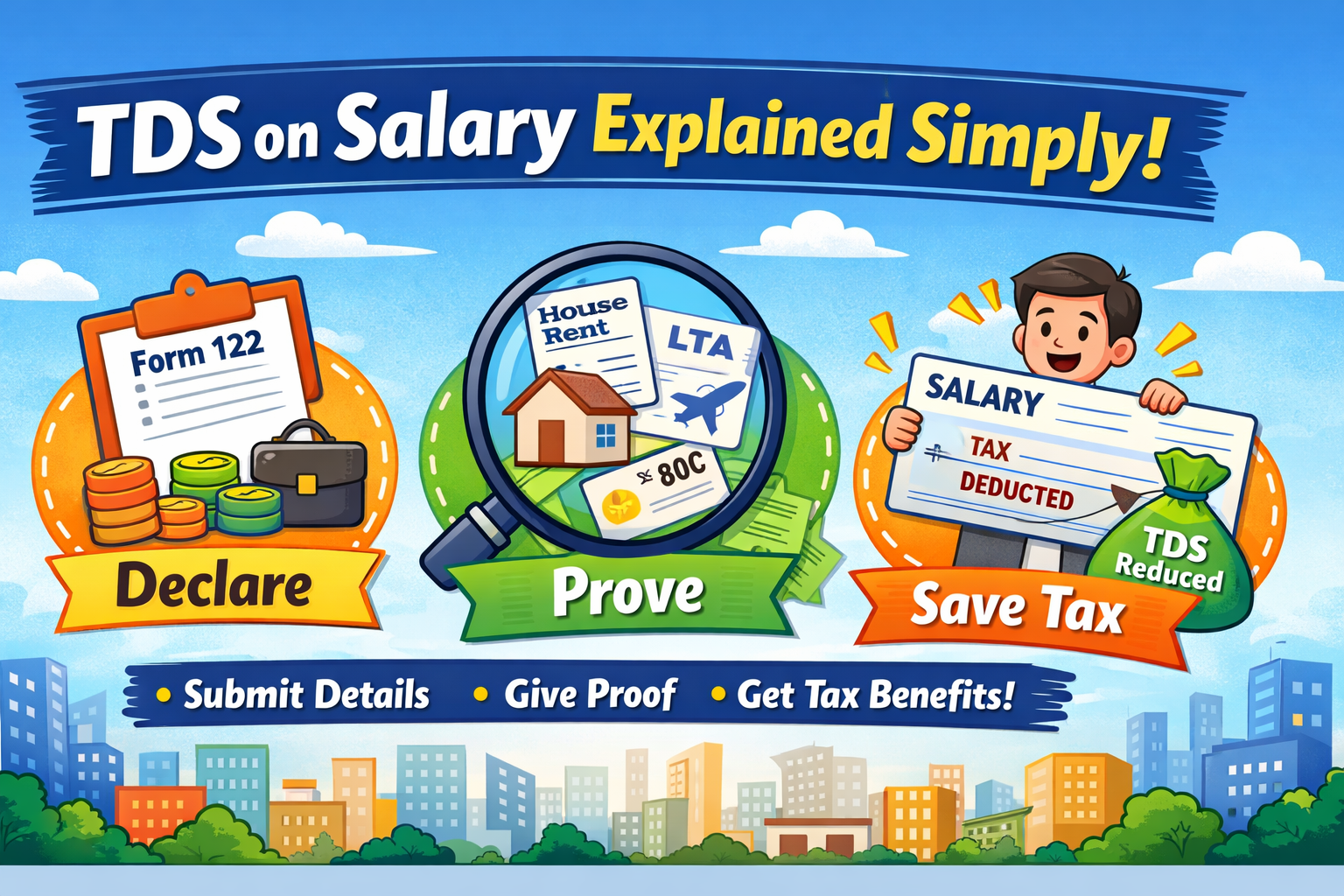
📘 TDS on Salary Explained

Under Income Tax Act, 2025 (New)

Rule 204, Rule 205 & Section 392 – Easy Guide for Everyone


✍️ Introduction

Every salaried person sees TDS (Tax Deducted at Source) in their salary slip.
But many people don’t understand:

👉 Why is tax deducted?
👉 Why is it sometimes more than expected?
👉 Why do we need to submit proofs to HR?

All of this is explained in Income-tax Act, 2025 (Section 392) and Rules 204 & 205.

Let’s understand this in simple language 👇


📌 What is TDS on Salary?

👉 TDS means:

💡 Your employer deducts tax before paying your salary

Example:

  • Your salary = ₹50,000
  • TDS deducted = ₹5,000
  • You receive = ₹45,000

👉 This tax is deposited with the government on your behalf

📖 As per law, employer must deduct tax at the time of payment


📌 What does Section 392 say?

Section 392 is the main law for salary TDS.

It says:

✅ 1. Employer must deduct tax

  • Based on your total yearly income estimate

✅ 2. Employer can adjust TDS

Based on details given by you like:

  • Other income
  • Home loan
  • Previous salary

📖 These details can increase or decrease your tax


❗ 3. Employer cannot reduce tax without proof

👉 Very important:

  • No proof = No deduction benefit
  • More TDS will be deducted

📖 Employer must collect proof before allowing deductions


📊 Rule 204 – What You Tell Your Employer

👉 Rule 204 is about giving information

You submit details in Form 122


🧾 What you can declare:

1. 💼 Salary from another job

If you changed jobs during the year


2. 🏠 Home loan loss

Example: Interest on housing loan


3. 💰 Other income

  • Bank interest
  • Capital gains

4. 🧾 TDS already deducted

From bank, etc.


🎯 Why this is important?

👉 If you don’t declare:

❌ Less TDS during year
❌ But big tax payment later


📊 Rule 205 – What You Need to Prove

👉 Rule 205 is about giving proof

You submit documents in Form 124


📑 Common proofs required:

🏠 HRA (House Rent)

  • Landlord name & PAN
  • Required if rent > ₹1 lakh/year

✈️ LTA (Travel)

  • Tickets & travel bills

🏡 Home Loan

  • Interest certificate
  • Lender details

💰 Investments (80C etc.)

  • LIC receipt
  • PPF
  • ELSS

❗ Important Rule

👉 Only telling is not enough — proof is compulsory


🔗 How Everything Works Together

👉 Simple flow:

  1. You declare income → Rule 204
  2. You submit proof → Rule 205
  3. Employer calculates tax → Section 392

💡 Real Life Example

👨‍💼 Rahul’s Case:

  • Salary = ₹10,00,000
  • Home loan interest = ₹2,00,000
  • LIC investment = ₹1,50,000

✅ If Rahul submits proof:

✔ Taxable income reduces
✔ Less TDS deducted


❌ If Rahul does NOT submit proof:

❌ Employer ignores deductions
❌ More TDS deducted
❌ Refund later (after ITR)


⚠️ Most Common Mistakes People Make

❌ Not declaring other income
❌ Not submitting investment proofs
❌ Submitting fake or incomplete documents
❌ Waiting till last month


🎯 Simple Tips for You

✔ Submit details at the beginning of the year
✔ Keep all proofs ready
✔ Check Form 26AS regularly
✔ Be honest with income declaration
✔ Don’t depend only on employer — file ITR properly


🧠 Final Understanding

👉 Remember this simple formula:

💡 Tell → Prove → Then Save Tax

  • Rule 204 = Tell your income
  • Rule 205 = Prove your deductions
  • Section 392 = Employer deducts correct tax

🔑 Final Takeaway

👉 TDS is not extra tax — it is your advance tax paid through your employer.

👉 If you follow rules properly:

✔ No extra tax burden
✔ No big refunds or surprises
✔ Smooth tax filing

👉 Want to understand how crypto & NFTs are taxed in India?
Read our detailed guide on Virtual Digital Assets (VDA) under Income-tax Act, 2025.

chatgpt image mar 23, 2026, 11 41 16 am

Virtual Digital Assets (VDA) under Income-tax Act, 2025 & Rules, 2026

A Complete Guide for Taxpayers in India


🚀 Introduction

With the rapid rise of cryptocurrencies, NFTs, and blockchain-based assets, the Indian government has introduced a clear and strict taxation framework for Virtual Digital Assets (VDA) under the Income-tax Act, 2025, effective from 1st April 2026 .

The objective is simple:
👉 Bring digital assets into the formal tax system
👉 Ensure transparency and compliance
👉 Prevent tax evasion in the digital economy


💡 What is a Virtual Digital Asset (VDA)?

A Virtual Digital Asset (VDA) generally includes:

  • Cryptocurrencies (Bitcoin, Ethereum, etc.)
  • NFTs (Non-Fungible Tokens)
  • Any digital asset based on cryptographic or blockchain technology
  • Any other asset notified by the government

👉 These are treated as “property” or digital assets under the tax framework, aligning with the broad definition of capital assets in the Act .


💰 Tax on VDA – Flat 30% Rule

One of the most important provisions:

👉 Income from transfer of VDA is taxed at 30% (flat rate)

✔ No slab benefit
✔ Applies to all taxpayers (individuals, firms, companies)

📌 Example:

  • Purchase: ₹1,00,000
  • Sale: ₹1,50,000
  • Profit: ₹50,000
  • Tax: ₹15,000 (30%)

❌ No Deductions Allowed

The law is very strict here.

👉 Only cost of acquisition is allowed

❌ Not allowed:

  • Mining expenses
  • Electricity cost
  • Internet bills
  • Professional fees
  • Any other expense

👉 This makes VDA one of the most heavily taxed asset classes


⚠️ No Set-off of Losses

Another strict rule:

  • ❌ Loss from VDA cannot be set off against:
    • Other VDAs
    • Any other income (salary, business, etc.)
  • ❌ Loss cannot be carried forward

👉 This significantly increases tax liability risk for traders.


🧾 TDS on VDA Transactions

📌 1% TDS Applicable

  • Deducted at the time of transfer
  • Usually deducted by the buyer or exchange

📌 Purpose:

  • Track transactions
  • Create audit trail
  • Ensure reporting to tax authorities

🎁 Tax on Gift of VDA

If you receive VDA as a gift:

👉 Taxable under “Income from Other Sources”

✔ Tax based on Fair Market Value (FMV)

✅ Exception:

  • Gift from relatives → Exempt

📊 Valuation of VDA

As per the Act:

👉 Fair Market Value (FMV) is key
Defined as the price an asset would fetch in open market

✔ Important in:

  • Crypto-to-crypto transactions
  • Gifts
  • Transfers without consideration

📋 Compliance & Reporting (Rules, 2026)

The Income-tax Rules, 2026 introduce strong compliance requirements:

🔍 Key Requirements:

  • Maintain transaction records
  • Capture:
    • PAN details
    • Buyer & seller identity
    • Transaction value
  • Maintain audit trail of transactions

👉 Similar to stock exchange compliance systems


🌍 Digital Economy & Significant Economic Presence (SEP)

The rules also link VDAs to global taxation:

📌 SEP Threshold:

  • ₹2 crore transaction value OR
  • 3 lakh users in India

👉 Applicable to:

  • Foreign crypto exchanges
  • Global digital platforms

⚖️ Legal Position of VDA

VDAs are treated as:

✔ Separate asset class
✔ Not equal to:

  • Currency
  • Shares
  • Securities

👉 Special taxation regime applies (30%)


🔐 Government Focus: Why So Strict?

The framework clearly shows that the government aims to:

  • Track every digital transaction
  • Prevent tax evasion
  • Regulate crypto ecosystem
  • Integrate VDAs into formal economy

📌 Practical Impact on Investors

👍 Pros:

  • Legal clarity
  • Structured taxation
  • Recognition of digital assets

👎 Cons:

  • High tax (30%)
  • No loss adjustment
  • TDS impacts liquidity
  • Compliance burden

🧠 Final Thoughts

The Income-tax Act, 2025 and Rules, 2026 mark a major shift in how India treats digital assets.

👉 VDAs are no longer unregulated—they are now:

✔ Fully taxable
✔ Closely monitored
✔ Strictly regulated

📢 If you are investing or trading in crypto or NFTs, proper tax planning and compliance is no longer optional—it’s essential.


📞 Need Help?

If you need assistance with:

  • VDA tax calculation
  • ITR filing
  • Crypto transaction reporting

👉 Feel free to reach out for professional guidance.

chatgpt image mar 20, 2026, 11 59 39 am

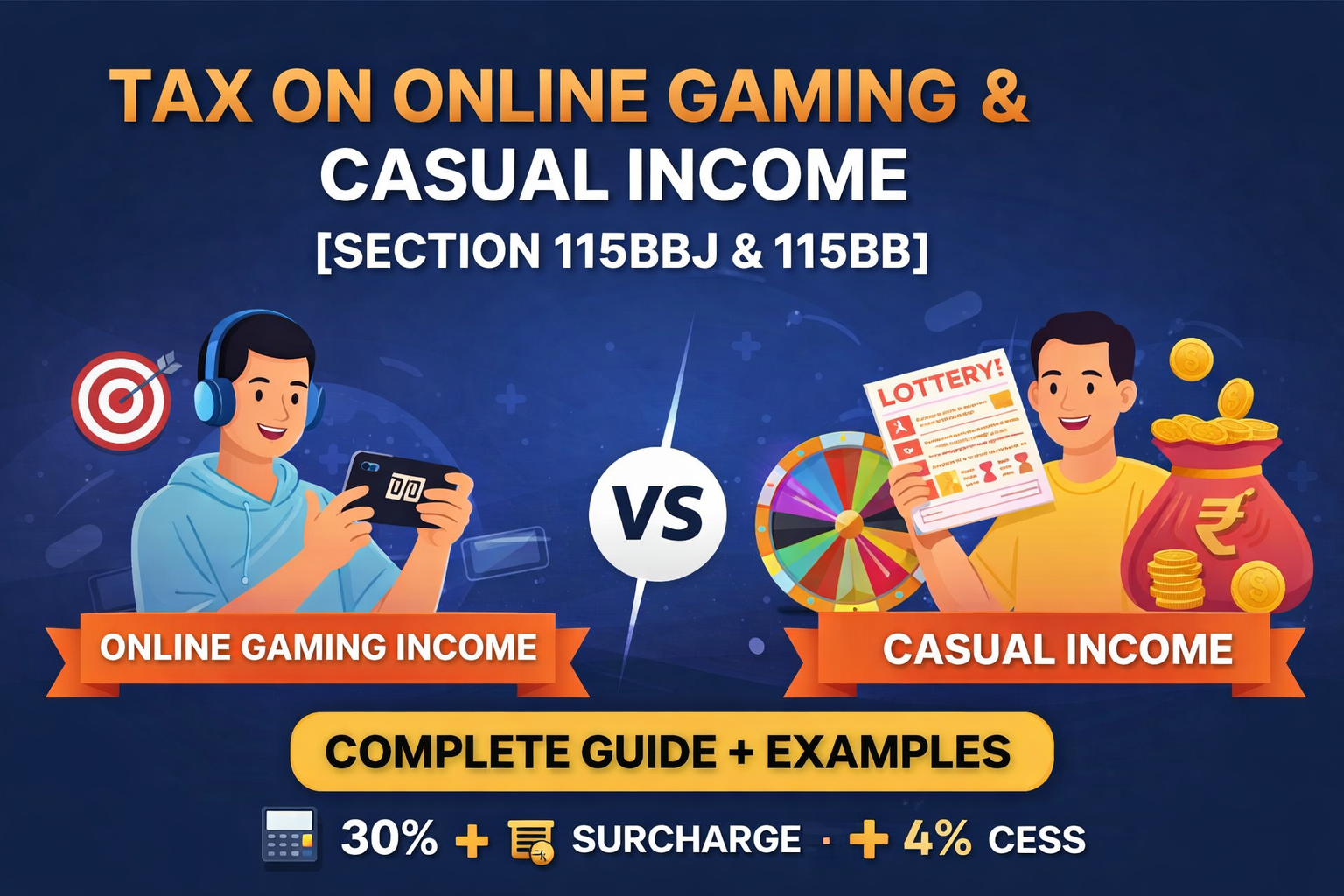
Tax on Online Gaming & Casual Income in India (Section 115BBJ & 115BB)

With the rise of online gaming and fantasy platforms, taxation on such income has become stricter and more clearly defined. The Income Tax Act now separates online gaming winnings and casual income (like lottery, betting, etc.) under different sections.

Let’s understand both in a simple way 👇

🕹️ What is Online Gaming Income?

📖 Meaning

Online gaming income means money earned from:

👉 Games played on internet platforms
👉 Using mobile apps, websites, or digital devices


📌 Examples of Online Gaming

  • Fantasy sports apps
  • Rummy / Poker apps
  • Online tournaments
  • Any internet-based game involving money

💡 Key Characteristics

  • 🌐 Played on internet
  • 💻 Requires platform/account
  • 🔄 Can involve multiple deposits & withdrawals

🕹️ Section 115BBJ – Tax on Online Gaming Winnings

📌 What does this section say?

If you earn money from online games, your net winnings are taxed at:

👉 30% flat tax
👉 + Applicable surcharge
👉 + 4% Health & Education Cess


🚫 Important Restrictions

  • ❌ No expenses allowed (internet, entry fees, etc.)
  • ❌ No deductions under Chapter VI-A (80C, 80D, etc.)
  • ❌ Cannot use basic exemption limit adjustment

💡 What is “Net Winnings”?

Net winnings = Total withdrawals – Total deposits (excluding bonuses)


📊 Example – Online Gaming Tax

Case:

  • Total deposits: ₹50,000
  • Total withdrawals: ₹1,20,000

👉 Net winnings = ₹1,20,000 – ₹50,000 = ₹70,000

Tax Calculation:

  • 30% of ₹70,000 = ₹21,000
  • Cess (4%) = ₹840

👉 Total Tax = ₹21,840


⚠️ Key Insight

Even if your total income is below ₹2.5 lakh, you still have to pay tax on online gaming winnings.

🎰 What is Casual Income?

📖 Meaning

Casual income means income that is:

👉 Unexpected / occasional
👉 Not earned regularly
👉 Based on luck rather than skill


📌 Examples of Casual Income

  • Lottery winnings
  • Crossword puzzle prizes
  • Horse race winnings
  • Card games (offline gambling)
  • Betting or gambling income

💡 Key Characteristics

  • 🎲 Based on luck/chance
  • 📉 Not a regular source of income
  • 💰 Usually received as lump sum

🎰 Section 115BB – Tax on Casual Income

This section covers income like:

  • Lottery winnings
  • Crossword puzzles
  • Horse racing
  • Card games
  • Gambling or betting

📌 Tax Rate

👉 Flat 30% tax
👉 + Surcharge
👉 + 4% cess


❗ Important Note

👉 Online gaming is NOT covered here anymore
(It is now taxed under Section 115BBJ)


🚫 Restrictions (Same as above)

  • ❌ No expense deduction
  • ❌ No Chapter VI-A deduction
  • ❌ No basic exemption adjustment

📊 Example – Lottery Winning

Case:

You win a lottery of ₹1,00,000

Tax Calculation:

  • 30% = ₹30,000
  • Cess (4%) = ₹1,200

👉 Total Tax = ₹31,200


💡 TDS Impact

  • TDS is usually deducted at 30% at source
  • You receive net amount after tax

Example:
Lottery ₹1,00,000 → You may receive around ₹70,000 (before cess adjustment)


⚖️ Difference Between Section 115BB & 115BBJ

ParticularSection 115BBSection 115BBJ
Applicable toLottery, betting, gamblingOnline gaming
Tax Rate30%30%
Deductions allowed❌ No❌ No
Basic exemption benefit❌ No❌ No
Net calculationGross winningsNet winnings

🚨 Practical Scenario (Combined Case)

Case:

  • Online gaming profit = ₹60,000
  • Lottery winning = ₹40,000

👉 Tax Calculation:

  1. Online gaming (115BBJ)
    • 30% of ₹60,000 = ₹18,000
  2. Lottery (115BB)
    • 30% of ₹40,000 = ₹12,000

👉 Total tax = ₹30,000 + cess

⚠️ Both incomes are taxed separately at flat rate


📌 Key Takeaways

✔ Online gaming income is taxed separately under Section 115BBJ
✔ Casual income like lottery is taxed under Section 115BB
✔ Flat 30% tax applies in both cases
✔ No deductions or exemption benefits allowed
✔ Tax applies even for low-income individuals


📣 Conclusion

If you are earning from online gaming, fantasy apps, or betting platforms, you must be careful about tax compliance. The government has made rules stricter, and ignoring them can lead to notices or penalties.


📞 Need Help?

👉 Confused about tax on gaming or lottery income?
👉 Want help in filing your ITR correctly?

Contact us today for professional assistance!

👉 Read our complete guide on Dividend Income Tax in India

chatgpt image mar 19, 2026, 09 49 02 am

Dividend Income under Income Tax

📌 Introduction

Dividend income is one of the most common forms of passive income for investors. Under the Income Tax Act, dividend is taxable under the head “Income from Other Sources” as per Section 56(2)(i).

However, the definition of dividend under the Act is much wider than its general meaning. It includes not only normal dividends but also several “deemed dividends” under Section 2(22).

In this blog, we will break down the concept in a simple and practical manner.

📖 What is Dividend as per Income Tax?

As per Section 2(22), dividend includes:

(a) Distribution of Accumulated Profits

  • Any distribution by a company to shareholders
  • Whether profits are capitalised or not
  • If it involves release of company assets → treated as dividend

👉 Example:
If a company distributes assets instead of cash, the market value is treated as dividend.


(b) Distribution of Debentures / Bonus to Preference Shareholders

  • Distribution of:
    • Debentures
    • Deposit certificates
    • Bonus shares to preference shareholders

👉 Important:

  • Bonus shares to equity shareholders = NOT dividend
  • Value considered = Market value

(c) Distribution on Liquidation

  • Amount received during liquidation
  • To the extent of accumulated profits → taxable as dividend

👉 Note:

  • Post-liquidation payments = Capital receipt (not dividend)

(d) Distribution on Reduction of Capital

  • If capital is reduced and shareholders receive money
  • It is treated as dividend to the extent of accumulated profits

⚠️ (e) Deemed Dividend – Loans & Advances

This is the most important.

When is Loan treated as Dividend?

If:

  • Company is closely held (not public company)
  • Loan/advance is given to:
    • Shareholder holding ≥10% voting power, OR
    • A concern where such shareholder has ≥20% interest

👉 Then:
➡️ Loan is treated as dividend (to the extent of accumulated profits)


💡 Key Points:

  • Applies only to closely held companies
  • Taxable in hands of shareholder
  • Limited to accumulated profits

❌ Exceptions to Deemed Dividend

The following are NOT treated as dividend:

✔️ (i) Loan in Ordinary Course of Business

  • If lending is a substantial business activity
  • Then loan is NOT dividend

✔️ (ii) Inter-group Loans (Specific Conditions)

  • Between group entities under prescribed conditions

✔️ (iii) Set-off of Dividend

  • If loan is later adjusted against dividend → no double taxation

🧾 CBDT Clarification

As per CBDT Circular No. 19/2017:

👉 Trade advances (commercial transactions) are NOT treated as deemed dividend

Examples:

  • Advance for job work
  • Business-related payments
  • Security deposits in business transactions

➡️ If transaction is commercial in nature, Section 2(22)(e) does NOT apply.


❌ Transactions NOT Treated as Dividend

  • Distribution on demerger
  • Shares issued for full cash consideration
  • Certain non-participating shares

📊 Meaning of “Accumulated Profits”

Accumulated profits include:

  • All profits up to the date of distribution

Special Points:

  • Includes capitalised profits
  • Excludes depreciation reserves (as per case law)
  • In amalgamation → includes profits of amalgamating company

📅 Basis of Taxation (Section 8)

Dividend is taxable in the year:

  • When declared OR
  • Distributed OR
  • Paid

👉 Whichever is applicable


⚡ Tax Rate on Dividend

  • Taxable at normal slab rates
  • Applicable for both:
    • Domestic dividend
    • Foreign dividend

📘 Practical Illustrations

✅ Illustration 1 (Trade Advance Case)

  • Dhaval holds 65% shares in a company
  • Company gives advance for job work

👉 Since it is a business transaction,
➡️ NOT treated as deemed dividend


✅ Illustration 2 (Loan Case)

  • Shareholder holds 15% shares
  • Loan received = ₹1,00,000
  • Accumulated profits = ₹10,00,000

👉 Entire ₹1,00,000 is:
➡️ Taxable as deemed dividend

👉 Even if loan is repaid later:
➡️ Still taxable


🧠 Key Takeaways

✔ Dividend is taxable under Income from Other Sources
✔ Definition is very wide under Section 2(22)
✔ Loans to major shareholders = deemed dividend
✔ Trade advances = NOT dividend
✔ Taxable at normal slab rates


🔍 Conclusion

Understanding dividend taxation is crucial for:

  • Investors
  • Business owners

The concept of deemed dividend under Section 2(22)(e) is particularly important as it prevents tax avoidance through loans instead of dividend distribution.

Proper classification of transactions (loan vs business advance) can significantly impact tax liability.

👉 If you also earn income from property, make sure to read our guide on Income Tax on Rental Income in India to understand its tax implications.

chatgpt image mar 17, 2026, 11 45 25 am

🏠 Income Tax on Rental Income in India

📝 Introduction

If you earn money by giving your house, shop, or office on rent, then that income is called rental income.

👉 And yes, it is taxable in India

But don’t worry — government gives big deductions, so you don’t have to pay tax on full rent.

Let’s understand everything in simple language with examples.


💡 What is Rental Income?

Rental income means:
👉 Money you receive from property on rent

Examples:

  • House rent
  • Shop rent
  • Office rent

👉 It is taxed under:
“Income from House Property”

Also, as per tax rules, any building or land attached to it is covered under this head


🏠 Types of Property

1️⃣ Self-Occupied Property

  • You live in your own house
    👉 Tax = Zero

2️⃣ Let-Out Property

  • Property given on rent
    👉 Tax = Applicable

3️⃣ Deemed Let-Out Property

  • More than 2 houses
    👉 Extra house treated as rented

🧮 How Rental Income is Calculated

Step 1: Gross Annual Value (GAV)

👉 Higher of:

  • Actual rent
  • Expected rent

Step 2: Less Municipal Tax

👉 Only if actually paid

👉 Result = Net Annual Value (NAV)


Step 3: Deductions

✅ 30% Standard Deduction

✅ Interest on Home Loan

👉 Allowed under Section 24


📊 Final Formula

👉 Taxable Income = NAV – 30% – Interest


📈 Detailed Practical Example (Very Important)

Let’s take a real-life situation 👇

👉 Example:

Rahul owns a flat and gives it on rent.

  • Monthly rent = ₹25,000
  • Annual rent = ₹3,00,000
  • Municipal tax paid = ₹20,000
  • Home loan interest = ₹1,80,000

🔢 Step-by-Step Calculation:

1️⃣ Gross Annual Value (GAV)

👉 ₹3,00,000


2️⃣ Net Annual Value (NAV)

👉 ₹3,00,000 – ₹20,000
👉 ₹2,80,000


3️⃣ Standard Deduction (30%)

👉 30% of ₹2,80,000 = ₹84,000


4️⃣ Interest Deduction

👉 ₹1,80,000


✅ Final Taxable Income:

👉 ₹2,80,000 – ₹84,000 – ₹1,80,000
👉 ₹16,000


🎯 Conclusion from Example

👉 Rahul earned ₹3,00,000 rent
👉 But pays tax only on ₹16,000 😮

👉 This is the power of deductions!


⚠️ Important Rules

🔹 TDS on Rent

  • If rent > ₹50,000/month
    👉 5% TDS

🔹 Security Deposit

  • Not taxable

🔹 Unrealized Rent

  • Can be excluded (conditions apply)

📉 Loss from House Property

If interest is high:

👉 Income can become negative

✔ Set-off up to ₹2 lakh
✔ Carry forward 8 years


💡 Tax Saving Tips

✔ Take home loan
✔ Use joint ownership
✔ Keep documents ready
✔ Choose correct tax regime


❌ Mistakes to Avoid

❌ Not reporting rent
❌ Ignoring extra property tax
❌ Missing deductions


🧾 Final Conclusion

Rental income is taxable, but:

👉 With proper planning, you can reduce tax significantly

Understanding basics will help you:
✅ Save tax
✅ Avoid notices
✅ Plan better

chatgpt image mar 16, 2026, 09 32 41 am

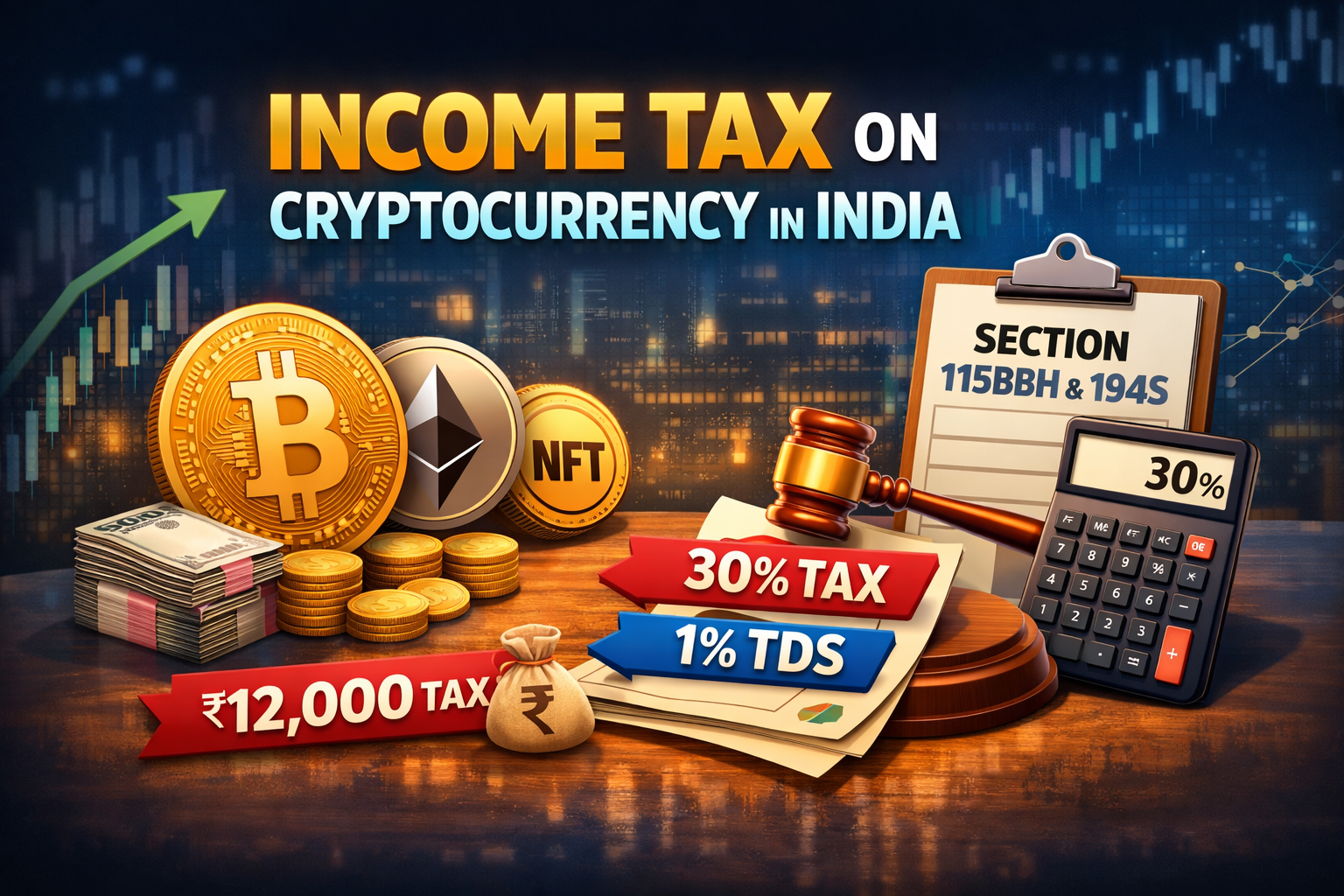
Income Tax on Cryptocurrency in India

Cryptocurrency (Bitcoin, Ethereum, etc.) is taxed in India under the category Virtual Digital Assets (VDAs). The government introduced specific tax rules in Union Budget 2022, mainly under Section 115BBH and Section 194S of the Income Tax Act.

Below is a clear explanation of how crypto is taxed in India.


1. 30% Tax on Crypto Profits

Any profit from selling or transferring cryptocurrency is taxed at a flat rate of 30%.

This applies to:

  • Selling crypto for INR
  • Crypto-to-crypto trading
  • Spending crypto to buy goods/services
  • NFTs and other digital assets

Example

  • Buy Bitcoin: ₹1,00,000
  • Sell Bitcoin: ₹1,40,000
  • Profit: ₹40,000

Tax = 30% of ₹40,000 = ₹12,000 + 4% cess

Important points:

  • No slab benefit (same tax for everyone)
  • Holding period doesn’t matter
  • Treated similar to lottery/winning income

2. Only Cost of Acquisition Allowed

Under Section 115BBH, you can deduct only the purchase cost of crypto.

Not allowed as deductions:

  • Trading fees
  • Internet cost
  • Mining cost
  • Exchange commission

3. Loss Cannot Be Set Off

Crypto losses have strict rules:

❌ Cannot adjust loss against:

  • Other crypto profits
  • Salary income
  • Business income

❌ Cannot carry forward losses to future years.

Example:

  • Bitcoin profit: ₹1,00,000
  • Ethereum loss: ₹50,000

Tax will still apply on ₹1,00,000.


4. 1% TDS on Crypto Transactions

A 1% TDS is deducted on crypto transactions under Section 194S.

This applies when yearly crypto transactions exceed:

  • ₹50,000 (for individuals / small investors)
  • ₹10,000 (for others)

Example:

  • Sell crypto for ₹1,00,000
  • TDS deducted = ₹1,000

You receive ₹99,000, and ₹1,000 goes to the government as TDS.

This TDS can be adjusted while filing ITR.


5. Tax on Crypto Gifts

If someone gifts you cryptocurrency:

  • If received from relatives → No tax
  • If received from non-relative → Taxable if value > ₹50,000

Tax is charged under Income from Other Sources.


6. Crypto Mining Tax

Mining rewards are treated as income.

  • Taxed as business income or other income at normal slab rates.
  • When you later sell mined crypto → 30% tax applies on profit.

7. Reporting Crypto in Income Tax Return

Crypto transactions must be reported in Schedule VDA of the ITR.

Common ITR forms:

  • ITR-2 → Investors
  • ITR-3 → Traders / business income

Quick Summary

ParticularTax Rule
Tax rate on profit30% + cess
TDS on transactions1%
Loss set-off allowed❌ No
Carry forward loss❌ No
Deduction allowedOnly cost of acquisition
ITR reportingSchedule VDA

✅ Example Full Calculation

Investment: ₹2,00,000
Sale Value: ₹2,80,000

Profit = ₹80,000

Tax = 30% × 80,000 = ₹24,000 + cess

Many influencers and content creators today also earn through crypto promotions, NFT sales, and blockchain collaborations. If you want to understand how earnings from YouTube, brand deals, and social media promotions are taxed, read our detailed guide on Income Tax for Influencers and YouTubers in India.

chatgpt image mar 15, 2026, 11 01 11 am

Income Tax for Influencers and YouTubers in India

With the rapid growth of YouTube, Instagram, and other social media platforms, many individuals in India earn money as content creators, influencers, and YouTubers. However, these earnings are taxable under the Income Tax Act, 1961.

This guide explains how influencers and YouTubers are taxed in India, deductions they can claim, GST applicability, and which ITR form to file.


Who is Considered an Influencer or YouTuber for Tax Purposes?

Influencers and YouTubers are individuals who earn income through online content creation, promotions, and collaborations.

Common examples include:

  • YouTube content creators
  • Instagram influencers
  • Bloggers and vloggers
  • Podcasters
  • Gaming streamers
  • Affiliate marketers

For income tax purposes, their income is treated as “Income from Business or Profession.”


Sources of Income for Influencers and YouTubers

Influencers can earn income from multiple sources.

1. Advertising Revenue

Platforms like YouTube pay creators through ad revenue.

Examples:

  • YouTube AdSense earnings
  • Revenue from monetized videos

2. Brand Collaborations

Brands pay influencers to promote products or services.

Examples:

  • Sponsored Instagram posts
  • Product promotions in YouTube videos

3. Affiliate Marketing

Influencers earn commission on product sales through affiliate links.

Examples:

  • Amazon affiliate links
  • Flipkart affiliate programs

4. Selling Digital Products

Some creators sell:

  • Online courses
  • E-books
  • Memberships
  • Merchandise

All these earnings are fully taxable.


How Influencer Income is Taxed

Income earned by influencers is taxed as business income under the head:

“Profits and Gains from Business or Profession.”

Tax is calculated according to individual income tax slab rates.

Income SlabTax Rate
Up to ₹2.5 lakhNil
₹2.5 lakh – ₹5 lakh5%
₹5 lakh – ₹10 lakh20%
Above ₹10 lakh30%

Influencers can choose between old tax regime or new tax regime.


Presumptive Taxation for Influencers (Section 44ADA)

Many influencers can opt for presumptive taxation under Section 44ADA.

Eligibility

  • Resident individual or partnership firm
  • Professional receipts up to ₹50 lakh

Tax Calculation

Under Section 44ADA:

  • 50% of total receipts is treated as taxable income
  • Remaining 50% treated as expenses

Example

If an influencer earns ₹30 lakh in a year

ParticularAmount
Gross income₹30,00,000
Taxable income (50%)₹15,00,000

This simplifies tax compliance since books of accounts and audit are generally not required.


Expenses Influencers Can Claim

If influencers choose normal taxation instead of 44ADA, they can deduct actual business expenses.

Common deductions include:

  • Camera and recording equipment
  • Laptop or editing software
  • Internet and mobile bills
  • Studio lighting and microphones
  • Video editing tools
  • Travel expenses for shoots
  • Marketing and promotion costs

These expenses reduce taxable income.


Free Products Received from Brands (Barter Deals)

Influencers often receive free products in exchange for promotion.

Important point:

The fair market value of such products is taxable as income.

Example:

  • Brand sends a ₹50,000 smartphone for promotion
  • ₹50,000 may be treated as income from profession

Which ITR Should Influencers File?

SituationITR Form
Presumptive taxation (44ADA)ITR-4
Normal taxationITR-3

Income should be reported under “Profits and Gains from Business or Profession.”


Advance Tax for Influencers

If total tax liability exceeds ₹10,000 in a financial year, advance tax must be paid.

Advance Tax Due Dates

InstallmentDue Date
15 June15%
15 September45%
15 December75%
15 March100%

Failure to pay advance tax may lead to interest penalties.


GST for Influencers and YouTubers

GST registration is required if:

  • Total turnover exceeds ₹20 lakh (₹10 lakh in special states)
  • Services are provided to foreign brands or clients

Export of services may be treated as zero-rated supply under GST, subject to conditions.


Common Tax Mistakes Influencers Make

Many creators unknowingly make tax mistakes such as:

  • Not reporting AdSense income
  • Ignoring foreign payments from platforms
  • Not paying advance tax
  • Not maintaining invoices and expense records
  • Forgetting to report barter collaborations

Proper compliance helps avoid income tax notices and penalties.


Conclusion

Income earned by influencers and YouTubers in India is treated as business or professional income and taxed according to income tax slab rates. Creators can simplify taxation by opting for presumptive taxation under Section 44ADA, or claim actual expenses under normal taxation.

Understanding these rules ensures influencers remain tax compliant while optimizing their tax liability.

Influencers and YouTubers may also need to comply with GST regulations, especially when providing services to brands or foreign clients. To understand GST applicability for digital creators, read our detailed guide on GST for Freelancers and Content Creators in India.

chatgpt image mar 11, 2026, 03 08 53 pm

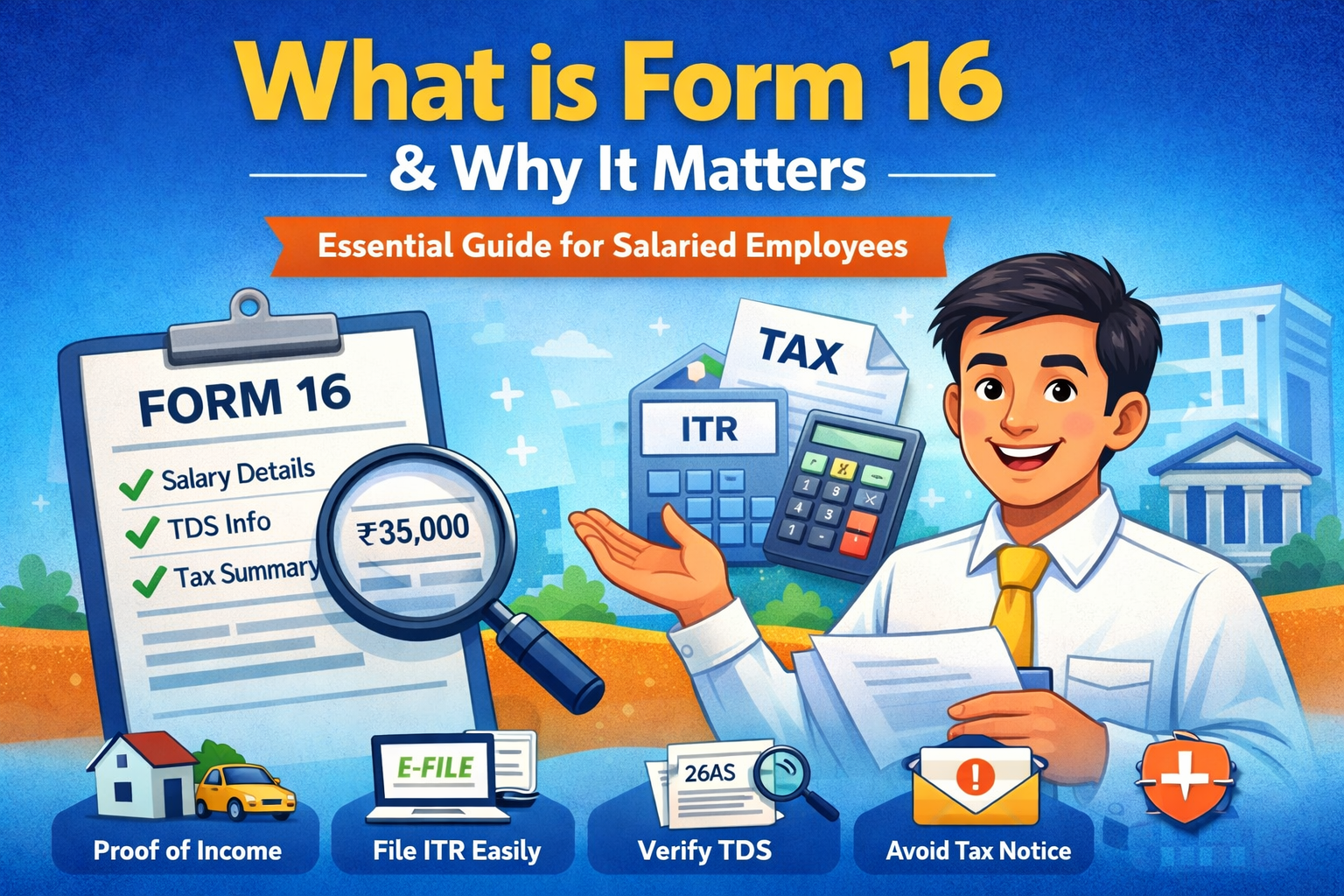
What is Form 16 and Why It Matters

If you are a salaried employee in India, Form 16 is one of the most important tax documents you will receive from your employer. It helps you file your Income Tax Return (ITR) and verify how much tax has already been deducted from your salary.

Let’s understand it in simple terms.


What is Form 16?

Form 16 is a TDS certificate issued by an employer to a salaried employee.

It shows:

  • Total salary paid during the financial year
  • Tax deducted at source (TDS) by the employer
  • Tax deposited to the government on your behalf

It is issued under Section 203 of the Income Tax Act.

👉 In simple words:
Form 16 is proof that your employer deducted tax from your salary and paid it to the government.


Who Issues Form 16?

Your employer issues Form 16 to you if:

  • Your salary crosses the taxable limit
  • The employer deducts TDS from your salary

It is usually issued after the financial year ends, generally by June 15.


Parts of Form 16

Form 16 has two main parts.

Part A – TDS Details

Part A contains:

  • Employer PAN & TAN
  • Employee PAN
  • Tax deducted and deposited
  • Summary of TDS

This part confirms that the tax deducted from your salary was deposited with the government.


Part B – Salary Breakdown

Part B contains:

  • Salary structure
  • Allowances (HRA, LTA, etc.)
  • Deductions (80C, 80D etc.)
  • Taxable income
  • Final tax calculation

This section helps you understand how your tax was calculated.


Why Form 16 Matters

1️⃣ Helps You File ITR Easily

Form 16 contains most of the information required to file your Income Tax Return.

You can simply copy the details while filing your return.


2️⃣ Proof of Income

Form 16 is accepted as official proof of income when applying for:

  • Loans
  • Credit cards
  • Visa applications
  • Renting houses

3️⃣ Verifies Tax Paid

It helps confirm that your employer has correctly deducted and deposited your tax.

You can cross-check it with your Form 26AS or AIS.


4️⃣ Avoid Tax Notices

Using Form 16 ensures that your ITR matches government records, reducing the chances of receiving an income tax notice.


What If You Don’t Receive Form 16?

You can still file your ITR using:

  • Salary slips
  • Bank statements
  • Form 26AS
  • AIS (Annual Information Statement)

Form 16 only makes filing easier, but it is not mandatory to file ITR.


Common Mistakes People Make with Form 16

❌ Not checking PAN details
❌ Ignoring deductions mentioned in Form 16
❌ Not matching it with Form 26AS
❌ Filing wrong ITR form

Always verify the details before filing your tax return.


Final Thoughts

Form 16 is one of the most important documents for salaried employees. It provides a complete summary of your salary, deductions, and taxes paid during the financial year.

Understanding your Form 16 helps you:

  • File your ITR accurately
  • Claim deductions correctly
  • Avoid tax notices

✅ Pro Tip:
Always download your Form 26AS and AIS and compare them with your Form 16 before filing your return.

chatgpt image mar 10, 2026, 10 12 45 pm

How to Calculate HRA

House Rent Allowance (HRA) is a part of the salary given by employers to employees to help them pay house rent. The good news is that a portion of HRA can be tax-free under the Income Tax Act if you live in a rented house.

Let’s understand HRA in very simple language with a practical salary example.


What is HRA?

House Rent Allowance (HRA) is an allowance given by your employer to cover your rent expenses.

If you live in a rented house, part of the HRA becomes tax-exempt, which means you don’t have to pay tax on that amount.

But if you live in your own house, the entire HRA becomes taxable.


Conditions to Claim HRA

You can claim HRA tax exemption only if:

✔ You receive HRA in your salary
✔ You pay rent for accommodation
✔ You live in a rented house

If rent paid is more than ₹1 lakh per year, you must provide the landlord’s PAN.


How HRA Exemption is Calculated

The tax-free HRA amount is the minimum of the following three values:

1️⃣ Actual HRA received from employer
2️⃣ 50% of salary (if living in metro city) OR 40% of salary (non-metro)
3️⃣ Rent paid – 10% of salary

Salary here means Basic Salary + Dearness Allowance (DA).


Practical Salary Slip Example

Let’s understand this with a real-life example.

Salary Structure

Salary ComponentAmount
Basic Salary₹40,000
HRA₹20,000
Other Allowances₹15,000
Total Salary₹75,000

Assume:

  • City: Delhi (Metro City)
  • Monthly Rent: ₹18,000

Step-by-Step HRA Calculation

Step 1 – Actual HRA Received

HRA received = ₹20,000 per month

Yearly HRA = ₹2,40,000


Step 2 – 50% of Salary (Metro)

Salary for HRA calculation = Basic Salary

Basic Salary = ₹40,000 per month

50% of salary = ₹20,000

Yearly = ₹2,40,000


Step 3 – Rent Paid minus 10% of Salary

Rent paid yearly

₹18,000 × 12 = ₹2,16,000

10% of salary

Salary yearly = ₹40,000 × 12 = ₹4,80,000

10% of salary = ₹48,000

Now calculate:

₹2,16,000 – ₹48,000 = ₹1,68,000


HRA Exemption

Minimum of the three:

  • Actual HRA = ₹2,40,000
  • 50% of salary = ₹2,40,000
  • Rent – 10% salary = ₹1,68,000

✅ Tax-free HRA = ₹1,68,000


Taxable HRA

Total HRA received = ₹2,40,000
Tax-free HRA = ₹1,68,000

Taxable HRA = ₹72,000

This ₹72,000 will be added to your taxable income.


Important Tips for Salaried Employees

✔ Always keep rent receipts
✔ If rent exceeds ₹50,000 per month, TDS must be deducted under Section 194IB
✔ If you live with parents and pay rent, you can still claim HRA
✔ HRA cannot be claimed if you choose the new tax regime


Common Mistake People Make

Many salaried employees claim full HRA as exemption, which is incorrect.

The exemption must always be calculated using the three-condition formula mentioned above.


Conclusion

HRA is one of the biggest tax-saving benefits for salaried employees living in rented houses. By properly calculating HRA, you can significantly reduce your taxable income and save tax legally.

Understanding your salary structure and rent payments is the key to maximizing this benefit.

If you want to reduce your tax further, you should also explore other tax saving options for salaried employees.

...
WhatsApp Chat with us!