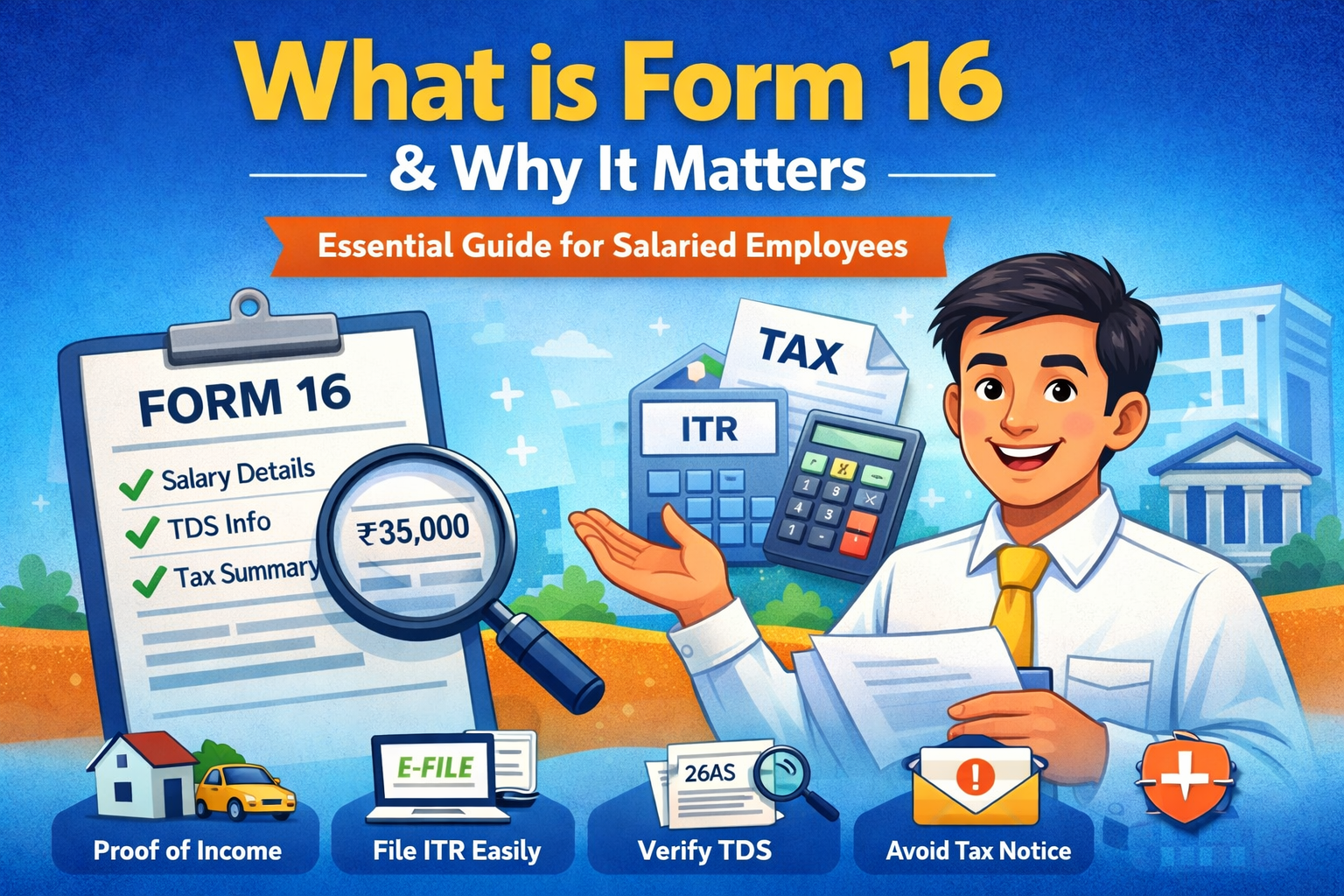
If you are a salaried employee in India, Form 16 is one of the most important tax documents you will receive from your employer. It helps you file your Income Tax Return (ITR) and verify how much tax has already been deducted from your salary.
Let’s understand it in simple terms.
What is Form 16?
Form 16 is a TDS certificate issued by an employer to a salaried employee.
It shows:
Total salary paid during the financial year
Tax deducted at source (TDS) by the employer
Tax deposited to the government on your behalf
It is issued under Section 203 of the Income Tax Act.
👉 In simple words: Form 16 is proof that your employer deducted tax from your salary and paid it to the government.
Who Issues Form 16?
Your employer issues Form 16 to you if:
Your salary crosses the taxable limit
The employer deducts TDS from your salary
It is usually issued after the financial year ends, generally by June 15.
Parts of Form 16
Form 16 has two main parts.
Part A – TDS Details
Part A contains:
Employer PAN & TAN
Employee PAN
Tax deducted and deposited
Summary of TDS
This part confirms that the tax deducted from your salary was deposited with the government.
Part B – Salary Breakdown
Part B contains:
Salary structure
Allowances (HRA, LTA, etc.)
Deductions (80C, 80D etc.)
Taxable income
Final tax calculation
This section helps you understand how your tax was calculated.
Why Form 16 Matters
1️⃣ Helps You File ITR Easily
Form 16 contains most of the information required to file your Income Tax Return.
You can simply copy the details while filing your return.
2️⃣ Proof of Income
Form 16 is accepted as official proof of income when applying for:
Loans
Credit cards
Visa applications
Renting houses
3️⃣ Verifies Tax Paid
It helps confirm that your employer has correctly deducted and deposited your tax.
You can cross-check it with your Form 26AS or AIS.
4️⃣ Avoid Tax Notices
Using Form 16 ensures that your ITR matches government records, reducing the chances of receiving an income tax notice.
What If You Don’t Receive Form 16?
You can still file your ITR using:
Salary slips
Bank statements
Form 26AS
AIS (Annual Information Statement)
Form 16 only makes filing easier, but it is not mandatory to file ITR.
Common Mistakes People Make with Form 16
❌ Not checking PAN details ❌ Ignoring deductions mentioned in Form 16 ❌ Not matching it with Form 26AS ❌ Filing wrong ITR form
Always verify the details before filing your tax return.
Final Thoughts
Form 16 is one of the most important documents for salaried employees. It provides a complete summary of your salary, deductions, and taxes paid during the financial year.
Understanding your Form 16 helps you:
File your ITR accurately
Claim deductions correctly
Avoid tax notices
✅ Pro Tip: Always download your Form 26AS and AIS and compare them with your Form 16 before filing your return.
Advance tax means paying income tax during the financial year itself instead of paying the entire tax at the end of the year.
Normally, tax is paid when filing the Income Tax Return. But if your total tax liability in a financial year is ₹10,000 or more, the Income Tax Act requires you to pay tax in instalments during the year. This is called Advance Tax.
Because of this system, the government receives tax regularly instead of waiting until the end of the year.
Advance tax is also known as “Pay As You Earn Tax.”
Who Needs to Pay Advance Tax?
You must pay advance tax if:
✔ Your total tax liability is ₹10,000 or more in a financial year.
Advance tax applies to:
Salaried employees (if tax liability remains after TDS)
Freelancers
Business owners
Professionals (CA, doctor, lawyer etc.)
Investors earning capital gains
Individuals earning rental income
People earning interest income
Example
Rahul works in a company and also earns ₹3,00,000 from freelance work.
His total tax liability becomes ₹45,000 after deductions.
Since his tax liability is more than ₹10,000, he must pay advance tax.
Who is NOT Required to Pay Advance Tax?
1️⃣ Senior Citizens
A resident senior citizen (age 60 years or more) does not have to pay advance tax if:
They do not have business or professional income
Example:
Mr. Sharma (age 65) earns:
Interest income: ₹5,00,000
Pension: ₹3,00,000
He does not need to pay advance tax.
2️⃣ Presumptive Taxation (Section 44AD / 44ADA)
Businesses or professionals using presumptive taxation scheme:
They can pay entire advance tax in one instalment by 15 March.
Example:
A consultant declaring income under Section 44ADA can pay 100% advance tax by 15 March.
Advance Tax Due Dates
Advance tax must be paid in four instalments during the year.
Due Date
Tax Payable
15 June
At least 15% of total tax
15 September
At least 45% of total tax
15 December
At least 75% of total tax
15 March
100% of total tax
Any advance tax paid up to 31 March is still considered advance tax.
Advance Tax Example
Let’s understand with a simple example.
Suppose your total tax liability for the year is ₹1,00,000.
You will pay tax like this:
Date
Amount
15 June
₹15,000
15 September
₹30,000
15 December
₹30,000
15 March
₹25,000
Total = ₹1,00,000
How to Calculate Advance Tax
Follow these steps:
Step 1
Estimate your total income for the year
Include income from:
Salary
Business
Freelancing
Rent
Capital gains
Interest income
Step 2
Subtract deductions
Example:
Section 80C
Section 80D
Section 80G etc.
Step 3
Calculate income tax as per applicable slab.
Step 4
Reduce:
TDS already deducted
TCS
Relief under sections 89/90/91
The remaining tax is advance tax payable.
Example of Advance Tax Calculation
Suppose Neha has the following income:
Salary: ₹8,00,000 Freelance income: ₹4,00,000
Total income = ₹12,00,000
She claims deduction under Section 80C = ₹1,50,000
Taxable income = ₹10,50,000
Tax liability ≈ ₹1,12,500
TDS deducted by employer = ₹70,000
Remaining tax = ₹42,500
Since this amount is above ₹10,000, she must pay advance tax.
How to Pay Advance Tax Online
You can pay advance tax through the Income Tax Portal.
Steps:
1️⃣ Visit the Income Tax e-filing portal 2️⃣ Go to e-Pay Tax 3️⃣ Select Advance Tax (Challan 280) 4️⃣ Enter PAN and details 5️⃣ Choose Assessment Year 6️⃣ Pay through net banking / UPI / debit card
After payment, keep the challan receipt safely.
Interest for Non-Payment of Advance Tax
If advance tax is not paid properly, interest may be charged under:
Section 234B
Section 234C
Interest Under Section 234B
This interest is charged when:
Advance tax not paid, OR
Advance tax paid is less than 90% of total tax liability
Interest Rate:
1% per month or part of month
Example
Total tax liability = ₹1,00,000 Advance tax paid = ₹50,000
Shortfall = ₹50,000
Interest will be charged from 1 April until payment.
Interest Under Section 234C
This interest is charged when advance tax instalments are not paid on time.
Interest rate:
1% per month
Example:
Suppose tax liability = ₹1,00,000
But by 15 September you paid only ₹20,000 instead of ₹45,000.
Shortfall = ₹25,000
Interest will be charged on ₹25,000.
When Interest Under 234C is NOT Applicable
Interest may not apply if shortfall is due to:
Capital gains
Lottery income
Dividend income
New business income
Provided the tax is paid in remaining instalments or by 31 March.
Interest for Late Filing of Return (Section 234A)
If you file your Income Tax Return after the due date, interest will apply.
Interest Rate:
1% per month
It is charged on unpaid tax amount.
Benefits of Paying Advance Tax
Paying advance tax on time helps you:
✔ Avoid heavy interest and penalties ✔ Manage tax payments easily ✔ Reduce financial burden at year end ✔ Stay compliant with tax laws
Common Mistakes People Make
❌ Ignoring freelance or side income ❌ Forgetting capital gains tax ❌ Not adjusting TDS ❌ Paying advance tax only in March ❌ Wrong income estimation
Conclusion
Advance tax is an important part of India’s tax system. If your tax liability exceeds ₹10,000, you must pay tax during the year in instalments.
Paying advance tax on time helps you avoid interest under Sections 234B and 234C and ensures smooth tax compliance.
If you have multiple income sources like freelancing, rent, or investments, always estimate your tax liability early and pay advance tax accordingly.
Frequently Asked Questions (FAQs)
Is advance tax mandatory?
Yes, if your tax liability is ₹10,000 or more in a financial year.
Do salaried employees need to pay advance tax?
Usually no, because employers deduct TDS. But if you have additional income, you may need to pay advance tax.
What happens if I miss an advance tax instalment?
Interest will be charged under Section 234C.
Can advance tax be paid after 15 March?
Yes. Any tax paid before 31 March is treated as advance tax.
Can advance tax be revised?
Yes. You can revise advance tax payments based on updated income estimates.