chatgpt image apr 15, 2026, 06 54 12 pm

Surcharge and Cess under Income Tax

When computing income tax liability, many taxpayers stop at slab-wise tax. However, the actual tax payable is materially impacted by two additional levies:

  • Surcharge (based on income thresholds)
  • Health & Education Cess (H&EC) (fixed percentage)

This article provides a comprehensive, technical, and practical analysis relevant for professional application.


1. Statutory Framework

(A) Surcharge

  • Governed by Finance Act of the relevant year (for AY 2026–27 → Finance Act, 2025)
  • It is not a separate tax, but an incremental charge on income tax

(B) Health & Education Cess

  • Introduced via Finance Act, 2018
  • Applicable @ 4% on: Income Tax + Surcharge

2. Surcharge Rates for Individuals (AY 2026–27)

(A) Normal Provisions (excluding special income adjustments)

Total IncomeSurcharge Rate
Up to ₹50 lakhNil
₹50 lakh – ₹1 crore10%
₹1 crore – ₹2 crore15%
₹2 crore – ₹5 crore25%
Above ₹5 crore37%

(B) Special Provisions / Restrictions

1. Section 115BAC (New Tax Regime)

  • Maximum surcharge capped at 25%
  • Effective from AY 2024–25 onwards

2. Special Rate Incomes

As per provisos to surcharge provisions:

Nature of IncomeMaximum Surcharge
Dividend income15%
Capital gains u/s 111A, 112, 112A15%

👉 Even if total income exceeds ₹2 crore / ₹5 crore, surcharge on such income cannot exceed 15%


3. Concept of Marginal Relief

Legal Intent

To ensure that:

Additional tax payable due to surcharge does not exceed the income exceeding the threshold.

Applicability Thresholds

  • ₹50 lakh
  • ₹1 crore
  • ₹2 crore
  • ₹5 crore

Illustration – Marginal Relief

Case:

  • Total Income = ₹51,00,000

Step 1: Tax without surcharge (₹50 lakh)
Assume tax = ₹13,12,500

Step 2: Tax on ₹51 lakh with surcharge

  • Tax ≈ ₹13,42,500
  • Surcharge @10% ≈ ₹1,34,250

Total = ₹14,76,750

Excess tax due to surcharge = ₹1,64,250
But income increased only by ₹1,00,000

👉 Marginal relief applies → excess tax is restricted to ₹1,00,000


4. Step-by-Step Tax Computation (Practical Illustration)

Case Study

  • Assessee: Individual
  • Total Income: ₹60,00,000
  • Regime: Old Tax Regime

Step 1: Slab-wise Tax Calculation under old tax regime

Income SlabRateTax
Up to ₹2,50,000Nil0
₹2,50,001 – ₹5,00,0005%₹12,500
₹5,00,001 – ₹10,00,00020%₹1,00,000
₹10,00,001 – ₹60,00,000 (₹50L)30%₹15,00,000

👉 Total Tax = ₹16,12,500


Step 2: Add Surcharge

  • Income > ₹50L → 10% surcharge

👉 ₹16,12,500 × 10% = ₹1,61,250


Step 3: Add Health & Education Cess

👉 (₹16,12,500 + ₹1,61,250) × 4%
= ₹17,73,750 × 4%
= ₹70,950


Step 4: Total Tax Liability

👉 ₹16,12,500

  • ₹1,61,250
  • ₹70,950
    = ₹18,44,700

Effective Tax Rate

👉 ₹18,44,700 ÷ ₹60,00,000 ≈ 30.75%


5. Key Practical Insights for Professionals

(A) Planning Around ₹50L / ₹1Cr Thresholds

  • Even small increments in income can trigger disproportionate tax liability
  • Evaluate:
    • Timing of income recognition
    • Capital gain realization
    • Bonus structuring

(B) Capital Gains Strategy

  • Prefer capital gains where possible:
    • Surcharge capped at 15%
  • Useful in:
    • Portfolio restructuring
    • ESOP planning

(C) Regime Selection (Old vs New – Section 115BAC)

  • For high-income individuals:
    • New regime may be beneficial due to 25% surcharge cap vs 37%

(D) Advance Tax Implications

  • Incorrect surcharge estimation leads to:
    • Interest u/s 234B & 234C
  • Always consider surcharge while computing installments

6. Common Errors and Compliance Risks

IssueRisk
Ignoring surcharge thresholdsUnderpayment of tax
Not applying marginal reliefExcess tax payment
Incorrect treatment of capital gains surchargeLitigation exposure
Ignoring surcharge cap under 115BACWrong regime selection
Advance tax miscalculationInterest liability

7. Important Legal References

  • Finance Act, 2025 – Surcharge rates
  • Finance Act, 2018 – Health & Education Cess @ 4%
  • Section 115BAC – New tax regime provisions
  • Sections 111A, 112, 112A – Special rate incomes
  • CBDT Circulars on marginal relief (various years)

8. Conclusion

Surcharge and cess are not merely add-ons—they are critical components of total tax liability, especially for high-income individuals.

From a professional standpoint:

  • Always compute effective tax rate, not just slab rate
  • Factor in marginal relief at threshold levels
  • Evaluate regime selection strategically
  • Incorporate surcharge in advance tax planning

A precise computation can optimize tax outflow and prevent compliance risks.

You can also read about ITR forms.

Please follow us on Social Media Platforms

https://www.youtube.com/@YourFinTaxBudd
https://www.instagram.com/yourfintaxbuddy

https://www.facebook.com/yourfintaxbuddy

chatgpt image apr 9, 2026, 10 32 40 pm

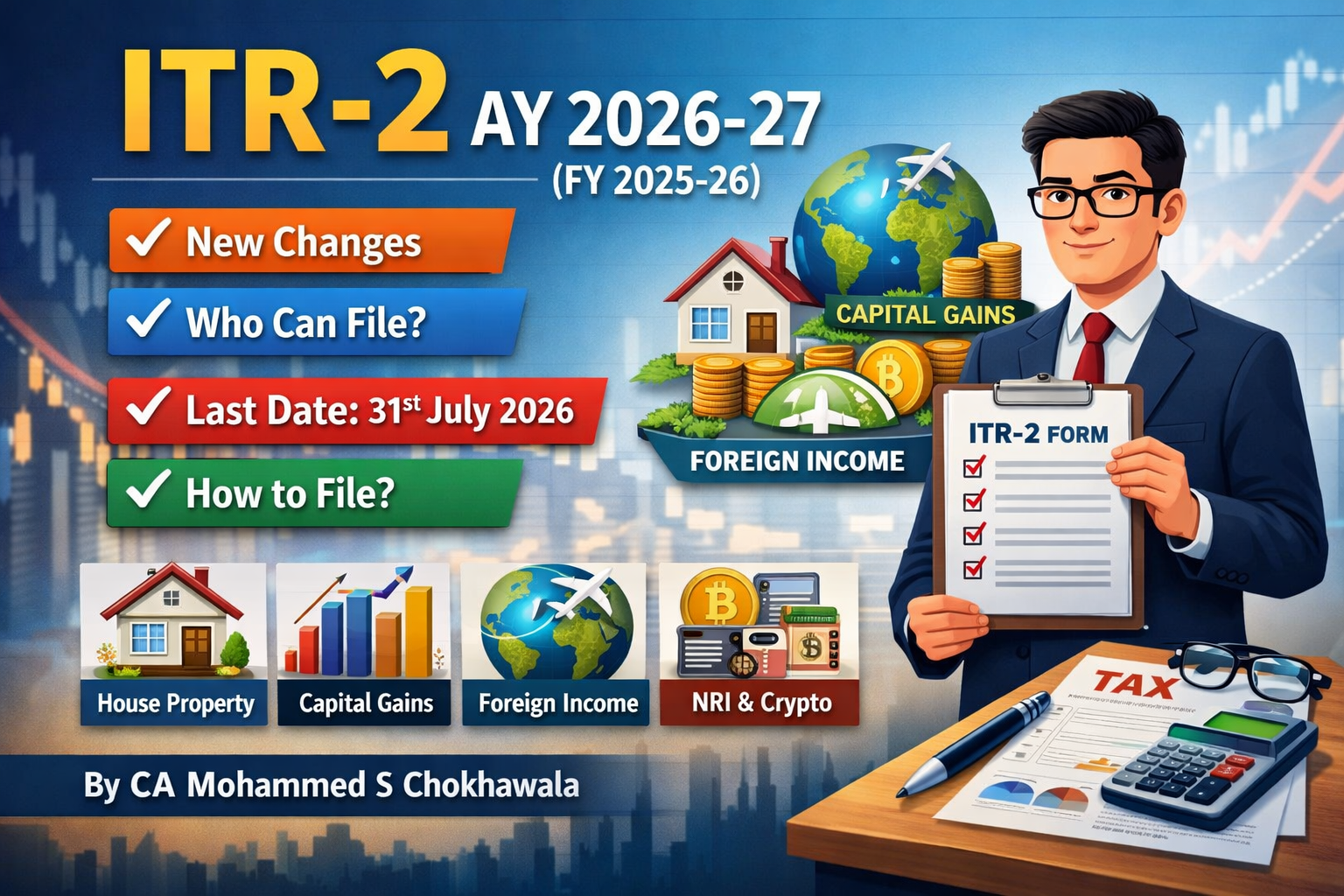
ITR-2 for AY 2026–27 (FY 2025–26)

By CA Ayush Rathor | Updated as per latest available changes (April 2026)


1. Overview – Where ITR-2 Fits Practically

ITR-2 is the default return form for individuals/HUFs who:

  • Do NOT have business/professional income (i.e., no income under Profits & Gains of Business or Profession)
  • But have complex income structures, such as:
    • Capital gains
    • Multiple house properties
    • Foreign assets/income
    • High-income cases (> ₹50 lakh)

👉 Professional View:
Whenever a case moves beyond the simplicity of ITR-1 (Sahaj), the migration typically happens to ITR-2 unless business income triggers ITR-3.


2. Key Changes in ITR-2 for AY 2026–27

(A) Rationalisation of Capital Gains Reporting

  • Earlier bifurcation:
    • Before 23 July 2024
    • After 23 July 2024

✅ Now removed

Practical Impact:

  • Simplifies reporting in Schedule CG
  • Reduces reconciliation complexity for:
    • Equity transactions
    • Real estate transactions

👉 CA Insight:
Earlier, this split created unnecessary compliance friction during audit trail verification and AIS reconciliation. Removal improves usability.


(B) Enhanced Disclosure for Donations (Section 80G)

  • Mandatory to report:
    • Transaction/Receipt Number
    • Donation reference details

📌 Legal Reference: Section 80G read with Rule 11AA

Practical Implication:

  • No more blanket deduction claims
  • Cross-verification with NGO filings (Form 10BD)

⚠️ Compliance Risk:

  • Mismatch between:
    • Donor claim (ITR)
    • Donee reporting (Form 10BD)
      → May lead to disallowance notices u/s 143(1)

(C) Removal of Rate-Specific Columns (CG Schedules)

  • Earlier explicit categories:
    • STCG @15% (Section 111A)
    • LTCG @10% (Section 112A)
    • LTCG @20% (Section 112)

✅ Now streamlined

Interpretation:

  • Backend computation logic retained
  • Front-end reporting simplified

👉 Conservative View for Practice:
Continue maintaining working papers classification-wise:

  • Section 111A
  • Section 112A
  • Section 112

3. Eligibility – Who Should File ITR-2

Covered Assessees:

Nature of IncomeRelevant Section
Salary/PensionSec 15–17
Multiple House PropertiesSec 22–27
Capital GainsSec 45
Other Sources (Lottery, etc.)Sec 56
Agricultural Income > ₹5,000Sec 10(1) (reporting requirement)
Foreign Income/AssetsFEMA + Income Tax
RNOR / Non-ResidentsSec 6

Special Mandatory Cases:

You must file ITR-2 if:

  • Director in a company
  • Investment in unlisted equity shares

👉 Even if income is otherwise simple.


Practical Illustration

Case 1:

  • Salary ₹18 lakh
  • LTCG ₹2 lakh (equity)

➡ Cannot use ITR-1 → ITR-2 mandatory


4. Who Cannot File ITR-2

❌ If income includes:

  • Business income (Sec 28)
  • Professional income

➡ Must shift to ITR-3


5. Due Date for AY 2026–27

  • Non-audit cases: 31st July 2026

📌 Legal Reference: Section 139(1)


Consequences of Delay

SectionImpact
Sec 234FLate fee up to ₹5,000
Sec 234AInterest on tax payable
Sec 139(4)Belated return restrictions

Practical Risk:

  • Loss carry forward disallowed (if filed late)
    👉 Especially relevant for:
  • Capital losses
  • House property losses

6. Structure of ITR-2 – Technical Breakdown

Part A – General Information

  • PAN, Aadhaar, residential status
  • Filing status (Original/Revised)

Core Income Schedules

SchedulePurpose
Schedule SSalary
Schedule HPHouse Property
Schedule CGCapital Gains
Schedule OSOther Sources

Capital Gains Special Schedules

  • Schedule 112A → Listed equity
  • Schedule 115AD (for NRIs)

Loss Adjustment Mechanism

ScheduleFunction
CYLACurrent year set-off
BFLABrought forward set-off
CFLCarry forward losses

Deductions

ScheduleSection
VIAChapter VI-A
80GDonations
80GGAScientific/Rural
80GGCPolitical contributions

Foreign & International Taxation

SchedulePurpose
FSIForeign income
TRForeign tax credit (Rule 128)
FAForeign assets disclosure

⚠️ High Risk Area:
Non-disclosure → scrutiny + penalty


High Net Worth Individuals

  • Schedule AL (Assets & Liabilities)

📌 Trigger: Income > ₹50 lakh


Special Computation Schedules

ScheduleSection
AMTSec 115JC
AMTCSec 115JD

Other Critical Schedules

  • Schedule SI → Special rate incomes
  • Schedule EI → Exempt income
  • Schedule VDA → Crypto taxation (Sec 115BBH)

7. Step-by-Step Filing Process (Practical Workflow)

Step 1: Data Collection

  • Form 16
  • AIS/TIS reconciliation
  • Capital gain statements (broker)
  • Interest certificates
  • Foreign asset details

Step 2: Reconciliation

  • Match:
    • AIS vs books
    • 26AS vs TDS claimed

Step 3: Capital Gains Working

  • Segregate:
    • STCG vs LTCG
    • Section-wise classification

Step 4: Deduction Validation

  • Ensure:
    • Proper documentation
    • Donation receipts with ARN

Step 5: Tax Computation

  • Normal vs special rate income
  • Apply:
    • Sec 112A
    • Sec 115BBH (crypto)

Step 6: Filing & Verification

  • File on income tax portal
  • Verify via:
    • Aadhaar OTP / EVC / DSC

8. Common Errors Observed in Practice

❌ Wrong ITR selection (ITR-1 instead of ITR-2)
❌ Ignoring AIS mismatches
❌ Incorrect capital gains classification
❌ Claiming 80G without valid receipt
❌ Non-disclosure of foreign assets


9. Best Practices (CA Advisory)

✔ Always prepare working papers before filing
✔ Maintain capital gain computation sheets
✔ Cross-check AIS, 26AS, broker statements
✔ Avoid aggressive deduction claims without documentation
✔ Use ITR-2 even voluntarily if complexity exists (risk mitigation)


10. Strategic Insight

ITR-2 is no longer just a compliance form—it is now a data-matching document:

  • AIS integration
  • NGO reporting (Form 10BD)
  • Foreign asset disclosures
  • Crypto tracking

👉 Conclusion (Professional View):
Accuracy, reconciliation, and documentation are now more critical than computation itself.

👉 Read our detailed guide on ITR-1 (Sahaj)

chatgpt image mar 19, 2026, 09 49 02 am

Dividend Income under Income Tax

📌 Introduction

Dividend income is one of the most common forms of passive income for investors. Under the Income Tax Act, dividend is taxable under the head “Income from Other Sources” as per Section 56(2)(i).

However, the definition of dividend under the Act is much wider than its general meaning. It includes not only normal dividends but also several “deemed dividends” under Section 2(22).

In this blog, we will break down the concept in a simple and practical manner.

📖 What is Dividend as per Income Tax?

As per Section 2(22), dividend includes:

(a) Distribution of Accumulated Profits

  • Any distribution by a company to shareholders
  • Whether profits are capitalised or not
  • If it involves release of company assets → treated as dividend

👉 Example:
If a company distributes assets instead of cash, the market value is treated as dividend.


(b) Distribution of Debentures / Bonus to Preference Shareholders

  • Distribution of:
    • Debentures
    • Deposit certificates
    • Bonus shares to preference shareholders

👉 Important:

  • Bonus shares to equity shareholders = NOT dividend
  • Value considered = Market value

(c) Distribution on Liquidation

  • Amount received during liquidation
  • To the extent of accumulated profits → taxable as dividend

👉 Note:

  • Post-liquidation payments = Capital receipt (not dividend)

(d) Distribution on Reduction of Capital

  • If capital is reduced and shareholders receive money
  • It is treated as dividend to the extent of accumulated profits

⚠️ (e) Deemed Dividend – Loans & Advances

This is the most important.

When is Loan treated as Dividend?

If:

  • Company is closely held (not public company)
  • Loan/advance is given to:
    • Shareholder holding ≥10% voting power, OR
    • A concern where such shareholder has ≥20% interest

👉 Then:
➡️ Loan is treated as dividend (to the extent of accumulated profits)


💡 Key Points:

  • Applies only to closely held companies
  • Taxable in hands of shareholder
  • Limited to accumulated profits

❌ Exceptions to Deemed Dividend

The following are NOT treated as dividend:

✔️ (i) Loan in Ordinary Course of Business

  • If lending is a substantial business activity
  • Then loan is NOT dividend

✔️ (ii) Inter-group Loans (Specific Conditions)

  • Between group entities under prescribed conditions

✔️ (iii) Set-off of Dividend

  • If loan is later adjusted against dividend → no double taxation

🧾 CBDT Clarification

As per CBDT Circular No. 19/2017:

👉 Trade advances (commercial transactions) are NOT treated as deemed dividend

Examples:

  • Advance for job work
  • Business-related payments
  • Security deposits in business transactions

➡️ If transaction is commercial in nature, Section 2(22)(e) does NOT apply.


❌ Transactions NOT Treated as Dividend

  • Distribution on demerger
  • Shares issued for full cash consideration
  • Certain non-participating shares

📊 Meaning of “Accumulated Profits”

Accumulated profits include:

  • All profits up to the date of distribution

Special Points:

  • Includes capitalised profits
  • Excludes depreciation reserves (as per case law)
  • In amalgamation → includes profits of amalgamating company

📅 Basis of Taxation (Section 8)

Dividend is taxable in the year:

  • When declared OR
  • Distributed OR
  • Paid

👉 Whichever is applicable


⚡ Tax Rate on Dividend

  • Taxable at normal slab rates
  • Applicable for both:
    • Domestic dividend
    • Foreign dividend

📘 Practical Illustrations

✅ Illustration 1 (Trade Advance Case)

  • Dhaval holds 65% shares in a company
  • Company gives advance for job work

👉 Since it is a business transaction,
➡️ NOT treated as deemed dividend


✅ Illustration 2 (Loan Case)

  • Shareholder holds 15% shares
  • Loan received = ₹1,00,000
  • Accumulated profits = ₹10,00,000

👉 Entire ₹1,00,000 is:
➡️ Taxable as deemed dividend

👉 Even if loan is repaid later:
➡️ Still taxable


🧠 Key Takeaways

✔ Dividend is taxable under Income from Other Sources
✔ Definition is very wide under Section 2(22)
✔ Loans to major shareholders = deemed dividend
✔ Trade advances = NOT dividend
✔ Taxable at normal slab rates


🔍 Conclusion

Understanding dividend taxation is crucial for:

  • Investors
  • Business owners

The concept of deemed dividend under Section 2(22)(e) is particularly important as it prevents tax avoidance through loans instead of dividend distribution.

Proper classification of transactions (loan vs business advance) can significantly impact tax liability.

👉 If you also earn income from property, make sure to read our guide on Income Tax on Rental Income in India to understand its tax implications.

chatgpt image mar 11, 2026, 03 08 53 pm

What is Form 16 and Why It Matters

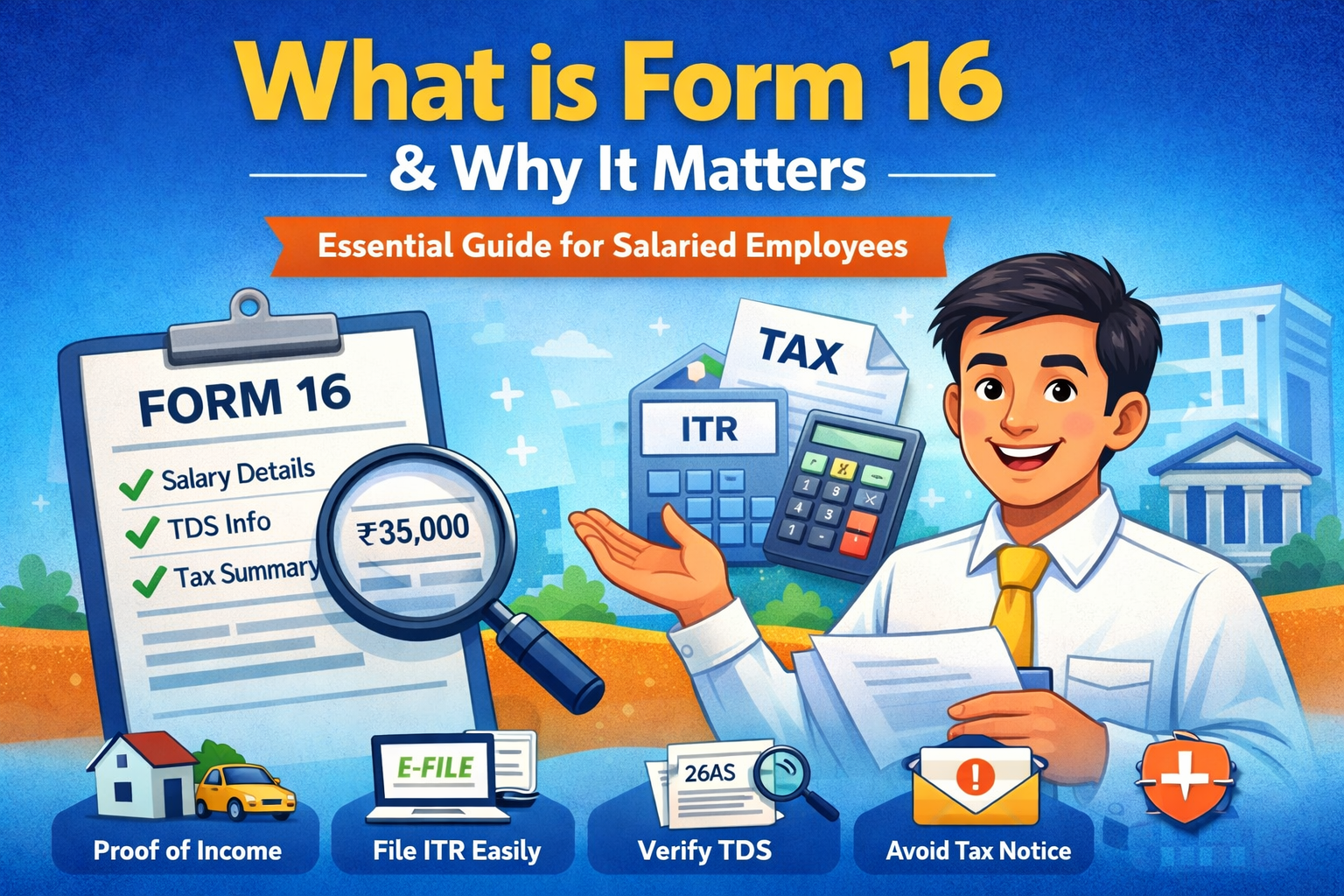
If you are a salaried employee in India, Form 16 is one of the most important tax documents you will receive from your employer. It helps you file your Income Tax Return (ITR) and verify how much tax has already been deducted from your salary.

Let’s understand it in simple terms.


What is Form 16?

Form 16 is a TDS certificate issued by an employer to a salaried employee.

It shows:

  • Total salary paid during the financial year
  • Tax deducted at source (TDS) by the employer
  • Tax deposited to the government on your behalf

It is issued under Section 203 of the Income Tax Act.

👉 In simple words:
Form 16 is proof that your employer deducted tax from your salary and paid it to the government.


Who Issues Form 16?

Your employer issues Form 16 to you if:

  • Your salary crosses the taxable limit
  • The employer deducts TDS from your salary

It is usually issued after the financial year ends, generally by June 15.


Parts of Form 16

Form 16 has two main parts.

Part A – TDS Details

Part A contains:

  • Employer PAN & TAN
  • Employee PAN
  • Tax deducted and deposited
  • Summary of TDS

This part confirms that the tax deducted from your salary was deposited with the government.


Part B – Salary Breakdown

Part B contains:

  • Salary structure
  • Allowances (HRA, LTA, etc.)
  • Deductions (80C, 80D etc.)
  • Taxable income
  • Final tax calculation

This section helps you understand how your tax was calculated.


Why Form 16 Matters

1️⃣ Helps You File ITR Easily

Form 16 contains most of the information required to file your Income Tax Return.

You can simply copy the details while filing your return.


2️⃣ Proof of Income

Form 16 is accepted as official proof of income when applying for:

  • Loans
  • Credit cards
  • Visa applications
  • Renting houses

3️⃣ Verifies Tax Paid

It helps confirm that your employer has correctly deducted and deposited your tax.

You can cross-check it with your Form 26AS or AIS.


4️⃣ Avoid Tax Notices

Using Form 16 ensures that your ITR matches government records, reducing the chances of receiving an income tax notice.


What If You Don’t Receive Form 16?

You can still file your ITR using:

  • Salary slips
  • Bank statements
  • Form 26AS
  • AIS (Annual Information Statement)

Form 16 only makes filing easier, but it is not mandatory to file ITR.


Common Mistakes People Make with Form 16

❌ Not checking PAN details
❌ Ignoring deductions mentioned in Form 16
❌ Not matching it with Form 26AS
❌ Filing wrong ITR form

Always verify the details before filing your tax return.


Final Thoughts

Form 16 is one of the most important documents for salaried employees. It provides a complete summary of your salary, deductions, and taxes paid during the financial year.

Understanding your Form 16 helps you:

  • File your ITR accurately
  • Claim deductions correctly
  • Avoid tax notices

✅ Pro Tip:
Always download your Form 26AS and AIS and compare them with your Form 16 before filing your return.

chatgpt image mar 10, 2026, 10 12 45 pm

How to Calculate HRA

House Rent Allowance (HRA) is a part of the salary given by employers to employees to help them pay house rent. The good news is that a portion of HRA can be tax-free under the Income Tax Act if you live in a rented house.

Let’s understand HRA in very simple language with a practical salary example.


What is HRA?

House Rent Allowance (HRA) is an allowance given by your employer to cover your rent expenses.

If you live in a rented house, part of the HRA becomes tax-exempt, which means you don’t have to pay tax on that amount.

But if you live in your own house, the entire HRA becomes taxable.


Conditions to Claim HRA

You can claim HRA tax exemption only if:

✔ You receive HRA in your salary
✔ You pay rent for accommodation
✔ You live in a rented house

If rent paid is more than ₹1 lakh per year, you must provide the landlord’s PAN.


How HRA Exemption is Calculated

The tax-free HRA amount is the minimum of the following three values:

1️⃣ Actual HRA received from employer
2️⃣ 50% of salary (if living in metro city) OR 40% of salary (non-metro)
3️⃣ Rent paid – 10% of salary

Salary here means Basic Salary + Dearness Allowance (DA).


Practical Salary Slip Example

Let’s understand this with a real-life example.

Salary Structure

Salary ComponentAmount
Basic Salary₹40,000
HRA₹20,000
Other Allowances₹15,000
Total Salary₹75,000

Assume:

  • City: Delhi (Metro City)
  • Monthly Rent: ₹18,000

Step-by-Step HRA Calculation

Step 1 – Actual HRA Received

HRA received = ₹20,000 per month

Yearly HRA = ₹2,40,000


Step 2 – 50% of Salary (Metro)

Salary for HRA calculation = Basic Salary

Basic Salary = ₹40,000 per month

50% of salary = ₹20,000

Yearly = ₹2,40,000


Step 3 – Rent Paid minus 10% of Salary

Rent paid yearly

₹18,000 × 12 = ₹2,16,000

10% of salary

Salary yearly = ₹40,000 × 12 = ₹4,80,000

10% of salary = ₹48,000

Now calculate:

₹2,16,000 – ₹48,000 = ₹1,68,000


HRA Exemption

Minimum of the three:

  • Actual HRA = ₹2,40,000
  • 50% of salary = ₹2,40,000
  • Rent – 10% salary = ₹1,68,000

✅ Tax-free HRA = ₹1,68,000


Taxable HRA

Total HRA received = ₹2,40,000
Tax-free HRA = ₹1,68,000

Taxable HRA = ₹72,000

This ₹72,000 will be added to your taxable income.


Important Tips for Salaried Employees

✔ Always keep rent receipts
✔ If rent exceeds ₹50,000 per month, TDS must be deducted under Section 194IB
✔ If you live with parents and pay rent, you can still claim HRA
✔ HRA cannot be claimed if you choose the new tax regime


Common Mistake People Make

Many salaried employees claim full HRA as exemption, which is incorrect.

The exemption must always be calculated using the three-condition formula mentioned above.


Conclusion

HRA is one of the biggest tax-saving benefits for salaried employees living in rented houses. By properly calculating HRA, you can significantly reduce your taxable income and save tax legally.

Understanding your salary structure and rent payments is the key to maximizing this benefit.

If you want to reduce your tax further, you should also explore other tax saving options for salaried employees.

chatgpt image mar 9, 2026, 10 57 49 am

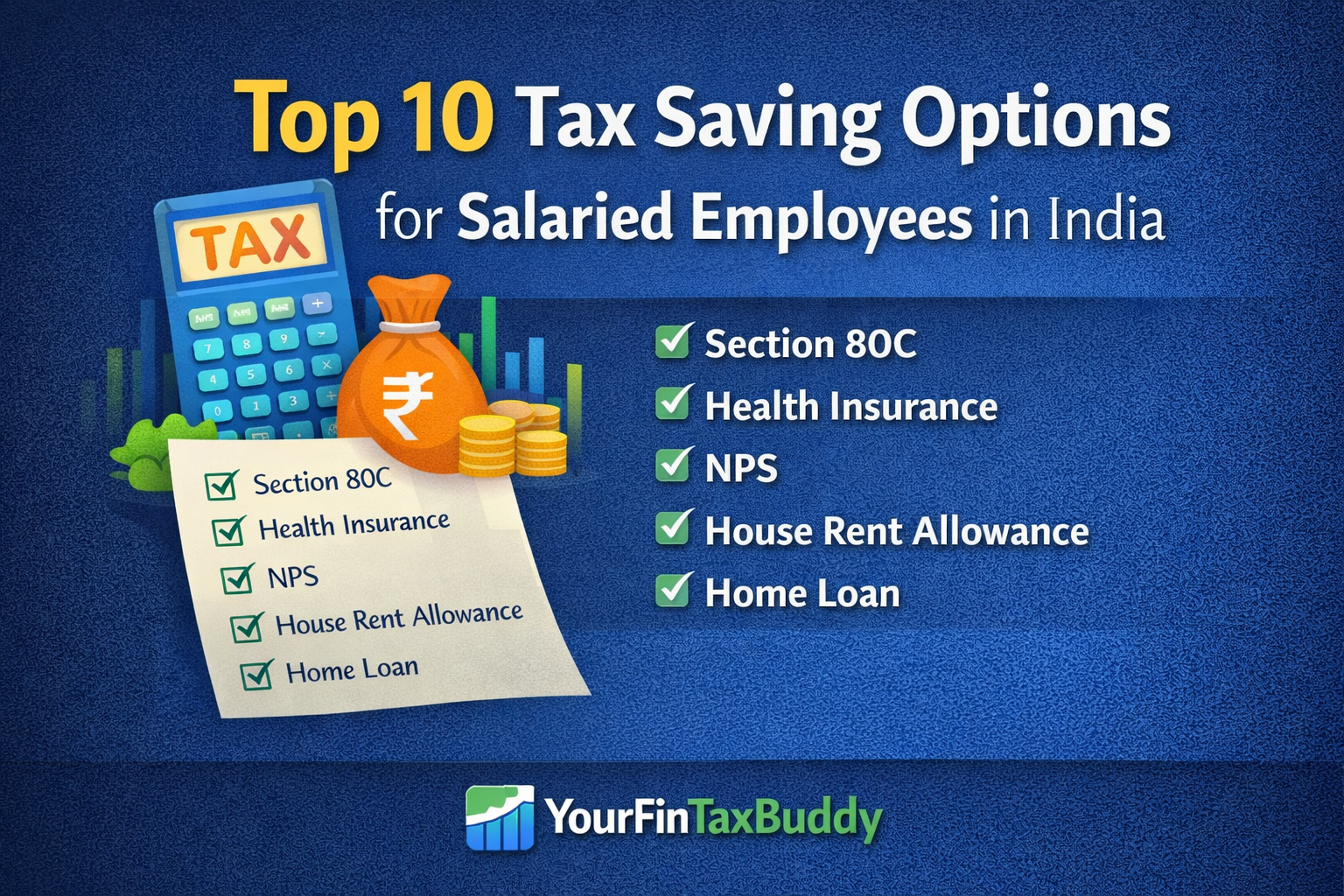
Top 10 Tax Saving Options for Salaried Employees

Many salaried employees feel that a large portion of their salary goes toward paying income tax. However, the Indian Income Tax Act provides several deductions and exemptions that can legally reduce your tax liability.

With proper tax planning, salaried individuals can save a significant amount of money every year.

In this article, we will explain the Top 10 Tax Saving Options for Salaried Employees in India in simple language with examples.


1. Section 80C – Tax Deduction up to ₹1.5 Lakh

Section 80C is one of the most commonly used tax-saving sections in India. Under this section, you can claim deductions for certain investments and expenses.

The maximum deduction allowed under Section 80C is ₹1,50,000 per financial year.

Popular investments under Section 80C:

• Public Provident Fund (PPF)
• Employee Provident Fund (EPF)
• Equity Linked Saving Scheme (ELSS)
• Life Insurance Premium
• National Savings Certificate (NSC)
• 5-Year Tax Saving Fixed Deposit
• Sukanya Samriddhi Yojana
• Tuition Fees for Children
• Principal repayment of home loan

Example

If your taxable income is ₹10 lakh and you invest ₹1.5 lakh under Section 80C, your taxable income reduces to ₹8.5 lakh.

This can significantly reduce your tax liability.


2. Health Insurance Deduction – Section 80D

Medical expenses are rising every year, and health insurance is becoming essential. The government provides tax benefits for health insurance premiums under Section 80D.

Deduction limits:

• Self, spouse and children: up to ₹25,000
• Parents (below 60 years): up to ₹25,000
• Parents (above 60 years): up to ₹50,000

Maximum deduction possible

A person paying insurance for self and senior citizen parents can claim up to ₹75,000 deduction.

This not only helps reduce tax but also provides financial security during medical emergencies.


3. National Pension System (NPS) – Section 80CCD(1B)

The National Pension System (NPS) is a government-backed retirement savings scheme. It offers an additional tax benefit of ₹50,000, which is over and above the Section 80C limit.

Key benefits of NPS:

• Additional deduction of ₹50,000
• Long-term retirement savings
• Market-linked returns
• Low-cost investment

Example

If you invest ₹50,000 in NPS, your taxable income reduces further after claiming Section 80C deductions.


4. House Rent Allowance (HRA)

If you live in a rented house and receive HRA as part of your salary, you can claim tax exemption on HRA.

The exemption depends on three factors:

• Basic salary
• Rent paid
• City of residence (metro or non-metro)

HRA exemption is the lowest of:

  1. Actual HRA received
  2. 50% of salary (metro cities) or 40% (non-metro)
  3. Rent paid minus 10% of salary

Example

If you pay rent of ₹20,000 per month and receive HRA, you may get a significant tax exemption.


5. Home Loan Interest – Section 24

If you have taken a home loan to buy or construct a house, you can claim deduction on the interest paid on the loan.

Maximum deduction allowed:

₹2,00,000 per year for self-occupied property.

Example

If you pay ₹2 lakh interest on your home loan, you can reduce your taxable income by that amount.

This is one of the biggest tax-saving opportunities for homeowners.


6. Principal Repayment of Home Loan – Section 80C

Apart from interest deduction, the principal portion of your home loan repayment also qualifies for deduction under Section 80C.

However, this deduction is included within the ₹1.5 lakh limit of Section 80C.

This means home loan EMI can help you claim deductions under two sections simultaneously.


7. Leave Travel Allowance (LTA)

Leave Travel Allowance allows salaried employees to claim tax exemption for travel expenses during vacations.

Conditions:

• Travel must be within India
• Only travel cost is covered (not hotel or food)
• Available for two journeys in four years

This benefit is usually provided by employers as part of the salary package.


8. Standard Deduction for Salaried Employees

The government provides a standard deduction of ₹50,000 to salaried individuals and pensioners.

The best part is that no investment or proof is required to claim this deduction.

This deduction automatically reduces your taxable income.


9. Education Loan Interest – Section 80E

If you have taken an education loan for higher studies, you can claim deduction on the interest paid.

Key points:

• No upper limit on deduction
• Available for 8 years
• Applicable for higher education loans

This deduction helps individuals manage the financial burden of education loans.


10. Donations – Section 80G

Donations made to certain charitable institutions are eligible for tax deductions under Section 80G.

Deduction available:

• 50% deduction
• 100% deduction (depending on the institution)

To claim this deduction, the donation must be made to approved organizations and proper receipts must be maintained.


Final Thoughts

Tax saving is not about making random investments at the end of the financial year. The best approach is to plan your taxes at the beginning of the year so that you can choose investments that match your financial goals.

Proper tax planning can help you:

• Reduce your tax liability legally
• Build long-term wealth
• Achieve financial security


✅ If you need help with tax planning, income tax filing, or GST services, feel free to connect with YourFinTaxBuddy.

You can also read our detailed guide on Section 80C deductions to understand all eligible tax-saving investments.

chatgpt image mar 6, 2026, 11 07 52 pm

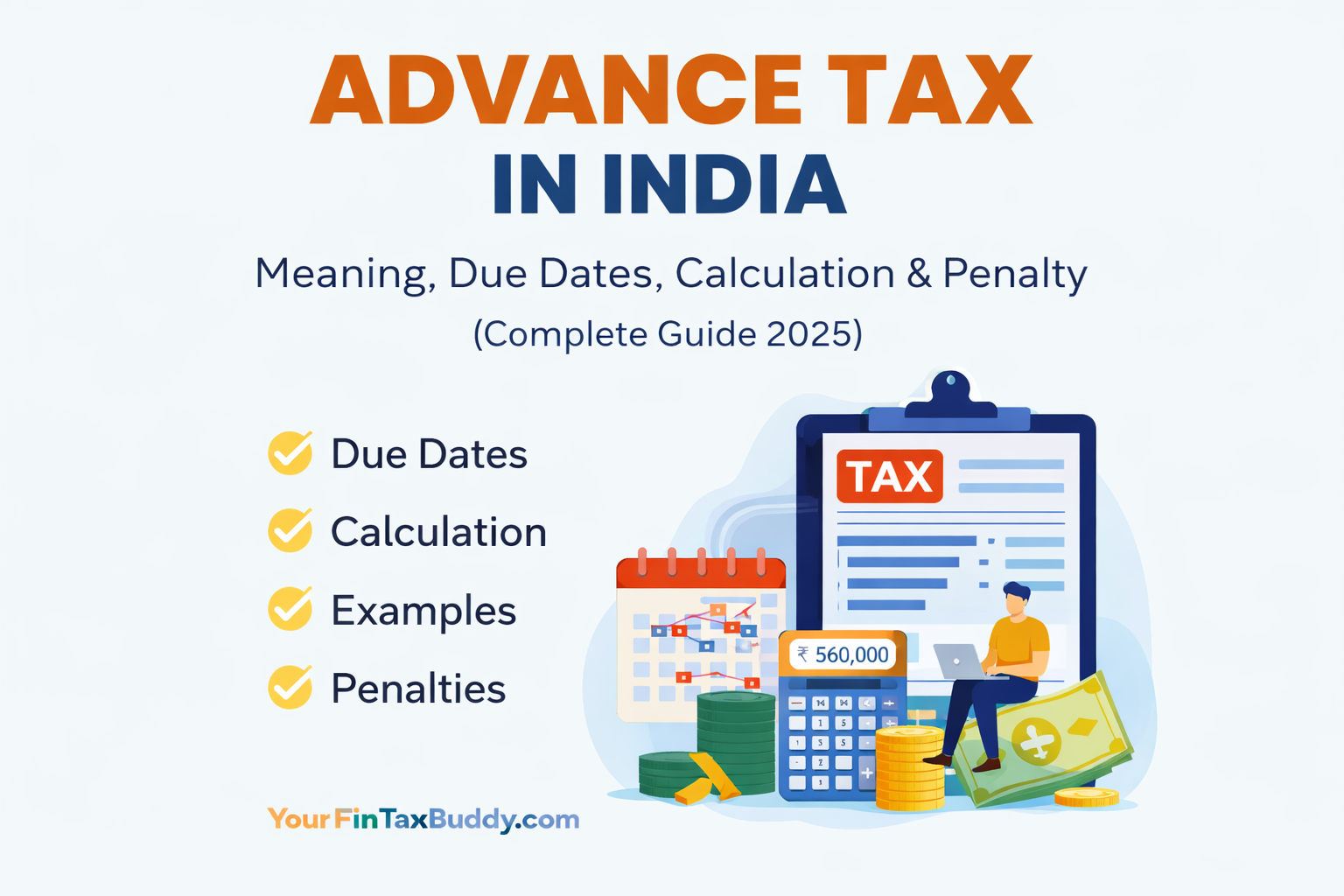
Advance Tax in India – Meaning, Due Dates, Calculation & Penalty (Complete Guide)

What is Advance Tax?

Advance tax means paying income tax during the financial year itself instead of paying the entire tax at the end of the year.

Normally, tax is paid when filing the Income Tax Return. But if your total tax liability in a financial year is ₹10,000 or more, the Income Tax Act requires you to pay tax in instalments during the year. This is called Advance Tax.

Because of this system, the government receives tax regularly instead of waiting until the end of the year.

Advance tax is also known as “Pay As You Earn Tax.”


Who Needs to Pay Advance Tax?

You must pay advance tax if:

✔ Your total tax liability is ₹10,000 or more in a financial year.

Advance tax applies to:

  • Salaried employees (if tax liability remains after TDS)
  • Freelancers
  • Business owners
  • Professionals (CA, doctor, lawyer etc.)
  • Investors earning capital gains
  • Individuals earning rental income
  • People earning interest income

Example

Rahul works in a company and also earns ₹3,00,000 from freelance work.

His total tax liability becomes ₹45,000 after deductions.

Since his tax liability is more than ₹10,000, he must pay advance tax.


Who is NOT Required to Pay Advance Tax?

1️⃣ Senior Citizens

A resident senior citizen (age 60 years or more) does not have to pay advance tax if:

  • They do not have business or professional income

Example:

Mr. Sharma (age 65) earns:

  • Interest income: ₹5,00,000
  • Pension: ₹3,00,000

He does not need to pay advance tax.


2️⃣ Presumptive Taxation (Section 44AD / 44ADA)

Businesses or professionals using presumptive taxation scheme:

  • They can pay entire advance tax in one instalment by 15 March.

Example:

A consultant declaring income under Section 44ADA can pay 100% advance tax by 15 March.


Advance Tax Due Dates

Advance tax must be paid in four instalments during the year.

Due DateTax Payable
15 JuneAt least 15% of total tax
15 SeptemberAt least 45% of total tax
15 DecemberAt least 75% of total tax
15 March100% of total tax

Any advance tax paid up to 31 March is still considered advance tax.


Advance Tax Example

Let’s understand with a simple example.

Suppose your total tax liability for the year is ₹1,00,000.

You will pay tax like this:

DateAmount
15 June₹15,000
15 September₹30,000
15 December₹30,000
15 March₹25,000

Total = ₹1,00,000


How to Calculate Advance Tax

Follow these steps:

Step 1

Estimate your total income for the year

Include income from:

  • Salary
  • Business
  • Freelancing
  • Rent
  • Capital gains
  • Interest income

Step 2

Subtract deductions

Example:

  • Section 80C
  • Section 80D
  • Section 80G etc.

Step 3

Calculate income tax as per applicable slab.


Step 4

Reduce:

  • TDS already deducted
  • TCS
  • Relief under sections 89/90/91

The remaining tax is advance tax payable.


Example of Advance Tax Calculation

Suppose Neha has the following income:

Salary: ₹8,00,000
Freelance income: ₹4,00,000

Total income = ₹12,00,000

She claims deduction under Section 80C = ₹1,50,000

Taxable income = ₹10,50,000

Tax liability ≈ ₹1,12,500

TDS deducted by employer = ₹70,000

Remaining tax = ₹42,500

Since this amount is above ₹10,000, she must pay advance tax.


How to Pay Advance Tax Online

You can pay advance tax through the Income Tax Portal.

Steps:

1️⃣ Visit the Income Tax e-filing portal
2️⃣ Go to e-Pay Tax
3️⃣ Select Advance Tax (Challan 280)
4️⃣ Enter PAN and details
5️⃣ Choose Assessment Year
6️⃣ Pay through net banking / UPI / debit card

After payment, keep the challan receipt safely.


Interest for Non-Payment of Advance Tax

If advance tax is not paid properly, interest may be charged under:

  • Section 234B
  • Section 234C

Interest Under Section 234B

This interest is charged when:

  • Advance tax not paid, OR
  • Advance tax paid is less than 90% of total tax liability

Interest Rate:

1% per month or part of month

Example

Total tax liability = ₹1,00,000
Advance tax paid = ₹50,000

Shortfall = ₹50,000

Interest will be charged from 1 April until payment.


Interest Under Section 234C

This interest is charged when advance tax instalments are not paid on time.

Interest rate:

1% per month

Example:

Suppose tax liability = ₹1,00,000

But by 15 September you paid only ₹20,000 instead of ₹45,000.

Shortfall = ₹25,000

Interest will be charged on ₹25,000.


When Interest Under 234C is NOT Applicable

Interest may not apply if shortfall is due to:

  • Capital gains
  • Lottery income
  • Dividend income
  • New business income

Provided the tax is paid in remaining instalments or by 31 March.


Interest for Late Filing of Return (Section 234A)

If you file your Income Tax Return after the due date, interest will apply.

Interest Rate:

1% per month

It is charged on unpaid tax amount.


Benefits of Paying Advance Tax

Paying advance tax on time helps you:

✔ Avoid heavy interest and penalties
✔ Manage tax payments easily
✔ Reduce financial burden at year end
✔ Stay compliant with tax laws


Common Mistakes People Make

❌ Ignoring freelance or side income
❌ Forgetting capital gains tax
❌ Not adjusting TDS
❌ Paying advance tax only in March
❌ Wrong income estimation


Conclusion

Advance tax is an important part of India’s tax system. If your tax liability exceeds ₹10,000, you must pay tax during the year in instalments.

Paying advance tax on time helps you avoid interest under Sections 234B and 234C and ensures smooth tax compliance.

If you have multiple income sources like freelancing, rent, or investments, always estimate your tax liability early and pay advance tax accordingly.


Frequently Asked Questions (FAQs)

Is advance tax mandatory?

Yes, if your tax liability is ₹10,000 or more in a financial year.


Do salaried employees need to pay advance tax?

Usually no, because employers deduct TDS.
But if you have additional income, you may need to pay advance tax.


What happens if I miss an advance tax instalment?

Interest will be charged under Section 234C.


Can advance tax be paid after 15 March?

Yes. Any tax paid before 31 March is treated as advance tax.


Can advance tax be revised?

Yes. You can revise advance tax payments based on updated income estimates.

...
WhatsApp Chat with us!