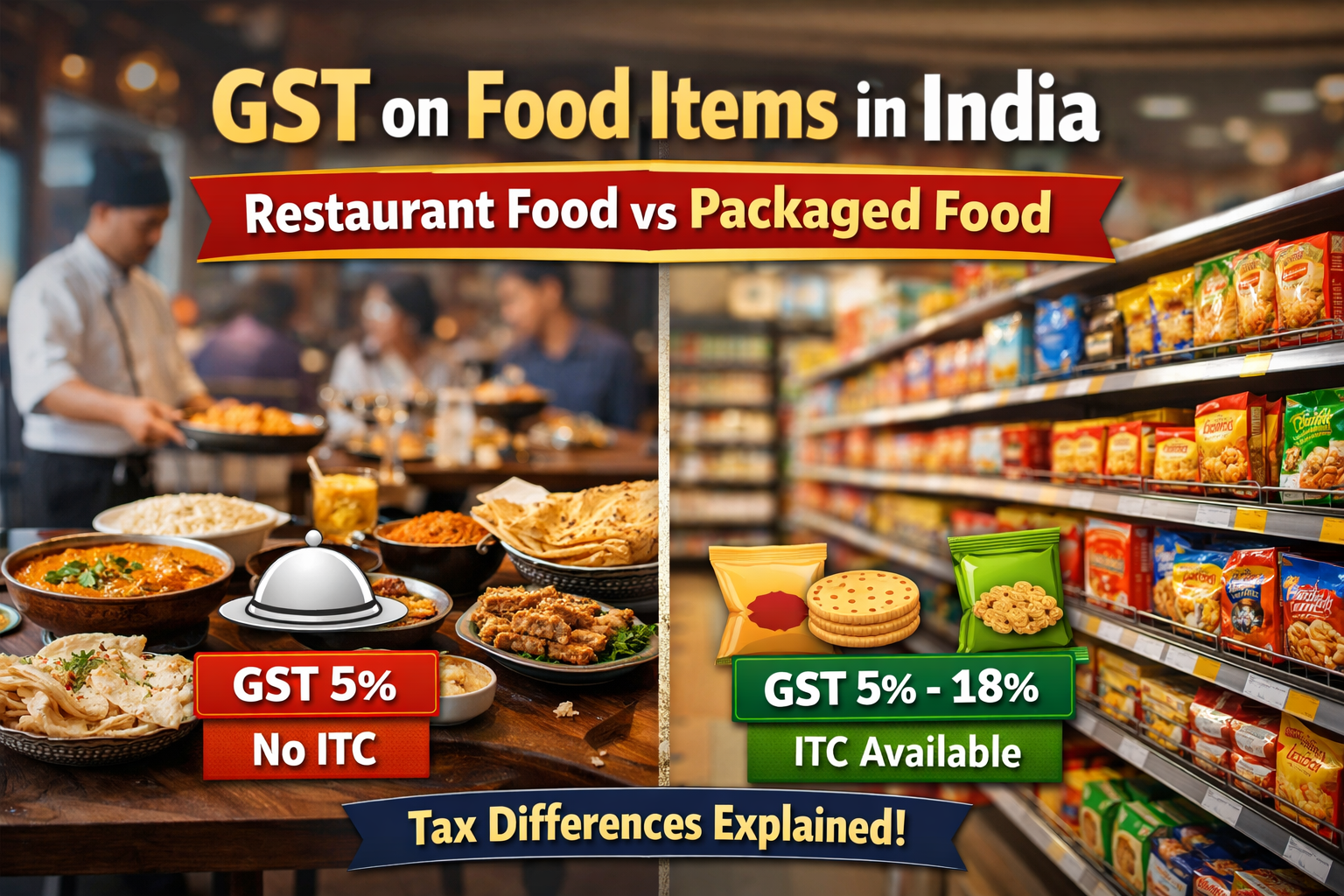
Food is one of the most common expenses for individuals and families in India. However, the GST rate on food items depends on how the food is supplied — whether it is served in a restaurant or sold as packaged food in shops or supermarkets.
Understanding this distinction is important because the GST rate, input tax credit (ITC), and compliance requirements vary significantly.
In this blog, we explain the GST treatment of restaurant food vs packaged food in India in a simple and practical manner.
1. GST on Food Served in Restaurants
Under GST, restaurants are treated as service providers because they provide not just food but also ambience, seating, service, and other facilities.
GST Rate on Restaurant Food
| Type of Restaurant | GST Rate | Input Tax Credit |
|---|---|---|
| Regular Restaurants | 5% | Not Allowed |
| AC / Non-AC Restaurants | 5% | Not Allowed |
| Restaurants in Hotels (Room tariff below ₹7,500) | 5% | Not Allowed |
| Restaurants in Hotels (Room tariff above ₹7,500) | 18% | Allowed |
Key Points
• Most restaurants charge 5% GST without ITC.
• This rule was introduced to simplify taxation and reduce compliance.
• Customers normally see GST included in the restaurant bill.
• Restaurants cannot claim ITC on raw materials or services used in preparing food when taxed at 5%.
Example
If you dine at a restaurant and the bill amount is:
Food Bill = ₹1,000
GST @ 5% = ₹50
Total Payable = ₹1,050
2. GST on Packaged Food Items
Packaged food refers to pre-packed food items sold in sealed packages such as:
• Biscuits
• Namkeen
• Packaged sweets
• Chips
• Instant noodles
• Ready-to-eat food
These are treated as supply of goods, not services.
GST Rates on Common Packaged Food
| Food Item | GST Rate |
|---|---|
| Packaged & labelled food grains | 5% |
| Biscuits | 18% |
| Namkeen / Bhujia | 12% |
| Chocolates | 18% |
| Ready-to-eat packaged food | 12% or 18% |
Important Update
Since July 2022 GST changes, even pre-packaged and labelled food items such as:
- Wheat flour
- Rice
- Pulses
are taxable at 5% GST, whereas earlier many of them were exempt.
3. Restaurant Food vs Packaged Food – GST Comparison
| Particulars | Restaurant Food | Packaged Food |
|---|---|---|
| Nature of Supply | Service | Goods |
| GST Rate | Mostly 5% | 5% – 18% |
| Input Tax Credit | Not allowed (generally) | Allowed |
| Billing | Restaurant bill | Product MRP invoice |
| Packaging | Prepared & served | Pre-packed |
4. Why GST Rates Are Different
The government differentiates between these two because:
1️⃣ Restaurants provide services like seating, staff, and ambience.
2️⃣ Packaged food is a manufactured product.
3️⃣ Input tax credit availability differs to balance tax revenue.
This classification ensures that the GST system treats goods and services appropriately.
5. Practical Examples
Example 1 – Eating in a Restaurant
A family eats at a restaurant and their food bill is ₹2,000.
GST @ 5% = ₹100
Total Bill = ₹2,100
Example 2 – Buying Packaged Food
You buy packaged biscuits worth ₹100.
GST @ 18% = ₹18
Total Price = ₹118
Conclusion
The GST on food items in India depends on the nature of supply. Food served in restaurants is taxed as a service at 5% without ITC, while packaged food items are treated as goods and can attract GST ranging from 5% to 18% with input tax credit available.
For businesses, correctly classifying the supply as restaurant service or packaged goods is essential to ensure proper GST compliance and avoid disputes with tax authorities.
Also Read:
GST on Freelancers and Content Creators in India


Leave a Reply