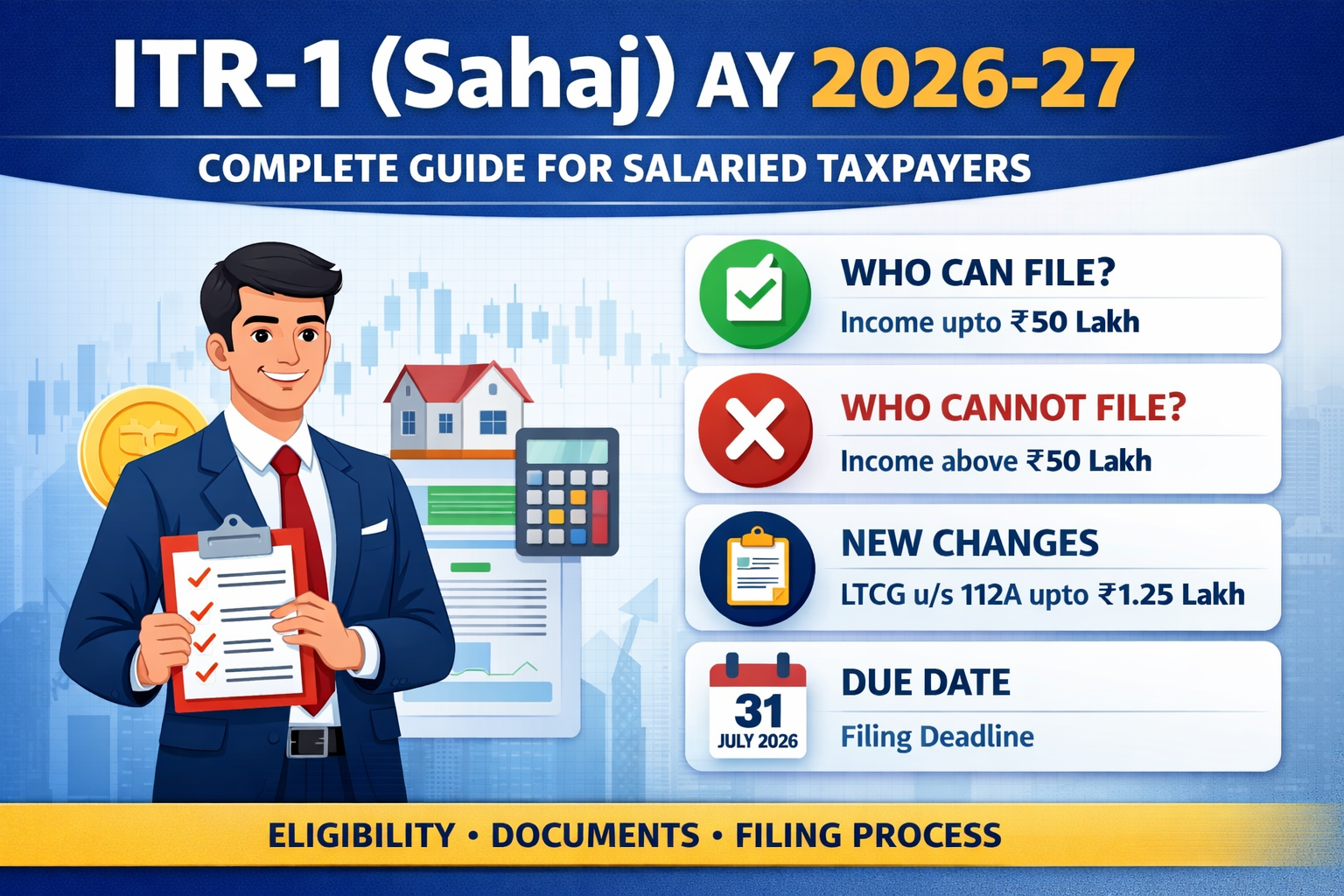
Eligibility | Latest Changes | Due Dates | Filing Strategy
By CA Ayush Rathor
📌 Overview
For most salaried individuals in India, ITR-1 (Sahaj) remains the primary return form. However, despite its simplicity, incorrect selection or incomplete reporting can result in defective returns under Section 139(9) and unnecessary compliance exposure.
For FY 2025-26 (AY 2026-27), certain key modifications have expanded the scope of ITR-1, making it essential to reassess eligibility before filing.
🔍 What is ITR-1 (Sahaj)?
ITR-1 is prescribed for resident individuals having total income up to ₹50 lakh with limited and straightforward sources of income.
Permissible Income Heads:
- Income from Salary or Pension
- Income from House Property (up to 2 houses)
- Income from Other Sources (interest, family pension, etc.)
- Agricultural income up to ₹5,000
- Long-Term Capital Gains under Section 112A up to ₹1.25 lakh (without carry forward/set-off of loss)
👉 Practically, ITR-1 should be used only where income structure is clean, linear, and non-litigious.
🚨 Key Changes in AY 2026-27
The following updates are significant from a compliance standpoint:
1. Inclusion of LTCG u/s 112A (Up to ₹1.25 lakh)
- Earlier restriction has been relaxed
- Now small equity investors can continue using ITR-1
- Condition: No brought forward or current year capital loss
2. Reporting of Two House Properties
- Earlier practical limitation removed
- Both self-occupied or let-out properties can now be reported
3. Removal of Foreign Retirement Income Reporting
- Simplifies compliance for salaried individuals with overseas retirement components
4. Alignment with Revised Capital Gains Framework
- Updated as per latest taxation rules applicable to listed securities
✅ Eligibility Criteria (Practical View)
You should opt for ITR-1 if ALL the following conditions are satisfied:
| Particulars | Condition |
|---|---|
| Residential Status | Resident Individual |
| Total Income | ≤ ₹50 lakh |
| House Property | Max. 2 |
| Capital Gains | Only LTCG u/s 112A up to ₹1.25 lakh |
| Agricultural Income | ≤ ₹5,000 |
| Other Income | Interest / family pension |
💡 Professional Insight:
Even if technically eligible, avoid ITR-1 where:
- Multiple adjustments are required
- AIS/TIS shows complex transactions
- There is any interpretational ambiguity
❌ Non-Eligibility (Critical Triggers)
ITR-1 must NOT be used in the following cases:
- Income exceeding ₹50 lakh
- Any business or professional income
- Director in a company (mandatory disclosure requirement)
- Holding unlisted equity shares
- Foreign assets / foreign income (Schedule FA applicability)
- Capital gains other than permitted LTCG
- Income from Virtual Digital Assets (Section 115BBH)
- Claim of relief under Sections 90 / 90A / 91
- Agricultural income exceeding ₹5,000
⚠️ Compliance Risk:
Wrong selection of ITR form may result in:
- Defective return notice u/s 139(9)
- Delay in refund
- Increased scrutiny risk
📅 Due Dates – AY 2026-27
| Particulars | Due Date |
|---|---|
| Original Return (Non-audit) | 31 July 2026 |
| Belated Return | 31 December 2026 |
Late Filing Consequences:
- Late fee u/s 234F: Up to ₹5,000
- Interest u/s 234A/B/C on tax liability
📂 Documentation Checklist
Ensure the following before initiating filing:
- Form 16 (Salary details)
- Form 26AS (TDS reconciliation)
- AIS & TIS (transaction-level verification)
- PAN & Aadhaar
- Bank account details (pre-validated)
- Deduction proofs:
- Section 80C (PF, LIC, ELSS, etc.)
- Section 80D (Mediclaim)
- HRA computation
- Housing loan interest certificate
⚙️ Filing Process (Condensed Workflow)
- Login to Income Tax Portal
- Select AY 2026-27 → File Return
- Choose ITR-1 (Sahaj)
- Auto-import data (Form 16, AIS)
- Validate income & deductions
- Compute tax liability
- Submit return
- Complete e-verification (mandatory)
📊 Practical Illustration
Case:
- Salary Income: ₹12,00,000
- Interest Income: ₹80,000
- LTCG u/s 112A: ₹1,10,000
- One self-occupied + one let-out property
👉 Eligible for ITR-1 since:
- Total income < ₹50 lakh
- LTCG within ₹1.25 lakh
- Only 2 house properties
- No losses
⚠️ Common Errors to Avoid
- Not reporting savings bank interest
- Ignoring AIS/TIS discrepancies
- Claiming deductions without documentation
- Using ITR-1 despite capital losses
- Incorrect house property reporting
💡 Professional Conclusion
ITR-1 is a convenience-based form, not a default choice.
Selection must be based on eligibility, accuracy, and risk assessment.
✔️ Validate data with AIS/TIS
✔️ Ensure correct head-wise reporting
✔️ Avoid aggressive or unsupported claims
📣 Advisory
Where income structure involves even moderate complexity, it is advisable to shift to ITR-2 instead of forcing ITR-1 eligibility.
👉 “Before filing your ITR-1, it is essential to understand how your salary tax is calculated. Read our detailed guide on TDS on Salary under Section 192 to ensure accurate reporting and avoid mismatches.”


Leave a Reply