By CA Ayush Rathor | Updated as per latest available changes (April 2026)
1. Overview – Where ITR-2 Fits Practically
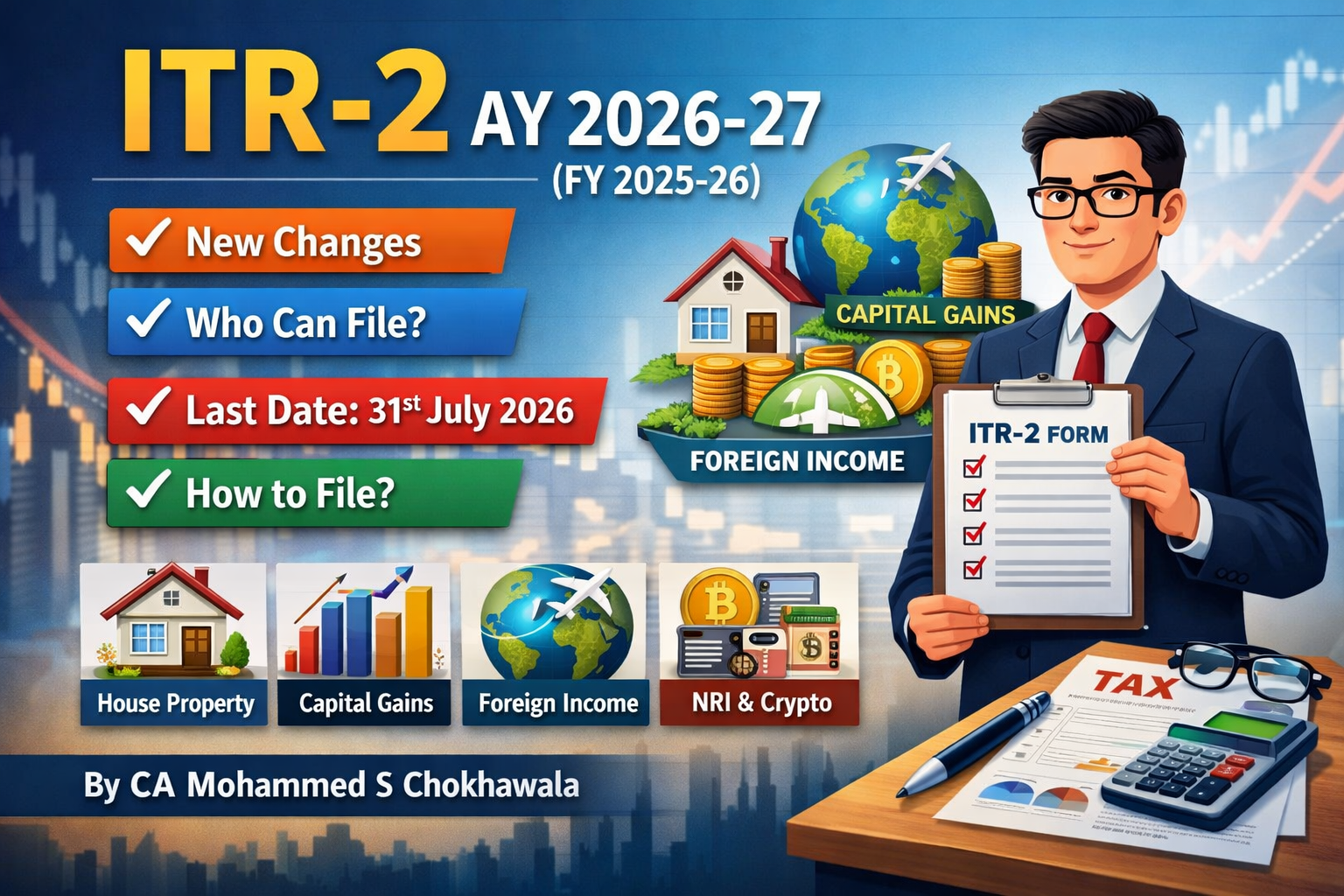
ITR-2 is the default return form for individuals/HUFs who:
- Do NOT have business/professional income (i.e., no income under Profits & Gains of Business or Profession)
- But have complex income structures, such as:
- Capital gains
- Multiple house properties
- Foreign assets/income
- High-income cases (> ₹50 lakh)
👉 Professional View:
Whenever a case moves beyond the simplicity of ITR-1 (Sahaj), the migration typically happens to ITR-2 unless business income triggers ITR-3.
2. Key Changes in ITR-2 for AY 2026–27
(A) Rationalisation of Capital Gains Reporting
- Earlier bifurcation:
- Before 23 July 2024
- After 23 July 2024
✅ Now removed
Practical Impact:
- Simplifies reporting in Schedule CG
- Reduces reconciliation complexity for:
- Equity transactions
- Real estate transactions
👉 CA Insight:
Earlier, this split created unnecessary compliance friction during audit trail verification and AIS reconciliation. Removal improves usability.
(B) Enhanced Disclosure for Donations (Section 80G)
- Mandatory to report:
- Transaction/Receipt Number
- Donation reference details
📌 Legal Reference: Section 80G read with Rule 11AA
Practical Implication:
- No more blanket deduction claims
- Cross-verification with NGO filings (Form 10BD)
⚠️ Compliance Risk:
- Mismatch between:
- Donor claim (ITR)
- Donee reporting (Form 10BD)
→ May lead to disallowance notices u/s 143(1)
(C) Removal of Rate-Specific Columns (CG Schedules)
- Earlier explicit categories:
- STCG @15% (Section 111A)
- LTCG @10% (Section 112A)
- LTCG @20% (Section 112)
✅ Now streamlined
Interpretation:
- Backend computation logic retained
- Front-end reporting simplified
👉 Conservative View for Practice:
Continue maintaining working papers classification-wise:
- Section 111A
- Section 112A
- Section 112
3. Eligibility – Who Should File ITR-2
Covered Assessees:
| Nature of Income | Relevant Section |
|---|---|
| Salary/Pension | Sec 15–17 |
| Multiple House Properties | Sec 22–27 |
| Capital Gains | Sec 45 |
| Other Sources (Lottery, etc.) | Sec 56 |
| Agricultural Income > ₹5,000 | Sec 10(1) (reporting requirement) |
| Foreign Income/Assets | FEMA + Income Tax |
| RNOR / Non-Residents | Sec 6 |
Special Mandatory Cases:
You must file ITR-2 if:
- Director in a company
- Investment in unlisted equity shares
👉 Even if income is otherwise simple.
Practical Illustration
Case 1:
- Salary ₹18 lakh
- LTCG ₹2 lakh (equity)
➡ Cannot use ITR-1 → ITR-2 mandatory
4. Who Cannot File ITR-2
❌ If income includes:
- Business income (Sec 28)
- Professional income
➡ Must shift to ITR-3
5. Due Date for AY 2026–27
- Non-audit cases: 31st July 2026
📌 Legal Reference: Section 139(1)
Consequences of Delay
| Section | Impact |
|---|---|
| Sec 234F | Late fee up to ₹5,000 |
| Sec 234A | Interest on tax payable |
| Sec 139(4) | Belated return restrictions |
Practical Risk:
- Loss carry forward disallowed (if filed late)
👉 Especially relevant for: - Capital losses
- House property losses
6. Structure of ITR-2 – Technical Breakdown
Part A – General Information
- PAN, Aadhaar, residential status
- Filing status (Original/Revised)
Core Income Schedules
| Schedule | Purpose |
|---|---|
| Schedule S | Salary |
| Schedule HP | House Property |
| Schedule CG | Capital Gains |
| Schedule OS | Other Sources |
Capital Gains Special Schedules
- Schedule 112A → Listed equity
- Schedule 115AD (for NRIs)
Loss Adjustment Mechanism
| Schedule | Function |
|---|---|
| CYLA | Current year set-off |
| BFLA | Brought forward set-off |
| CFL | Carry forward losses |
Deductions
| Schedule | Section |
|---|---|
| VIA | Chapter VI-A |
| 80G | Donations |
| 80GGA | Scientific/Rural |
| 80GGC | Political contributions |
Foreign & International Taxation
| Schedule | Purpose |
|---|---|
| FSI | Foreign income |
| TR | Foreign tax credit (Rule 128) |
| FA | Foreign assets disclosure |
⚠️ High Risk Area:
Non-disclosure → scrutiny + penalty
High Net Worth Individuals
- Schedule AL (Assets & Liabilities)
📌 Trigger: Income > ₹50 lakh
Special Computation Schedules
| Schedule | Section |
|---|---|
| AMT | Sec 115JC |
| AMTC | Sec 115JD |
Other Critical Schedules
- Schedule SI → Special rate incomes
- Schedule EI → Exempt income
- Schedule VDA → Crypto taxation (Sec 115BBH)
7. Step-by-Step Filing Process (Practical Workflow)
Step 1: Data Collection
- Form 16
- AIS/TIS reconciliation
- Capital gain statements (broker)
- Interest certificates
- Foreign asset details
Step 2: Reconciliation
- Match:
- AIS vs books
- 26AS vs TDS claimed
Step 3: Capital Gains Working
- Segregate:
- STCG vs LTCG
- Section-wise classification
Step 4: Deduction Validation
- Ensure:
- Proper documentation
- Donation receipts with ARN
Step 5: Tax Computation
- Normal vs special rate income
- Apply:
- Sec 112A
- Sec 115BBH (crypto)
Step 6: Filing & Verification
- File on income tax portal
- Verify via:
- Aadhaar OTP / EVC / DSC
8. Common Errors Observed in Practice
❌ Wrong ITR selection (ITR-1 instead of ITR-2)
❌ Ignoring AIS mismatches
❌ Incorrect capital gains classification
❌ Claiming 80G without valid receipt
❌ Non-disclosure of foreign assets
9. Best Practices (CA Advisory)
✔ Always prepare working papers before filing
✔ Maintain capital gain computation sheets
✔ Cross-check AIS, 26AS, broker statements
✔ Avoid aggressive deduction claims without documentation
✔ Use ITR-2 even voluntarily if complexity exists (risk mitigation)
10. Strategic Insight
ITR-2 is no longer just a compliance form—it is now a data-matching document:
- AIS integration
- NGO reporting (Form 10BD)
- Foreign asset disclosures
- Crypto tracking
👉 Conclusion (Professional View):
Accuracy, reconciliation, and documentation are now more critical than computation itself.
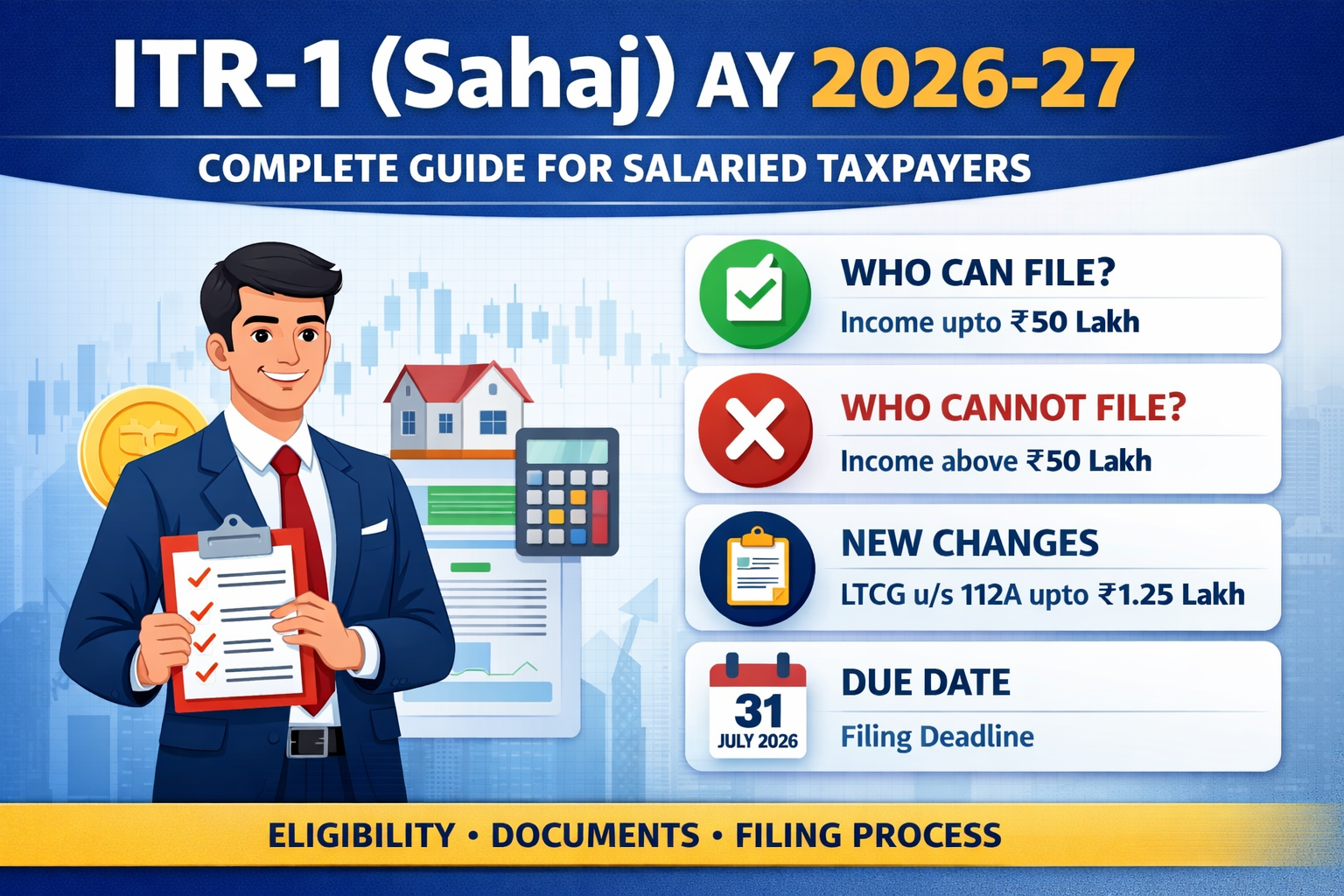
👉 Read our detailed guide on ITR-1 (Sahaj)