Introduction
Tax planning is an important part of personal financial management. In India, one of the most popular ways to reduce income tax liability is through Section 80C of the Income Tax Act.
Section 80C allows taxpayers to claim deductions on certain investments and expenses, thereby reducing their taxable income.
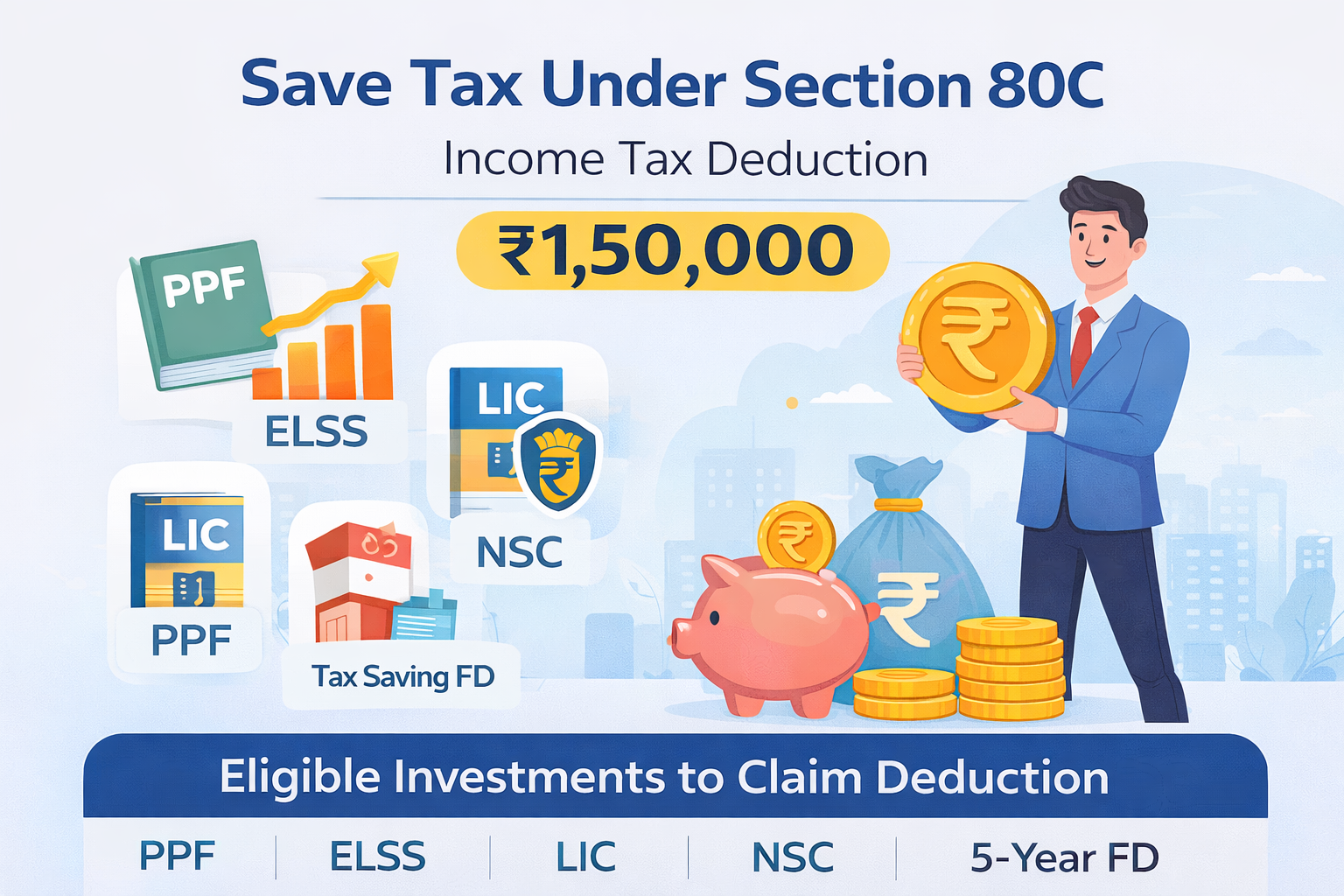
Under this section, individuals and Hindu Undivided Families (HUFs) can claim a maximum deduction of ₹1,50,000 in a financial year.
However, it is important to note that this deduction is available only under the Old Tax Regime.
This article explains Section 80C in simple terms, including eligible investments, conditions, and important points taxpayers should know.
What is Section 80C?
Section 80C is a provision under the Income Tax Act that allows taxpayers to reduce their taxable income by investing in specified financial instruments or making certain eligible payments.
This deduction encourages individuals to:
- Save money
- Invest for the future
- Build retirement funds
- Secure their family financially
Maximum Deduction Limit
The maximum deduction allowed under Section 80C is:
₹1,50,000 per financial year
Even if your total investments exceed ₹1,50,000, the deduction cannot go beyond this limit.
Who Can Claim Deduction Under Section 80C?
The deduction is available to:
- Individual taxpayers
- Hindu Undivided Families (HUF)
Companies and partnership firms cannot claim deduction under Section 80C.
Important Condition
Section 80C deduction is not available under the New Tax Regime.
If a taxpayer chooses the New Tax Regime under Section 115BAC, they will not be able to claim this deduction.
Popular Investments Eligible Under Section 80C
Below are some of the most common investments that qualify for deduction under Section 80C.
1. Life Insurance Premium
Premium paid for life insurance policies is eligible for deduction.
This includes policies taken for:
- Self
- Spouse
- Children
Both term insurance and endowment policies qualify for deduction.
2. Public Provident Fund (PPF)
PPF is one of the safest long-term investment options backed by the Government of India.
Key features:
- Lock-in period: 15 years
- Tax-free returns
- Investment qualifies for Section 80C deduction
Maximum investment allowed per year: ₹1,50,000.
3. Employee Provident Fund (EPF)
For salaried employees, contributions to the Employee Provident Fund (EPF) automatically qualify for deduction under Section 80C.
Both employer and employee contribute to this retirement savings scheme.
4. Equity Linked Saving Scheme (ELSS)
ELSS mutual funds are tax-saving mutual funds that invest primarily in equity.
Key features:
- Lock-in period: 3 years (shortest among 80C investments)
- Potential for higher returns
- Market-linked investment
5. Sukanya Samriddhi Yojana
This scheme is designed for the financial security of a girl child.
Parents or guardians can open an account for their daughter.
Benefits include:
- High interest rate
- Tax deduction under Section 80C
- Tax-free maturity
6. National Savings Certificate (NSC)
NSC is a government savings scheme available at post offices.
Features:
- Fixed interest rate
- Lock-in period of 5 years
- Investment eligible for tax deduction
7. Tax Saving Fixed Deposit (5-Year FD)
Banks offer tax-saving fixed deposits with a lock-in period of five years.
Investment made in these deposits qualifies for deduction under Section 80C.
8. Senior Citizen Savings Scheme (SCSS)
This scheme is designed specifically for senior citizens and offers attractive interest rates.
Deposits made under this scheme are eligible for Section 80C deduction.
9. Post Office 5-Year Time Deposit
Similar to bank fixed deposits, the Post Office 5-year time deposit also qualifies for tax deduction.
10. Tuition Fees for Children
Parents can claim deduction for tuition fees paid for full-time education of their children.
Important conditions:
- Maximum deduction allowed for 2 children
- Only tuition fees qualify
- Development fees and donations are not allowed
11. Repayment of Home Loan Principal
The principal portion of the home loan EMI is eligible for deduction under Section 80C.
In addition, the following expenses are also eligible:
- Stamp duty
- Registration charges
However, the property should not be sold within 5 years.
Lock-In Period for Common Investments
Different investments have different lock-in periods.
| Investment | Lock-in Period |
|---|---|
| ELSS Mutual Funds | 3 years |
| Tax Saving FD | 5 years |
| NSC | 5 years |
| PPF | 15 years |
| Sukanya Samriddhi Yojana | 21 years |
When Can Deduction Be Reversed?
The deduction claimed under Section 80C may be reversed if certain conditions are not met.
Examples include:
- Selling a house property within 5 years
- Surrendering life insurance policy early
- Premature withdrawal from tax-saving deposits
In such cases, the earlier deduction may become taxable income.
Example of Tax Saving Using Section 80C
Suppose your annual income is:
₹8,00,000
You invest the following:
PPF: ₹50,000
Life Insurance: ₹40,000
ELSS: ₹60,000
Total Investment = ₹1,50,000
Your taxable income becomes:
₹8,00,000 − ₹1,50,000 = ₹6,50,000
Thus, your tax liability reduces significantly.
Conclusion
Section 80C is one of the most important provisions for tax planning in India. It allows taxpayers to reduce their taxable income while building long-term financial security.
By choosing the right combination of investments such as PPF, ELSS, life insurance, and tax-saving deposits, individuals can save tax while growing their wealth.
However, taxpayers should carefully compare the Old Tax Regime and New Tax Regime before making investment decisions.
Proper tax planning can help you save money, reduce taxes, and achieve financial stability.
