Complete Practical Guide with Amendments, Eligibility & Filing Process
1. Overview of ITR-4 (Sugam)
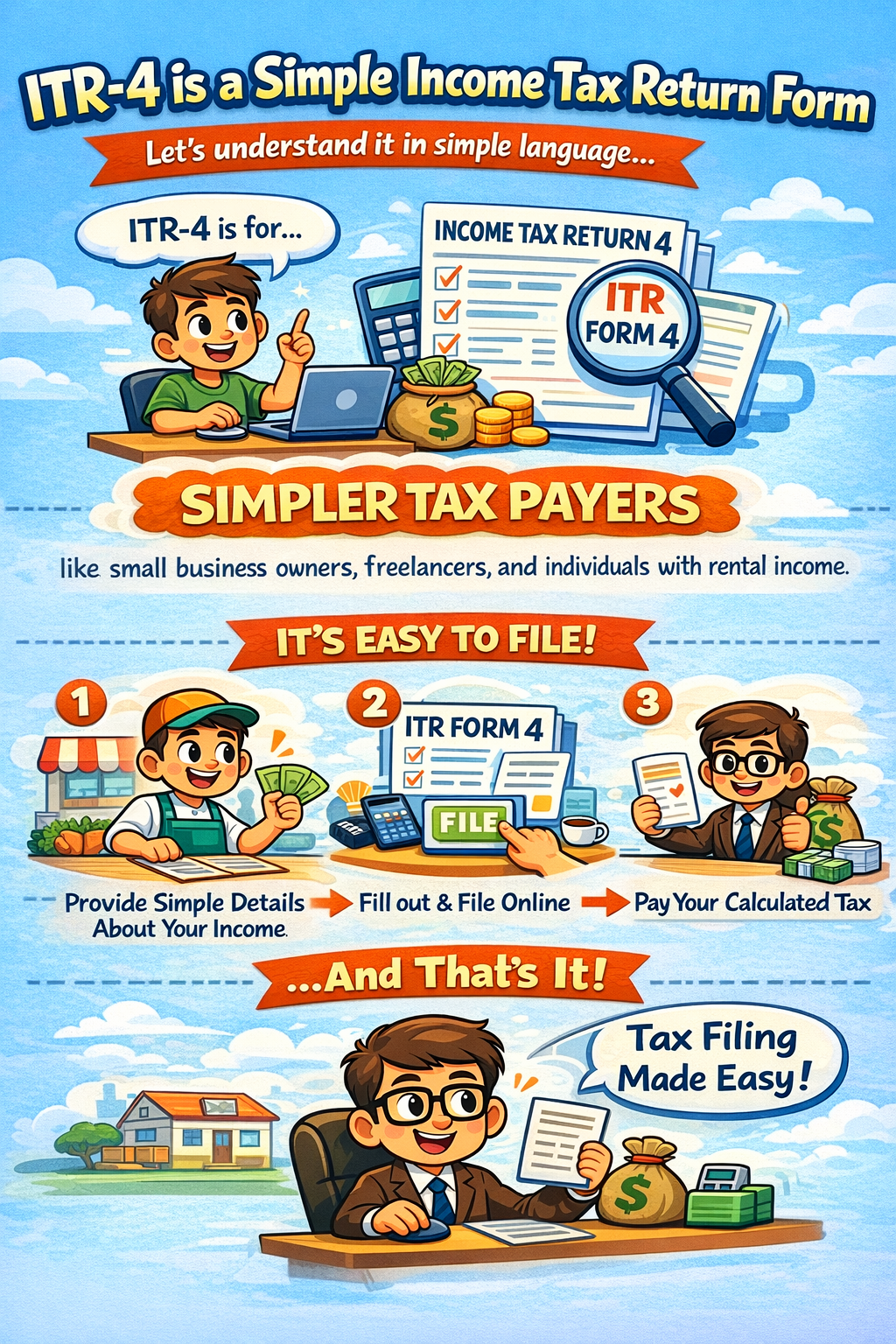
ITR-4 (Sugam) is a simplified return form prescribed under Rule 12 of the Income-tax Rules, 1962 for small taxpayers opting for presumptive taxation schemes.
It is applicable to:
- Individuals
- HUFs
- Partnership Firms (other than LLP)
Relevant Sections Covered:
- Section 44AD – Presumptive taxation for business
- Section 44ADA – Presumptive taxation for professionals
- Section 44AE – Presumptive taxation for transporters
Income Threshold:
- Total income ≤ ₹50 Lakhs
2. Key Changes in ITR-4 for AY 2026-27 (FY 2025-26)
Recent updates reflect increased reporting requirements and alignment with compliance monitoring systems:
(1) Reporting of Two House Properties
- Earlier restriction: 1 house property
- Now allowed: Up to 2 house properties
Practical Impact:
- Small taxpayers owning multiple houses can now continue using ITR-4 without shifting to ITR-3.
(2) Removal of Foreign Retirement Benefit Reporting
- Disclosure under Section 89A removed
Impact:
- Simplifies return for taxpayers with foreign retirement accounts.
(3) Mandatory Bank Balance Disclosure
- Taxpayer must disclose:
- Bank account details
- Balance as on year-end
Compliance Risk:
- Mismatch with AIS/TIS may trigger scrutiny under risk management system.
(4) Reporting LTCG u/s 112A up to ₹1.25 Lakhs
- Now allowed to report limited capital gains under:
- Section 112A
Conditions:
- Only LTCG on equity shares / equity mutual funds
- No brought forward losses
- No carry forward losses
3. Eligibility Criteria – Who Can File ITR-4
A taxpayer can file ITR-4 if ALL the following conditions are satisfied:
Residential Status
- Must be Resident (ROR)
Income Sources Allowed
| Income Head | Conditions |
|---|---|
| Business Income | u/s 44AD or 44AE |
| Professional Income | u/s 44ADA |
| Salary/Pension | Allowed |
| House Property | Maximum 2 |
| Other Sources | Interest, etc. |
| Capital Gains | Only LTCG u/s 112A (≤ ₹1.25 lakh) |
Example – Practical Case
Mr. A (Resident Individual):
- Business income (44AD): ₹30 lakhs turnover
- Declared profit: ₹3 lakhs
- Salary income: ₹5 lakhs
- Interest income: ₹50,000
- LTCG (equity): ₹1 lakh
✅ Eligible for ITR-4
4. Who Cannot File ITR-4 (Critical Restrictions)
The following taxpayers must NOT use ITR-4:
(A) Income/Threshold Based Restrictions
- Total income > ₹50 lakhs
- Agricultural income > ₹5,000
(B) Nature of Income Restrictions
- Income from:
- Lottery / betting / racehorses
- Any capital gains (except limited 112A case)
- Income from crypto (VDA) – taxable u/s Section 115BBH
(C) Compliance-Based Restrictions
- Required to maintain books u/s:
- Section 44AA
- Tax audit applicable u/s:
- Section 44AB
(D) Specific Disqualifications
- Director in a company
- Investment in unlisted shares
- RNOR / Non-resident
- Foreign assets or signing authority
- Claiming relief u/s:
- Section 90
- Section 90A
- Section 91
(E) Other Important Cases
- TDS deducted u/s Section 194N
5. Due Dates – AY 2026-27
| Category | Due Date |
|---|---|
| Non-Audit Cases | 31st August 2026 |
| Audit Cases | 31st October 2026 |
Amendment Note:
- Extended timeline introduced via Budget 2026 for non-audit cases.
6. Structure of ITR-4 – Detailed Breakdown
PART A – General Information
- PAN, Aadhaar, business nature, filing status
PART B – Gross Total Income
- Income from all heads consolidated
PART C – Deductions
- Chapter VI-A deductions (80C, 80D, etc.)
PART D – Tax Computation
- Tax liability, rebate u/s 87A, interest, late fee
Key Schedules
| Schedule | Purpose |
|---|---|
| Schedule BP | Presumptive income computation |
| GST Details | Turnover reconciliation |
| Financial Particulars | Assets & liabilities |
| Schedule TDS/TCS | Tax credits |
| Schedule IT | Advance tax & self-assessment |
7. Step-by-Step Filing Process (Practical Workflow)
Step 1: Data Collection
- PAN, Aadhaar
- Bank statements
- GST turnover (if applicable)
- AIS/TIS reconciliation
Step 2: Choose Presumptive Scheme
| Section | Rate |
|---|---|
| 44AD | 8% (6% digital) |
| 44ADA | 50% |
| 44AE | Fixed per vehicle |
Step 3: Compute Income
Example (44AD):
- Turnover: ₹40 lakhs
- Digital receipts: ₹20 lakhs
Income:
- 6% of 20L = ₹1.2L
- 8% of 20L = ₹1.6L
- Total = ₹2.8L
Step 4: Claim Deductions
- Chapter VI-A deductions
Step 5: Tax Calculation
- Include:
- Interest u/s 234A/B/C
- Late fee u/s Section 234F
Step 6: File Return
- Through income tax portal
- Validate using:
- Aadhaar OTP
- DSC
- Net banking
8. Compliance Risks & Common Mistakes
High-Risk Areas
- ❌ Turnover mismatch with GST returns
- ❌ Under-reporting digital receipts
- ❌ Incorrect presumptive percentage
- ❌ Ignoring AIS/TIS data
- ❌ Claiming ineligible deductions
Practical Red Flags
- Cash deposits inconsistent with turnover
- High expenses despite presumptive scheme
- Bank balance mismatch
9. Best Practices (Professional Approach)
- Reconcile:
- Books vs GST vs AIS
- Maintain working papers (even if presumptive)
- Ensure correct classification of income
- Avoid aggressive tax positions
10. Strategic Advisory (CA Perspective)
- Use ITR-4 only when strictly eligible
- If:
- Turnover high
- Margins low
→ Consider opting out and filing ITR-3
- Evaluate:
- 5-year lock-in under 44AD (Section 44AD(4))
Conclusion
ITR-4 is a highly efficient compliance tool for small taxpayers under presumptive taxation. However, with increasing data integration (AIS, GST, banking), accuracy and reconciliation have become critical.
A conservative and well-documented approach is essential to avoid notices and ensure smooth assessments.
Read about ITR Form 3
Read about ITR Form 2
Read about ITR Form 1