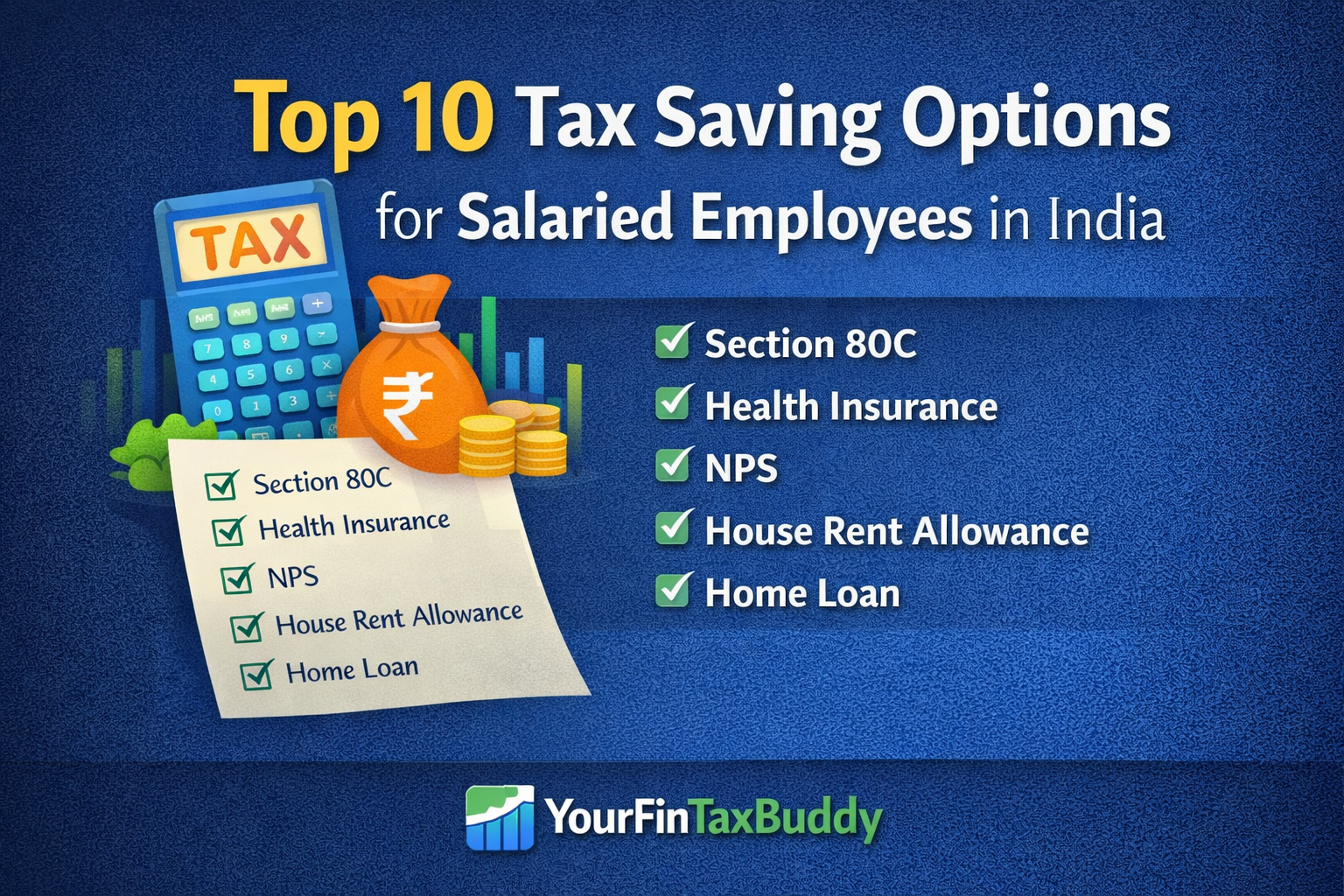
Many salaried employees feel that a large portion of their salary goes toward paying income tax. However, the Indian Income Tax Act provides several deductions and exemptions that can legally reduce your tax liability.
With proper tax planning, salaried individuals can save a significant amount of money every year.
In this article, we will explain the Top 10 Tax Saving Options for Salaried Employees in India in simple language with examples.
1. Section 80C – Tax Deduction up to ₹1.5 Lakh
Section 80C is one of the most commonly used tax-saving sections in India. Under this section, you can claim deductions for certain investments and expenses.
The maximum deduction allowed under Section 80C is ₹1,50,000 per financial year.
Popular investments under Section 80C:
• Public Provident Fund (PPF)
• Employee Provident Fund (EPF)
• Equity Linked Saving Scheme (ELSS)
• Life Insurance Premium
• National Savings Certificate (NSC)
• 5-Year Tax Saving Fixed Deposit
• Sukanya Samriddhi Yojana
• Tuition Fees for Children
• Principal repayment of home loan
Example
If your taxable income is ₹10 lakh and you invest ₹1.5 lakh under Section 80C, your taxable income reduces to ₹8.5 lakh.
This can significantly reduce your tax liability.
2. Health Insurance Deduction – Section 80D
Medical expenses are rising every year, and health insurance is becoming essential. The government provides tax benefits for health insurance premiums under Section 80D.
Deduction limits:
• Self, spouse and children: up to ₹25,000
• Parents (below 60 years): up to ₹25,000
• Parents (above 60 years): up to ₹50,000
Maximum deduction possible
A person paying insurance for self and senior citizen parents can claim up to ₹75,000 deduction.
This not only helps reduce tax but also provides financial security during medical emergencies.
3. National Pension System (NPS) – Section 80CCD(1B)
The National Pension System (NPS) is a government-backed retirement savings scheme. It offers an additional tax benefit of ₹50,000, which is over and above the Section 80C limit.
Key benefits of NPS:
• Additional deduction of ₹50,000
• Long-term retirement savings
• Market-linked returns
• Low-cost investment
Example
If you invest ₹50,000 in NPS, your taxable income reduces further after claiming Section 80C deductions.
4. House Rent Allowance (HRA)
If you live in a rented house and receive HRA as part of your salary, you can claim tax exemption on HRA.
The exemption depends on three factors:
• Basic salary
• Rent paid
• City of residence (metro or non-metro)
HRA exemption is the lowest of:
- Actual HRA received
- 50% of salary (metro cities) or 40% (non-metro)
- Rent paid minus 10% of salary
Example
If you pay rent of ₹20,000 per month and receive HRA, you may get a significant tax exemption.
5. Home Loan Interest – Section 24
If you have taken a home loan to buy or construct a house, you can claim deduction on the interest paid on the loan.
Maximum deduction allowed:
₹2,00,000 per year for self-occupied property.
Example
If you pay ₹2 lakh interest on your home loan, you can reduce your taxable income by that amount.
This is one of the biggest tax-saving opportunities for homeowners.
6. Principal Repayment of Home Loan – Section 80C
Apart from interest deduction, the principal portion of your home loan repayment also qualifies for deduction under Section 80C.
However, this deduction is included within the ₹1.5 lakh limit of Section 80C.
This means home loan EMI can help you claim deductions under two sections simultaneously.
7. Leave Travel Allowance (LTA)
Leave Travel Allowance allows salaried employees to claim tax exemption for travel expenses during vacations.
Conditions:
• Travel must be within India
• Only travel cost is covered (not hotel or food)
• Available for two journeys in four years
This benefit is usually provided by employers as part of the salary package.
8. Standard Deduction for Salaried Employees
The government provides a standard deduction of ₹50,000 to salaried individuals and pensioners.
The best part is that no investment or proof is required to claim this deduction.
This deduction automatically reduces your taxable income.
9. Education Loan Interest – Section 80E
If you have taken an education loan for higher studies, you can claim deduction on the interest paid.
Key points:
• No upper limit on deduction
• Available for 8 years
• Applicable for higher education loans
This deduction helps individuals manage the financial burden of education loans.
10. Donations – Section 80G
Donations made to certain charitable institutions are eligible for tax deductions under Section 80G.
Deduction available:
• 50% deduction
• 100% deduction (depending on the institution)
To claim this deduction, the donation must be made to approved organizations and proper receipts must be maintained.
Final Thoughts
Tax saving is not about making random investments at the end of the financial year. The best approach is to plan your taxes at the beginning of the year so that you can choose investments that match your financial goals.
Proper tax planning can help you:
• Reduce your tax liability legally
• Build long-term wealth
• Achieve financial security
✅ If you need help with tax planning, income tax filing, or GST services, feel free to connect with YourFinTaxBuddy.
You can also read our detailed guide on Section 80C deductions to understand all eligible tax-saving investments.
