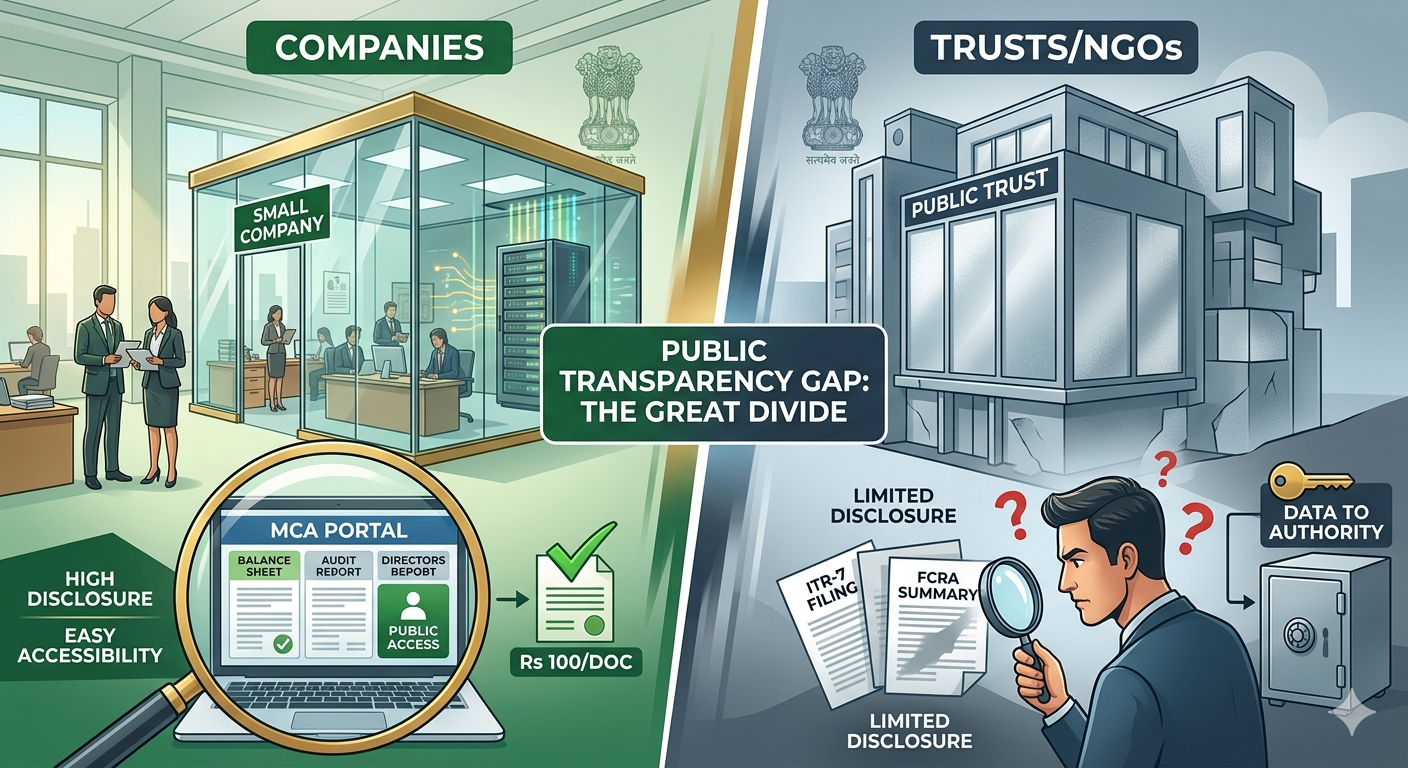
In India’s regulatory landscape, there is a striking paradox. A small private company with a few lakhs in capital is a “glass house”—anyone with a smartphone and ₹100 can peek at their bank loans, profits, and director details.
Meanwhile, massive charitable trusts handling hundreds of crores in public donations often operate behind a veil of limited financial visibility. This isn’t necessarily a story of non-compliance; it is a story of asymmetrical disclosure architecture.
1. The Corporate Model: Transparency by Default
Companies in India are governed by the Companies Act, 2013, which treats financial data as a public good.
- The Gold Standard (MCA21): Every company must file audited financials (Form AOC-4) and annual returns (Form MGT-7) with the Registrar of Companies (ROC).
- Section 399: This legal provision gives any citizen the right to inspect these documents.
- The “₹100” Reality: Whether a company earns ₹10,000 or ₹10 billion, their balance sheet is downloadable for a nominal fee on the Ministry of Corporate Affairs portal.
The Result: Corporate India operates in a high-tax, high-disclosure environment. If you want to check a competitor’s debt or an employer’s health, the data is just a click away.
2. The Trust/NGO Model: Compliance Without Visibility
Trusts and Societies operate under a fragmented legal framework (like the Indian Trusts Act, 1882 or state-specific laws like the Bombay Public Trusts Act). While they are heavily regulated, they lack a centralized public portal.
- File-with-Authority: Trusts file their Income Tax Returns (ITR-7) and audit reports with the Tax Department. However, these filings are confidential between the taxpayer and the government.
- The DARPAN Limitation: While the NITI Aayog’s NGO DARPAN portal lists basic details, it rarely provides full, downloadable audited balance sheets for the public.
- FCRA Portals: These offer a glimpse into foreign funding, but if an NGO receives 100% of its funds from domestic Indian donors, that data remains largely invisible to the public.
3. Comparing the Two Worlds
| Feature | Private Companies | Public Trusts / NGOs |
| Governing Law | Companies Act, 2013 | Fragmented State/Central Laws |
| Public Access | Fully Accessible (MCA Portal) | Very Limited |
| Financial Format | Standardized & Machine-readable | Non-standardized / Paper-based |
| Audit Trigger | Mandatory for all | Conditional (Income-based) |
| Philosophy | “Public-by-default” | “Privacy-by-default” |
4. Why This Gap Matters
This is not just a technicality; it has real-world consequences for the development sector:
- Information Asymmetry: A donor giving ₹5,000 cannot easily perform the same due diligence on an NGO that a small investor can perform on a private company.
- Trust Deficit: When financial data is hard to find, even genuine, high-impact NGOs face skepticism from the public.
- The Section 8 Irony: Interestingly, NGOs registered as Section 8 Companies must follow the strict disclosure rules of the Companies Act. This proves that public transparency is possible—it’s just not mandatory for most.
5. A Practicing CA’s Perspective: The Way Forward
The issue in India is not a lack of regulation—it is a lack of centralized accessibility. Compliance exists, but transparency does not.
Proposed Best Practices for NGOs:
- Voluntary Disclosure: Don’t wait for a law. Publish your last three years of audited financials on your website.
- Standardized Reporting: Move toward corporate-style reporting to build institutional credibility.
- Impact Dashboards: Clearly link every rupee spent to a specific outcome or project.
Conclusion
In 2026, as the “Social Stock Exchange” begins to gain traction, the pressure for transparency will only grow. It is time we bridged the gap. If a ₹10 lakh turnover company can be an “open book,” there is no reason a ₹50 crore public trust should remain a closed one.
What are your thoughts? Should the government introduce an “MCA-style” portal for all public trusts? Let’s discuss in the comments.
