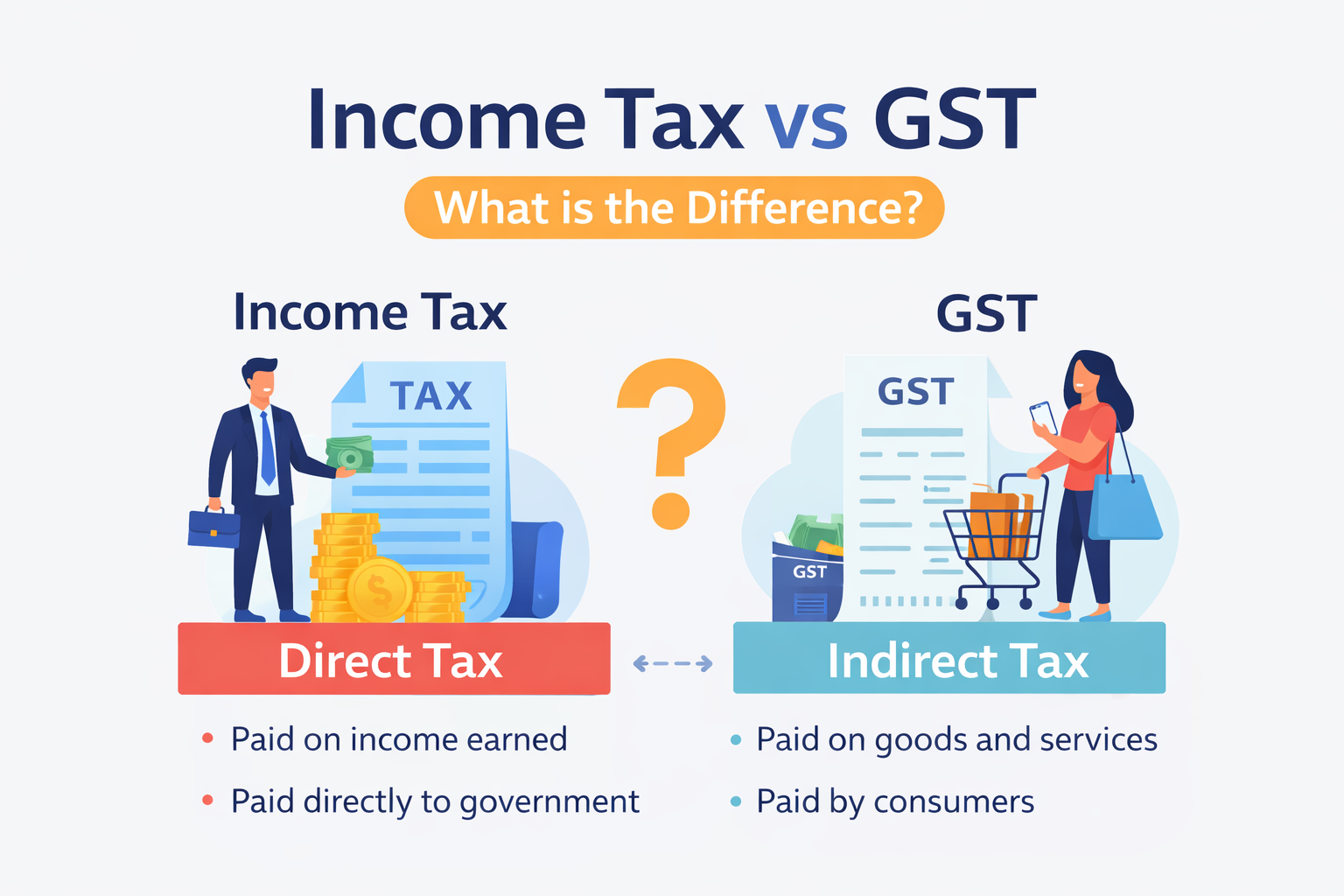
Many people in India hear the words Income Tax and GST very often, but they are confused about what these taxes actually mean.
Some people think both are the same, but in reality they are completely different types of taxes.
In this article, we will understand:
- What is Income Tax
- What is GST
- The major differences between Income Tax and GST
- Simple real-life examples
Let’s understand everything step by step.
What is Income Tax?
Income Tax is a direct tax that you pay to the government on the income you earn.
This means if you earn money from:
- Salary
- Business
- Profession
- Rent
- Interest
- Capital gains
then you may have to pay Income Tax.
The tax is calculated based on your total yearly income.
Example
Suppose:
Rahul works in a company and earns ₹8,00,000 per year.
After applying deductions and tax slabs, he may have to pay some Income Tax to the government.
Here the tax is paid directly by Rahul, so it is called a Direct Tax.
What is GST?
GST stands for Goods and Services Tax.
It is an Indirect Tax that is charged when you buy goods or services.
You pay GST when you purchase things like:
- Mobile phones
- Clothes
- Restaurant food
- Online services
- Electronics
- Furniture
But the tax is collected by the seller and then deposited to the government.
Example
Suppose you buy a mobile phone for ₹20,000.
GST rate on mobiles is 18%.
GST amount = ₹3,600
So you pay:
₹20,000 + ₹3,600 = ₹23,600
Here you paid GST indirectly, which the seller deposits to the government.
That is why GST is called an Indirect Tax.
Key Difference Between Income Tax and GST
| Basis | Income Tax | GST |
|---|---|---|
| Type of Tax | Direct Tax | Indirect Tax |
| Paid By | Individual or business earning income | Final consumer |
| Applied On | Income earned | Goods and services purchased |
| Collected By | Government directly from taxpayer | Businesses collect and deposit |
| Example | Salary income tax | GST on restaurant bill |
Simple Real-Life Example
Let’s understand this with a simple example.
Rahul earns ₹10,00,000 salary per year.
From this income, he may have to pay Income Tax depending on tax slabs.
Now Rahul goes to a restaurant and eats dinner worth ₹1,000.
Restaurant GST = 5%
GST = ₹50
Total bill = ₹1,050
So in this situation:
- Income Tax was paid because Rahul earned income
- GST was paid because Rahul purchased a service
Who Needs to Pay Income Tax?
Income Tax must be paid by:
- Salaried employees
- Business owners
- Professionals (CA, lawyer, doctor, consultant)
- Freelancers
- Investors earning capital gains
However, tax is payable only if income exceeds the exemption limit.
Who Needs to Register for GST?
GST registration is required mainly for:
- Businesses selling goods
- Service providers
- E-commerce sellers
- Online businesses
But GST registration is required only if turnover crosses certain limits.
Generally:
- ₹40 lakh for goods
- ₹20 lakh for services
(Some states have different limits.)
Why Both Taxes Are Important
Both Income Tax and GST are important because they help the government collect revenue which is used for:
- Roads and infrastructure
- Healthcare
- Education
- Defence
- Government services
Without taxes, it would be difficult for the government to run the country.
Conclusion
In simple words:
- Income Tax is paid on the money you earn
- GST is paid on the things you buy
Income Tax is a direct tax, while GST is an indirect tax collected through businesses.
Understanding the difference between these two taxes helps people better understand the Indian tax system and manage their finances more efficiently.
