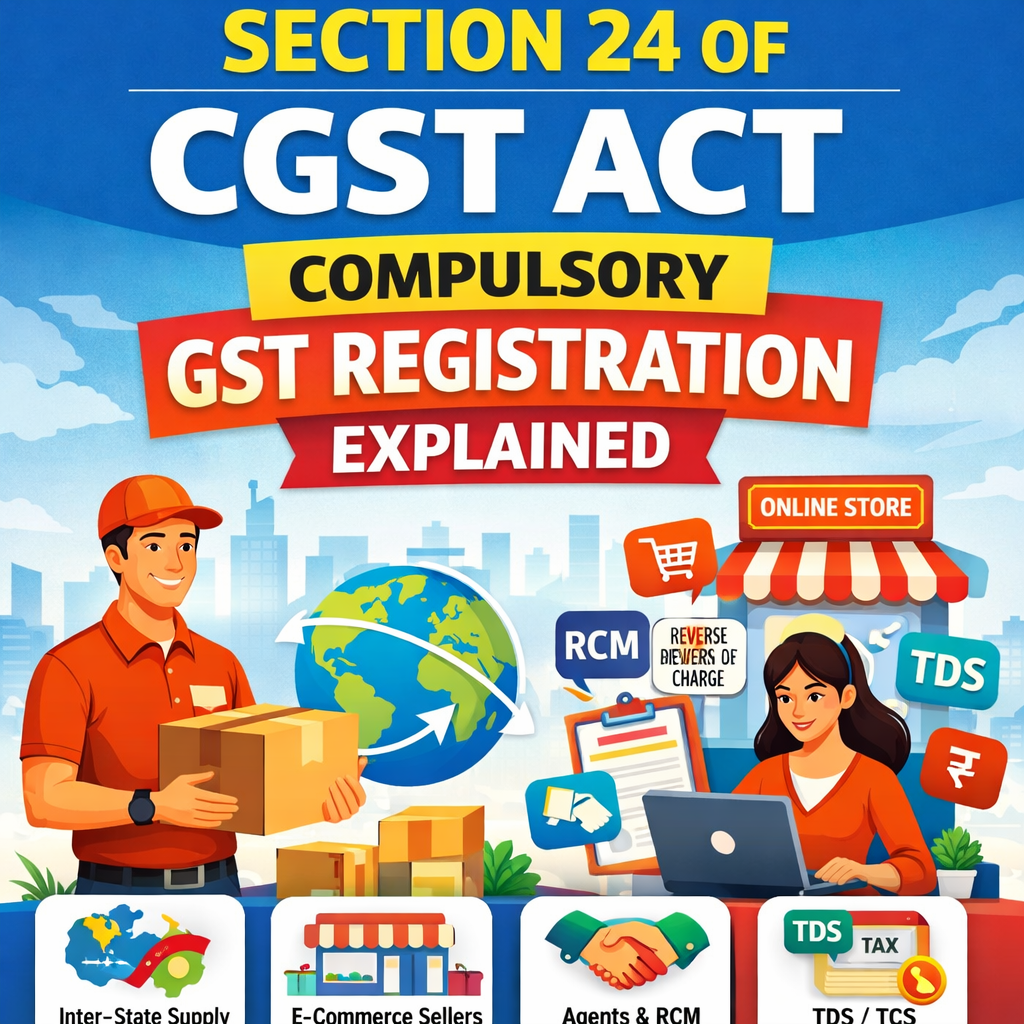
Below are the main categories where GST registration becomes mandatory.
1. Persons Making Inter-State Taxable Supply
If a person supplies goods or services from one state to another state, GST registration becomes compulsory.
Example
Rahul lives in Delhi and sells graphic design services to a company in Mumbai.
Even if Rahul earns only ₹3 lakh per year, he is making an inter-state supply, therefore:
➡ Rahul must obtain GST registration.
2. Casual Taxable Persons
A casual taxable person is someone who occasionally supplies goods or services in a state where they do not have a fixed place of business.
Example
A clothing seller from Jaipur sets up a stall in a Delhi exhibition for 5 days.
Even if he sells products worth ₹50,000, he must obtain temporary GST registration as a casual taxable person.
3. Persons Required to Pay Tax under Reverse Charge (RCM)
In some transactions, the buyer (recipient) is required to pay GST instead of the seller.
This is called Reverse Charge Mechanism (RCM).
If a person is liable to pay tax under RCM, GST registration becomes compulsory.
Example
A company hires services from an unregistered transporter.
The company may have to pay GST under RCM, therefore GST registration is required.
4. E-Commerce Operators
Businesses that operate online marketplaces where other sellers list their products must register under GST.
Example
Companies like:
- Amazon
- Flipkart
- Meesho
These platforms are called e-commerce operators, and GST registration is compulsory for them.
5. Persons Supplying Through E-Commerce Platforms
If you sell products through platforms like:
- Amazon
- Flipkart
- Meesho
GST registration is generally mandatory, even if your turnover is small.
Example
Priya sells handmade jewellery through Amazon.
Her yearly sales are ₹1.5 lakh, but since she sells through an e-commerce platform, she must obtain GST registration.
(Note: Some service providers have been given relaxation by the government.)
6. Input Service Distributor (ISD)
Large businesses with multiple branches often distribute input tax credit (ITC) from their head office to other branches.
Such offices are called Input Service Distributors (ISD) and must register under GST.
Example
A company has offices in:
- Delhi
- Mumbai
- Bangalore
The head office distributes GST credit to branches, therefore it must obtain ISD registration.
7. Non-Resident Taxable Persons
A non-resident taxable person is someone who:
- Does not have a fixed place of business in India
- But supplies goods or services in India
Such persons must obtain GST registration before starting business.
Example
A foreign company participates in a trade exhibition in India and sells products there.
It must obtain GST registration as a Non-Resident Taxable Person.
8. Persons Required to Deduct TDS under GST
Certain government departments and notified entities must deduct Tax Deducted at Source (TDS) under GST.
These entities must register under GST.
Example
A government department makes a payment of ₹5 lakh to a contractor.
The department may be required to deduct GST TDS, therefore GST registration becomes mandatory.
9. Persons Required to Collect TCS
E-commerce operators must collect Tax Collected at Source (TCS) from sellers using their platform.
Such operators must obtain GST registration.
10. Agents Supplying on Behalf of Other Persons
If a person supplies goods or services as an agent for another business, GST registration becomes compulsory.
Example
A commission agent sells agricultural equipment for a manufacturer.
Even if his commission income is small, he must obtain GST registration.
Important Point to Remember
If a person falls under Section 24, the GST exemption limit does not apply.
This means:
- Even ₹1 of business turnover
- Can require GST registration.
Simple Summary
GST registration becomes compulsory if you:
✔ Supply goods/services to another state
✔ Sell through e-commerce platforms
✔ Operate an e-commerce marketplace
✔ Participate in exhibitions or temporary sales
✔ Pay GST under reverse charge
✔ Work as an agent for another business
✔ Deduct TDS or collect TCS under GST
Conclusion
Section 24 of the CGST Act ensures that certain categories of businesses must register under GST regardless of their turnover.
This rule mainly applies to:
- Online sellers
- Inter-state suppliers
- Agents
- E-commerce businesses
- Casual traders
Understanding this provision is important because operating without required GST registration can lead to penalties and legal issues.
If you are starting a new business, freelancing, or selling online, it is always advisable to check whether Section 24 applies to you before assuming that GST registration is not required.


Leave a Reply