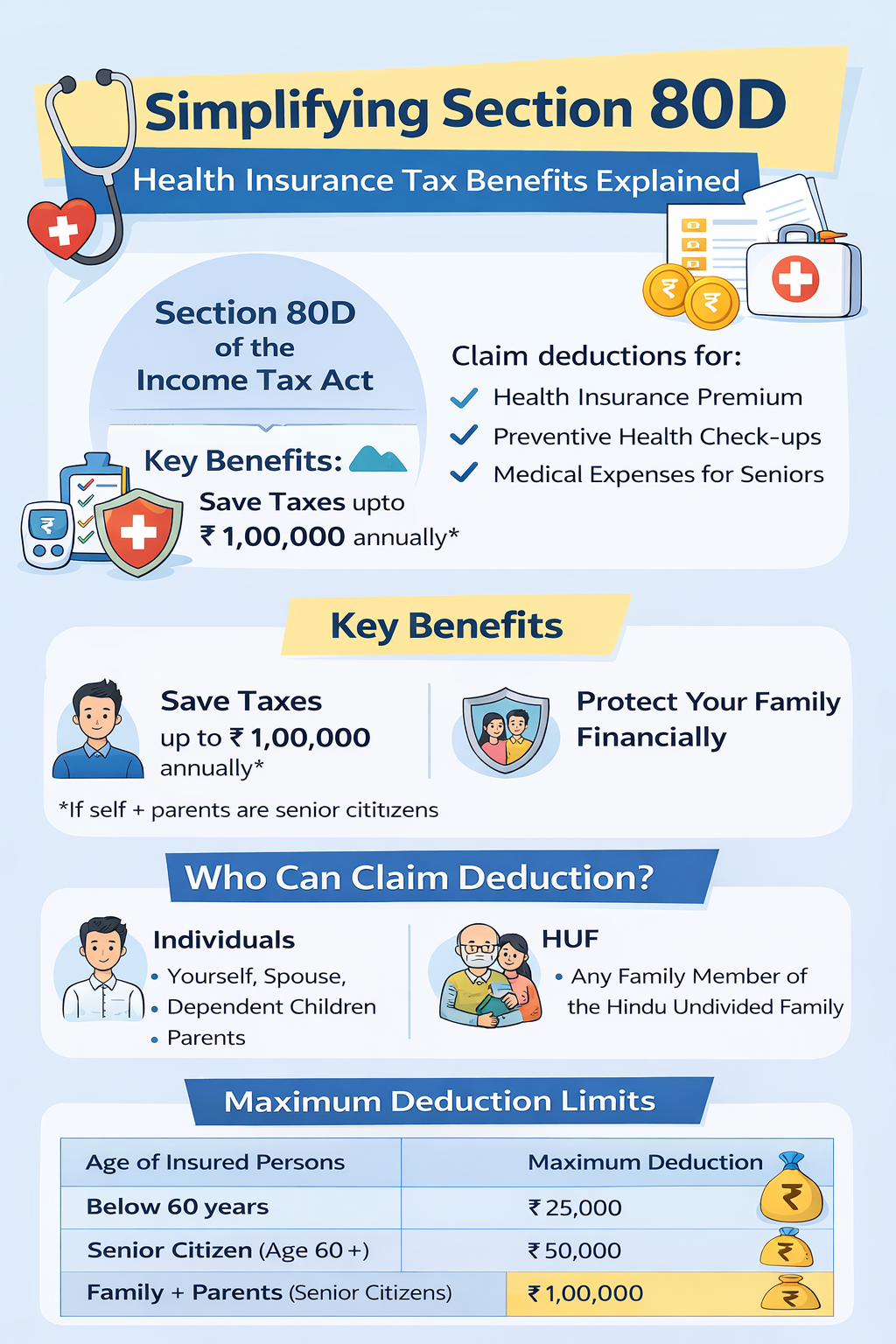
Health expenses are increasing every year. To encourage people to buy health insurance and take care of their health, the government provides a tax deduction under Section 80D of the Income Tax Act.
This deduction allows taxpayers to reduce their taxable income by paying health insurance premiums for themselves and their family.
In this guide, we will explain Section 80D in simple language, including eligibility, deduction limits, preventive health checkups, and examples.
What is Section 80D?
Section 80D allows individuals and Hindu Undivided Families (HUF) to claim tax deductions for health insurance premiums and certain medical expenses.
You can claim deductions for:
- Health insurance premium
- Preventive health check-ups
- Medical expenses for senior citizens (if no insurance is available)
- Contribution to CGHS (Central Government Health Scheme)
However, this deduction is available only under the old tax regime.
If you choose the new tax regime under Section 115BAC, you cannot claim this deduction.
Who Can Claim Deduction Under Section 80D?
The following taxpayers can claim this deduction:
Individuals
You can claim deduction for insurance premiums paid for:
- Yourself
- Your spouse
- Dependent children
- Parents
HUF (Hindu Undivided Family)
An HUF can claim deduction for insurance premium paid for any family member of the HUF.
Maximum Deduction Allowed Under Section 80D
The deduction depends on age of insured persons.
1. For Self, Spouse and Children
| Age | Maximum Deduction |
|---|---|
| Below 60 years | ₹25,000 |
| If any person is a senior citizen | ₹50,000 |
2. For Parents
| Parents Age | Maximum Deduction |
|---|---|
| Below 60 years | ₹25,000 |
| Senior citizen (60+ years) | ₹50,000 |
Maximum Total Deduction Possible
| Situation | Maximum Deduction |
|---|---|
| Self + Family (<60) + Parents (<60) | ₹50,000 |
| Self + Family (<60) + Parents (>60) | ₹75,000 |
| Self (>60) + Parents (>60) | ₹1,00,000 |
This means a taxpayer can reduce taxable income by up to ₹1,00,000 under Section 80D.
Deduction for Preventive Health Check-up
The government also encourages preventive healthcare.
You can claim deduction up to:
₹5,000 per year
This includes health check-ups for:
- Self
- Spouse
- Children
- Parents
Important points:
- Payment can be made in cash
- It is included within the overall limit of ₹25,000 or ₹50,000
Example:
If your limit is ₹25,000 and you paid:
- Insurance premium = ₹23,000
- Health check-up = ₹4,000
You can claim only ₹25,000 deduction.
Deduction for Medical Expenses of Senior Citizens
Sometimes senior citizens are unable to get health insurance due to age or medical conditions.
In such cases:
You can claim deduction for medical expenses up to ₹50,000.
Conditions:
- Person must be 60 years or older
- No health insurance policy exists for that person
Mode of Payment Rules
To claim deduction under Section 80D:
Health Insurance Premium
Payment must be made through:
- Online payment
- Debit card
- Credit card
- Bank transfer
- Cheque
Cash payment is not allowed for insurance premiums.
Preventive Health Check-up
Payment can be made in cash.
Contribution to CGHS
If you contribute to Central Government Health Scheme (CGHS), it also qualifies for deduction under Section 80D.
This is mainly applicable to government employees and pensioners.
Deduction When Premium is Paid for Multiple Years
Sometimes insurance companies allow lump sum premium for multiple years.
In such cases, the deduction is spread over the policy period.
Example:
If you pay ₹60,000 for 3-year policy
You can claim:
₹60,000 ÷ 3 = ₹20,000 deduction per year
Example of Section 80D Deduction
Let’s understand with a simple example.
Example
Mr. A pays:
- Health insurance for self & spouse = ₹20,000
- Preventive health check-up = ₹3,000
- Health insurance for father (age 63) = ₹47,000
Deduction Calculation
Self + spouse:
20,000 + 3,000 = 23,000
Maximum allowed = ₹25,000
Deduction allowed = ₹23,000
Parents (senior citizen):
Premium = ₹47,000
Maximum allowed = ₹50,000
Deduction allowed = ₹47,000
Total Deduction
₹23,000 + ₹47,000 = ₹70,000
This amount will reduce the taxable income.
Important Conditions to Remember
Before claiming deduction under Section 80D, remember:
1️⃣ Deduction is available only under the old tax regime
2️⃣ Premium must be paid from taxable income
3️⃣ Insurance policy must be from IRDAI approved insurer
4️⃣ Premium payment cannot be made in cash
5️⃣ Preventive health check-up limit is ₹5,000
Why Section 80D is Important
Section 80D provides two major benefits:
Tax Saving
You can reduce taxable income by up to ₹1,00,000.
Financial Protection
Health insurance protects you from unexpected medical expenses.
In today’s world where medical costs are rising rapidly, having health insurance is both a financial and health necessity.
Final Thoughts
Section 80D is one of the most useful tax deductions available to taxpayers in India.
By purchasing health insurance for yourself and your family, you can:
- Save tax
- Protect your family financially
- Cover medical emergencies
Therefore, every taxpayer should understand and utilize Section 80D effectively while filing income tax returns.
👉 You can also read our detailed guide on tax saving investments under Section 80C.


Leave a Reply